The fight for gender equality is currently facing significant challenges, and pressure is mounting for the next leader of the United Nations to be the first woman in its more than 80-year history. With UN Women highlighting an uphill struggle for women's rights and leadership representation in various sectors, including international organizations, governments, and technology, the urgency for change has never been clearer.
According to UN Women’s recent “gender snapshot,” at the existing pace of progress, achieving gender equality may take up to 171 years. This goal was initially targeted for completion by 2015 and later postponed to 2030. The report reveals alarming statistics: nearly one in three women worldwide have faced sexual violence, one in five girls is married before the age of 18, and gender parity in parliamentary representation is projected to be achieved only by 2089.
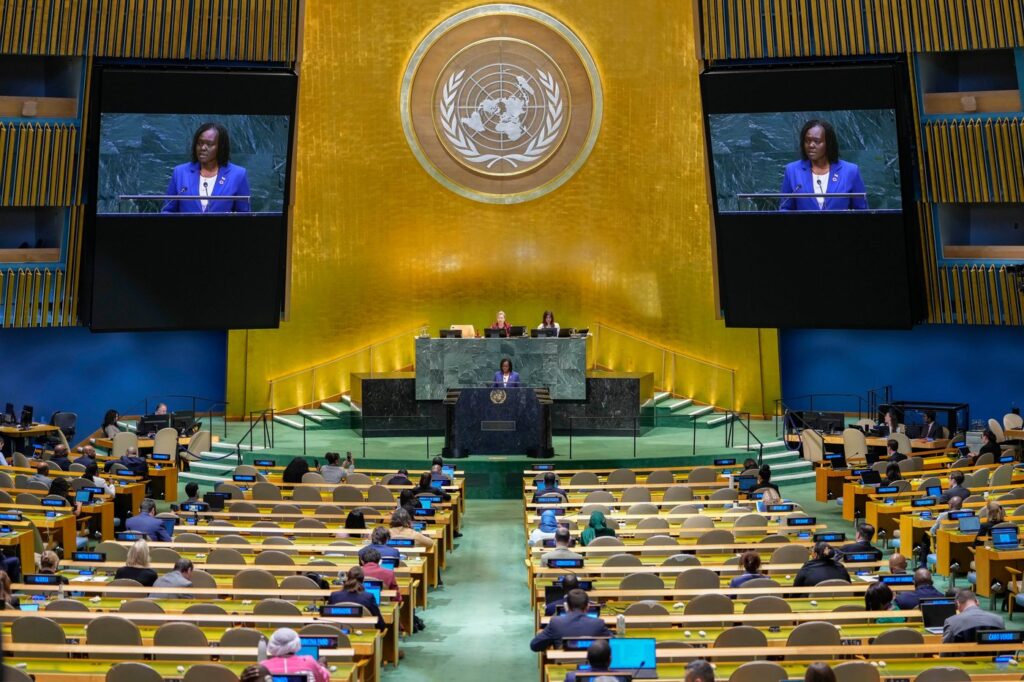
Despite previous advancements, there is a noted decline in women holding political leadership roles, with six out of seven countries globally still led by men. Sarah Hendriks, a senior official in UN Women, emphasized the recent annual gathering of world leaders in the U.N. General Assembly hall reflected a largely male-dominated world in both representation and discourse. She expressed hope regarding the potential election of a woman as the next UN chief, a notion that unites various regions and political backgrounds.
"It’s crucial that the U.N. not only advocates for global gender equality but also embodies it within its own structures," Hendriks stated. "We cannot urge governments to eliminate barriers for women leaders while maintaining those barriers within our institutions." The discussions at the assembly stressed that women must have equal opportunities to hold the world's most powerful positions, including the role of Secretary-General.
East Timor's President José Ramos-Horta, a co-winner of the 1996 Nobel Peace Prize, asserted that after more than 80 years, the U.N. should select a woman of unquestionable integrity as its leader. Botswana's President Duma Boko lamented the absence of female leadership in the Secretary-General position, highlighting it as an "unfinished chapter" in U.N. history.
There are currently seven candidates vying for the role of Secretary-General Antonio Guterres, whose second five-year term concludes on December 31. The candidates include four women and three men, with former Chilean President Michele Bachelet having withdrawn from the race. U.N. trade chief Rebeca Grynspan of Costa Rica and Guyana's U.N. Ambassador Caroline Rodrigues Birkett topped the latest Security Council straw poll, indicating strong support for female candidates.
UN Women’s director of policy, programs, and intergovernmental division, Hendriks, stated that the upcoming choice reflects the type of multilateralism the U.N. aspires to embody for the following 80 years. However, during the high-level meeting, there was a noticeable reduction in the emphasis on gender equality, despite pressing global issues like the conflicts in the Middle East and climate change being the focus of many speeches.
Hendriks noted that the intersection of gender and the technological transformations, particularly in the field of artificial intelligence, has received insufficient attention. Currently, women occupy only 22% of global AI professional positions and hold a mere 14% of leadership roles. She urged that neglecting this issue could perpetuate inequality in future technological developments.
Nonetheless, some leaders advocated for gender equality, including Liberian President Joseph Boakai, who articulated that when women lead, peace agreements are more durable, economies flourish, and government becomes increasingly accountable. In his farewell address at the assembly, UN Secretary-General Antonio Guterres referred to gender inequality as the most pervasive form of inequality, stating that women's rights and voices must not be marginalized.
Guterres underscored the significant contributions women make toward sustainable peace, dynamic economies, and effective institutions. He also highlighted that throughout his decade-long tenure, the U.N. has achieved gender parity within its senior leadership and professional staff for the first time in its history. He urged that if the U.N. could embrace equality, so too could governments, parliaments, businesses, and various global processes.