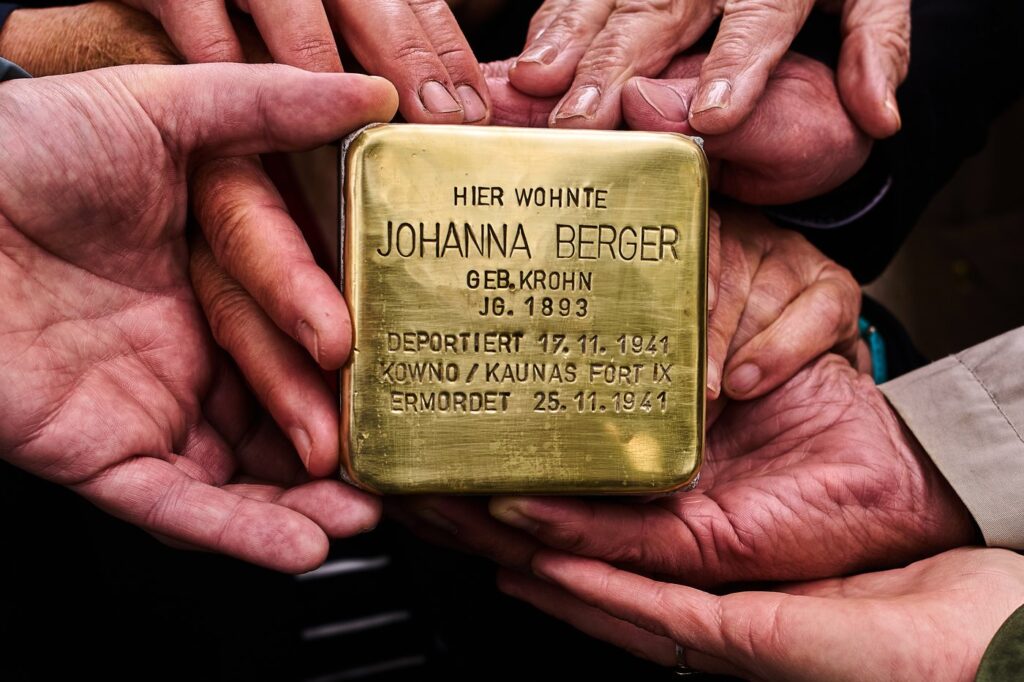
GENEVA (AP) A recent decision by the city council of Heidenau, located southeast of Dresden in eastern Germany, has ignited significant controversy. The council voted to halt the installation of memorial plaques that honor Holocaust victims. This decision was fueled by support from members of Chancellor Friedrich Merz's conservative party, the Christian Democratic Union (CDU), along with the far-right Alternative for Germany (AfD).
The memorial plaques, known as Stolpersteine or "stumbling blocks," were created by German artist Gunter Demnig. They are small, brass plaques engraved with the names and fates of Jews and other individuals who were persecuted by the Nazis. Since their inception in 1992 in Cologne, more than 126,000 Stolpersteine have been installed in over 30 countries in Europe, serving as a significant form of Holocaust remembrance and honoring the millions of victims of the Nazi regime.
Proponents of the Heidenau city council's decision argue that many relatives of Holocaust victims find the plaques inappropriate, as individuals walk over them on the sidewalks where they are placed, often near the victims' former homes. However, this perspective has faced vehement backlash, particularly from Jewish communities and Holocaust survivors.
Israeli ambassador to Germany, Ron Prosor, expressed his shame over the decision, noting that some of the plaques in Berlin commemorate his own relatives. He described the decision as deeply troubling, especially in light of Germany's historical context and cultural commitment to remembrance. Many Jewish individuals visit Germany specifically to attend the stone-laying ceremonies, viewing the plaques as a vital connection to their loved ones who perished in concentration camps.
Christian Meyer-Heidemann, the state commissioner for political education in Schleswig-Holstein, condemned the vote, stating it represented "a deliberate attack on our culture of remembrance." He highlighted the significance of Stolpersteine as a public acknowledgment of historical atrocities and the importance of maintaining this memory for future generations.
Besides Heidenau, other cities, like Munich, have also opted to restrict the installation of Stolpersteine. Munich does not allow these plaques to be placed on city-owned land and has sought alternative memorials, citing concerns that they enable the names of victims to be trampled upon.
The AfD has been gaining traction in eastern Germany, capitalizing on anti-immigration sentiment and recent electoral successes. The party has often been criticized for downplaying or denying the severity of Nazi-era crimes, leading to increased tensions within German politics. In light of their rise, CDU leader Merz faces scrutiny for his party's alignment with AfD members in support of the memorial plaque decision, despite his stated opposition to cooperation with the far-right party.
Demnig, the creator of the Stolpersteine, remarked on the situation, acknowledging that such decisions were to be expected following the AfD's electoral gains. He accused the CDU of abandoning its foundational Christian values, urging society to reflect on the importance of memory and historical accountability.
The discourses surrounding the Stolpersteine continue to reveal deep divisions in contemporary German society, particularly concerning memory politics and how to honor the victims of the Holocaust. As discussions unfold, the implications of this decision may resonate beyond Heidenau, influencing similar movements within other communities across Germany.