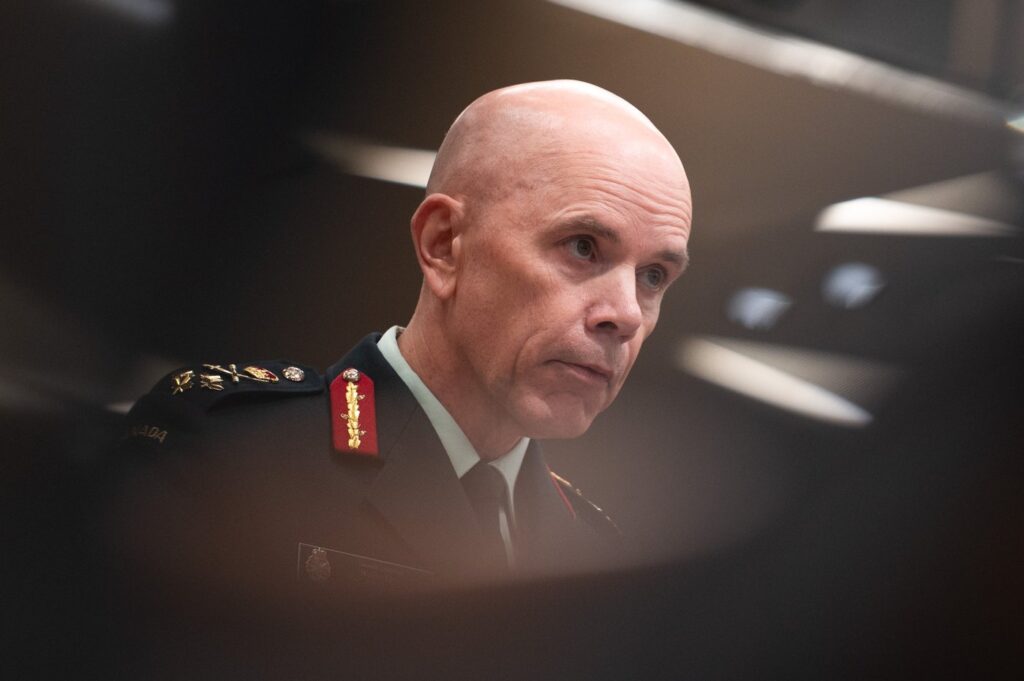
OTTAWA – In his upcoming memoir, retired General Wayne Eyre asserts that Canada’s self-image as a nation of peacekeepers is a "persistent myth" that has not evolved in response to a rapidly changing global landscape. According to Eyre, this notion "needs to fade away."
His book, titled Into the Breach: A Soldier's Journey, set to release on October 6, reflects on Eyre’s extensive military career, including his participation in peacekeeping operations in Croatia, Bosnia, and Cyprus, as well as his experiences in Afghanistan. Eyre recalls the pivotal moment in 1993 at Medak Pocket, which he argues marked the death of traditional UN peacekeeping.
During the Battle of Medak Pocket, Eyre, then serving as a captain with the 2nd Battalion Princess Patricia's Canadian Light Infantry, faced intense artillery and machine-gun fire while attempting to drive back Croatian forces. Eyre vividly describes entering the village of Licki Citluk, where his battalion encountered evidence of ethnic cleansing amid smoldering ruins. He emphasizes that effective peacekeeping requires a well-armed force, yet the United Nations Protection Force failed to provide adequate strength, ultimately leading to a brutal escalation of violence.
"The only thing that the belligerents respected was force," Eyre remarked in an interview with The Canadian Press, illustrating how the conflicts in the former Yugoslavia negated the efficacy of traditional peacekeeping missions.
Eyre reflects on the evolution of peacekeeping, noting that it was a defining era for the Canadian military that came to an end in the early 1990s. He points out that contemporary missions occur in a drastically altered geopolitical environment. For instance, many current peacekeeping operations are situated in Africa, where local resistance to the presence of large Western forces complicates their effectiveness.
In his memoir, Eyre shares profound memories of the sights and smells of war, particularly recalling the "overpowering smells of smoke and death" that lingered long after the battle, impacting him deeply. His book also delves into the highs and lows of his military career, culminating in his role as chief of the defence staff, a position he assumed in 2021 amidst significant challenges.
Eyre discusses his experiences in this role, explaining that he frequently encountered requests from politicians who seemed unaware of the implications of their decisions or the diminishing resources available to the Canadian Armed Forces, particularly in light of prolonged underfunding and new military commitments, such as the Russian deterrence mission in Latvia.
He describes Canada’s current military landscape as defined by strong alliances and the selective deployment of military power. Eyre identifies Canada’s leadership in Latvia, where 2,000 troops are stationed as part of NATO’s eastern flank, as the most significant deployment since the Cold War ended.
Eyre’s reflections on the military are shaped by a series of historical milestones, such as the end of the Cold War, the 9/11 terrorist attacks, and the Afghanistan War. He details his leadership of Canada’s largest combat advisory mission in Afghanistan, illustrating how these critical events influenced his career trajectory.
Taking on the role of chief of the defence staff was not his initial intention. Eyre found himself in this position following the resignation of Admiral Art McDonald amid a sexual misconduct allegation, which ultimately did not result in charges. Initially serving as acting chief, he soon contemplated resignation due to a perceived lack of trust from the government, exemplified when then-deputy Prime Minister Chrystia Freeland openly criticized his decisions regarding military leadership amid scandals.
Eyre comments on the complexities of political-military relationships, describing how his tenure was interrupted by various crises, including the COVID-19 pandemic, the chaotic evacuation from Afghanistan in 2021, the onset of the Ukraine war, and the disruptions caused by the "Freedom Convoy" in Ottawa, alongside local disasters such as forest fires and floods.
Despite the myriad challenges, Eyre highlights the need for clarity in national security objectives during times of pressure. He criticizes the slow pace of governmental decision-making processes and expresses frustration over extending commitments without timely directives from Ottawa.
Ultimately, Eyre believes that a well-articulated national security strategy can provide necessary guidance in crisis situations. His memoir serves as a historical narrative, offering insights from a military leader who has witnessed profound changes in warfare and peacekeeping.