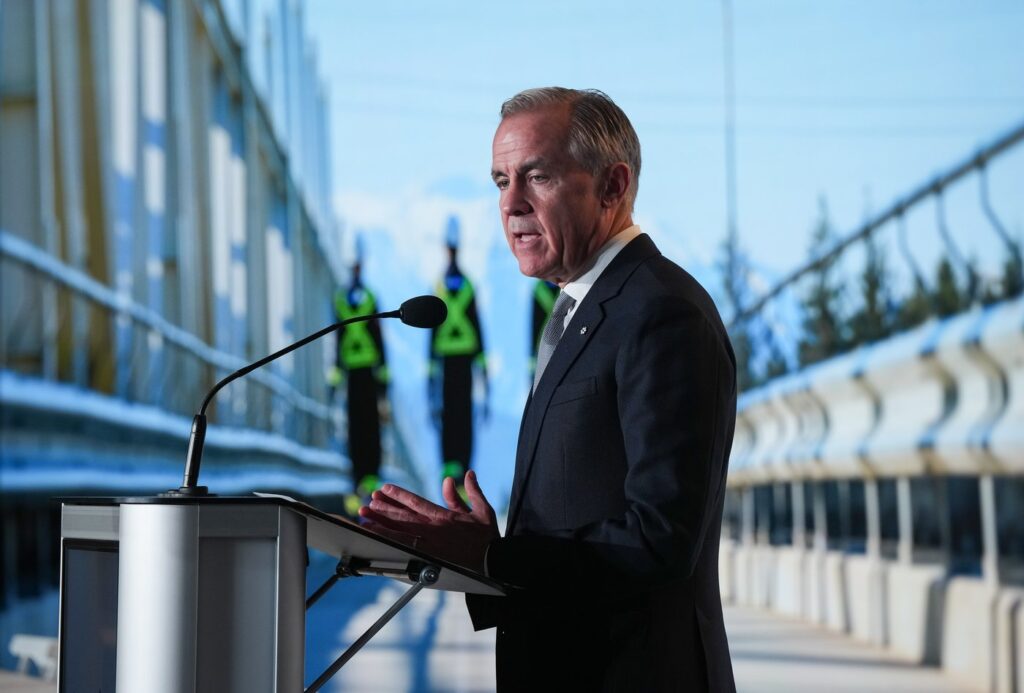
VANCOUVER — On Tuesday, Prime Minister Mark Carney announced a significant investment of $1.2 billion in federal funding dedicated to ocean protections. This funding comes as Canada approaches crucial decisions regarding a proposed new pipeline to the West Coast, along with the expansion of a major port located in Metro Vancouver.
During his announcement, Carney emphasized that these major infrastructure projects would lead to "more ships on the water and more pressure on the habitats that we are all working to protect." He asserted, "So we must scale up our systems to protect marine life in the event that something goes wrong."
The allocated funds will be utilized for several initiatives aimed at safeguarding marine ecosystems. Key measures include enhancing the Canadian Coast Guard's capacity to monitor marine traffic, establishing a national near-shore weather forecasting system, and developing a marine mammal oil spill response plan. Additionally, these efforts will include upgrading search and rescue stations, improving seabed mapping, and strengthening fisheries conservation initiatives.
The announcement, made in North Vancouver, British Columbia, precedes a critical deadline on Thursday, when Ottawa must determine whether to designate the proposed pipeline stretching from Alberta to British Columbia's south coast as a project of national interest. Carney pointed out that the pipeline would serve to diversify the Canadian economy, potentially generating nearly 150,000 new jobs across the country while reducing dependence on the United States.
Carney noted, "But we know it’s not just what we build, it’s how we build. And this government is taking a protect-while-we-build approach to new investments." He reassured the public that the proposed pipeline would avoid "highly sensitive areas," with its route similar to that of the existing Trans Mountain pipeline. He reiterated that the tanker ban across B.C.’s northern coast will remain in place.
In related news, LNG Canada confirmed its decision to proceed with a Phase 2 expansion of its facility in Kitimat, B.C., which would double its capacity. Carney had previously expressed his support for the expansion of the Port of Vancouver's Roberts Bank terminal. In July, he mentioned that his government was prepared to invest approximately $10 billion in this project as part of Ottawa's broader strategy to enhance trade relationships beyond the United States.
Highlighting the urgency of marine protection measures, Carney stated that the port is already operating at tight capacity and that expansion is essential for Canada's international trading goals. This includes protecting endangered species such as the southern resident killer whales that inhabit the waters off B.C.'s south coast.
To combat underwater noise pollution affecting marine life, Carney declared that Ottawa would allocate $100 million towards establishing long-term capacity for monitoring and mitigating noise across all three coasts: Pacific, Atlantic, and Arctic. He announced that the government aims to keep underwater noise levels to those of 2023, despite increases in vessel traffic.
Carney assured that rigorous conditions would accompany construction activities, stating that work would cease if a killer whale were to approach the site during the proposed Roberts Bank expansion. This terminal is situated near the mouth of the Fraser River in Delta, B.C. He also reported that there would be funding for Indigenous-led stewardship and restoration projects in the Lower Fraser River Estuary.
Additionally, $90 million will be allocated to bolster front-line fisheries enforcement, providing fisheries officers with modernized tools, including drones. The new funding package also includes $186 million designated for the Northern Shelf Bioregion Reconciliation Framework Agreement, promoting collaborative governance, conservation, waterway management, emergency preparedness, and cumulative effects work in the Great Bear Sea region.
Coastal First Nations have expressed their support for the funding, with their president, Samuel Schooner, noting that it represents a significant step toward enhancing collaborative efforts in preparation for the anticipated increase in vessel traffic resulting from major projects. Schooner acknowledged the heightened risks of accidents and impacts on sensitive coastal ecosystems and highlighted the communities' advocacy for safe and responsible shipping investments in line with economic development.
In contrast, the Wilderness Committee criticized the $1.2 billion investment for ocean protection as "pennies" compared to the federal government's $10 billion contribution towards the proposed Roberts Bank expansion. They also voiced concerns regarding the newly proposed Bill C-39 aimed at strengthening the economy, asserting that it undermines protections for at-risk species.