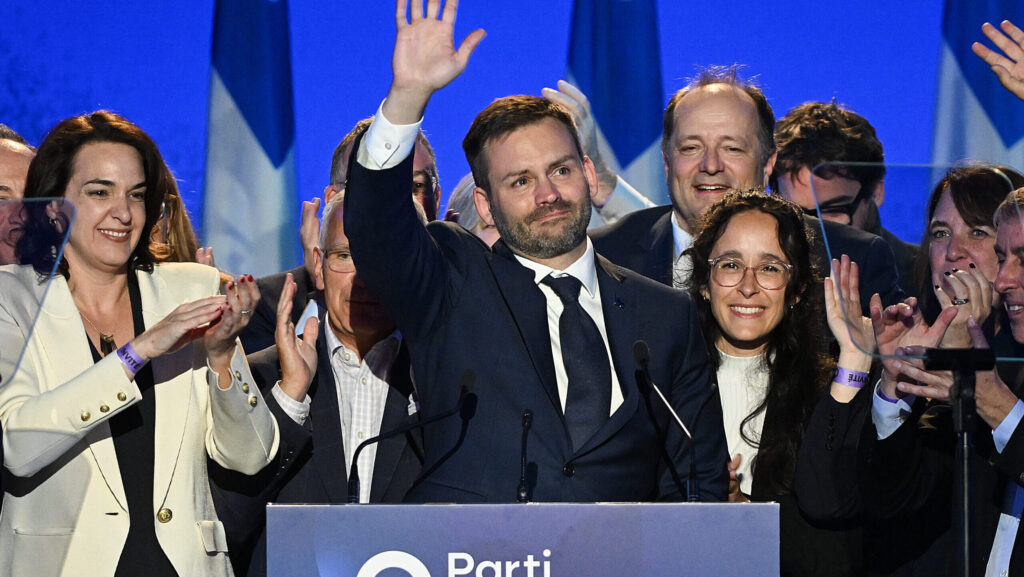
Paul St-Pierre Plamondon will assume the role of the next premier of Quebec, marking a significant resurgence for the Parti Québécois (PQ) after over a decade of decline and years in political obscurity within the National Assembly. The pro-independence party is projected to form a minority government, winning 59 seats, which falls short of the 64 needed for a majority in Quebec's legislature.
The PQ’s victory on election night, October 5, 2026, seemed inevitable after three years of leading polls and securing four consecutive byelection wins—clear indicators of increasing support for the sovereigntist party. St-Pierre Plamondon addressed supporters at the PQ headquarters in Montreal, emphasizing the beginning of a new political cycle: “While our campaign concludes tonight, a new political cycle is beginning, and a new chapter in our history is opening for our nation in the years ahead.” He vowed to restore confidence in both the government and the capability of Quebecers to achieve great things.

In this election, the Liberal Party of Quebec, led by Charles Milliard, will serve as the official opposition for the third consecutive time with an expected 40 seats. The Conservative Party of Quebec, under Éric Duhaime, has gained official party status by winning 19 seats, exceeding the number required for recognition in the National Assembly. Quebec solidaire, however, experienced a drop in representation, securing only nine seats, while the Coalition Avenir Québec (CAQ), prior to this election the ruling majority party for eight years, failed to win any seats.
St-Pierre Plamondon, who won his riding of Camille-Laurin on the Island of Montreal, acknowledged the minority mandate given by the voters and pledged to be “the premier for all Quebecers, without exception,” including his “English-speaking friends in Quebec.” He stated, “Quebecers have spoken tonight. They have decided to elect the Parti Québécois while also asking it to work with the other parties... I will do everything in my power to live up to what Quebecers are asking of us.”

St-Pierre Plamondon plans to present an economic update addressing the cost of living and homelessness as winter approaches. He mentioned intentions to collaborate on the budget to reflect elements from other parties' election platforms, signifying his willingness to work with all political factions in Quebec. He asserted that good ideas can emerge from every party.
The victory of the Parti Québécois may pave the way for a referendum on Quebec's independence. St-Pierre Plamondon has stated that they will hold a referendum once Donald Trump leaves the U.S. presidency, maintaining that the current political climate is not suitable for such discussions. He articulated that Quebec desires to exist as an independent entity, highlighting the importance of its cultural survival for the French-speaking population in North America.
Reflecting on his campaign, St-Pierre Plamondon encouraged Quebecers not to fear the idea of independence, referencing Jacques Parizeau's historical calls for democratic engagement concerning Quebec’s future. The PQ estimates that organizing a referendum would cost about $130 million. This marks the first pro-independence government in Quebec since 2014, signaling a significant shift in the province's political landscape after years of decline for the PQ.
The road to this electoral success has been rocky for the Parti Québécois, which saw its influence diminish significantly over the last few years. Following a dismal performance in the 2022 election, where the PQ won only three seats with a mere 14 percent of the vote, St-Pierre Plamondon has since led the party through a remarkable turnaround, culminating in this recent electoral victory.
Campaign Promises
In addition to their commitment to a referendum, St-Pierre Plamondon has outlined various other campaign promises aimed at addressing key issues in Quebec. On the economy, the PQ aims to support local businesses facing U.S. tariffs, achieve a balanced budget by the 2028-29 fiscal year, and abolish the Quebec sales tax on used goods. On immigration, they plan to significantly reduce the number of temporary and permanent immigrants, alongside establishing a citizenship ceremony for Quebec. The PQ also promises initiatives focusing on the French language, healthcare, and homelessness, including the construction of 2,000 housing units for the homeless within the next four years and the creation of new subsidized childcare spaces.