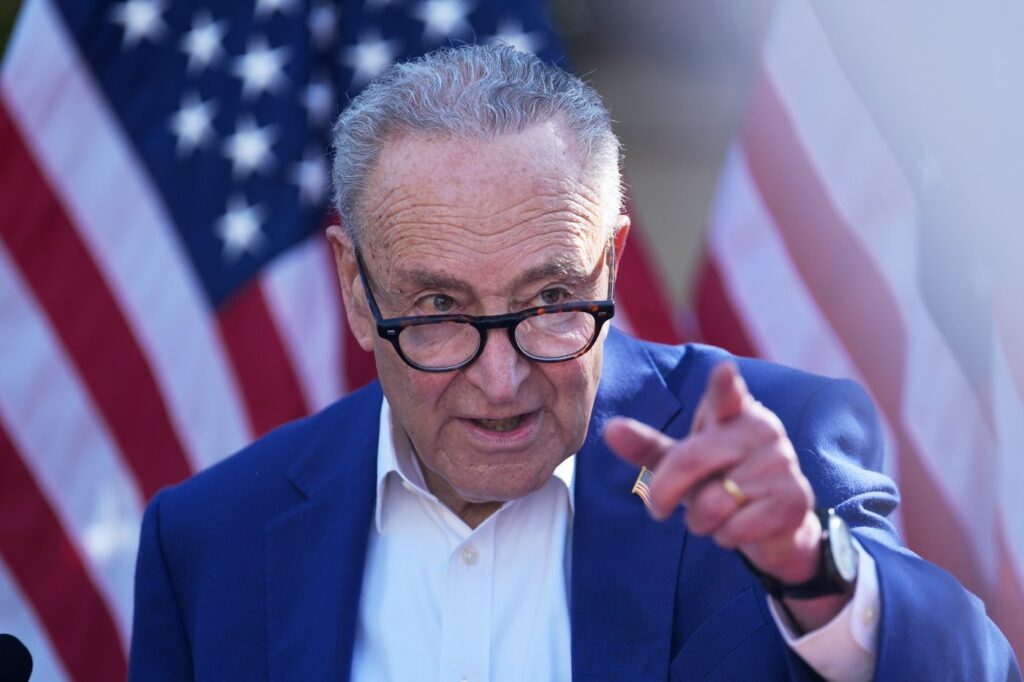
WASHINGTON (AP) — Senate Democratic Leader Chuck Schumer has asserted that Democrats will not permit President Donald Trump to appoint a “right-winger” to the Supreme Court after they regain power, hinting at the possibility of blocking a presidential nominee should a vacancy arise in the next two years. In an interview with The Associated Press on Thursday, Schumer refrained from confirming whether he would aim to hold a Supreme Court vacancy open until after the next presidential election, akin to the strategy employed by former Senate Republican Leader Mitch McConnell in 2016. Nevertheless, he firmly stated that Democrats will "not allow any crappy nominees" to be confirmed to the Supreme Court, lower courts, or Trump's Cabinet. He stressed, "The bottom line is we’re not going to allow a right-winger on the court."
Schumer's commitment followed a powerful performance by Democrats in the midterm elections, where they secured a decisive Senate majority, a result many had not anticipated a year prior. The New Yorker faced significant criticism from progressive factions within his party, while Senate Republicans were optimistic about maintaining power due to favorable electoral maps and backing from Trump. Although some within the party continue to express dissatisfaction with Schumer's leadership, he is expected to easily be reelected as leader by his caucus, reflecting his successful campaign strategy that saw Democrats win in Republican-leaning states across the country. If Democrats also secure victories in Mississippi and Alaska, they could potentially hold up to 56 Senate seats, an achievement Schumer describes as “a durable majority” that has been two decades in the making.
Schumer is betting on the notion that the Senate flipping is not merely a one-time occurrence. He believes the Democratic majority will give them the leverage to reject Trump's nominees, compelling the president to consider more moderate alternatives, while also allowing the party to challenge the Iran war and other policies they have struggled against while in the minority. He emphasized that the party's agenda will revolve around controlling costs, alongside five key issues they previously focused on: healthcare, housing, Trump’s tariffs, childcare, and lowering energy bills. Schumer also signaled intentions to impose a ban on federal elected officials partaking in stock trades and to limit consumer costs linked to data center expansion.
Moreover, Democrats aim to scrutinize Immigration and Customs Enforcement (ICE) raids nationwide and investigate the Trump administration, which Schumer labeled as “the most corrupted administration by far in American history.” However, he avoided detailing how he intends to negotiate with Trump, who has indicated strong opposition to Democratic initiatives. Beyond dealing with the Trump administration, Schumer faces challenges from his own caucus, as incoming freshman senators from red states may not be fully committed to supporting him as leader. He forecasts that Republicans may face more losses if they continue to align closely with Trump without making bipartisan efforts.
Navigating the legislative landscape will not be straightforward. Schumer refrained from committing to whether he will attempt to abolish the filibuster, a move he previously attempted and failed during President Joe Biden’s tenure to enable Democrats to pass legislation with a simple majority rather than needing 60 votes. He emphasized the primary goal must be to "get things done," expressing a determination to find pathways forward.
When asked about the potential for a third Trump impeachment, Schumer indicated he would support an impeachment of Defense Secretary Pete Hegseth, a move that House lawmakers have already initiated. However, he deferred on the question of Trump's impeachment, stating, “That’s up to the House.”
Reflecting on the Democratic victories, Schumer noted the wins were attributable to strong candidates and a focus on local issues in districts previously dominated by Republicans, such as the impact of Trump’s tariffs on farming in Iowa and conflicts in trade with Canada affecting Maine. He noted significant engagement in his campaign efforts, having invested $67 million into races influenced by local issues, such as in Ohio, where former Senator Sherrod Brown successfully reclaimed his seat.
Despite this year’s successes, uncertainty lingers regarding Schumer's longevity in power as calls for a new generation of leadership begin to surface. He is up for reelection in 2028 but has not confirmed whether he intends to pursue a sixth term. While senators within his caucus express loyalty to his leadership, there is a push for reform and acknowledgment of criticism surrounding legislative efforts. Senator Chris Van Hollen has called for an “open and honest discussion” regarding future leadership, while Vermont Senator Peter Welch pointed out the necessity for Schumer to adapt and consider criticisms. Nevertheless, there is currently no indication of a genuine leadership challenge, with Welch noting Schumer’s successful navigation through the electoral landscape.