President Donald Trump and his Department of Justice are adopting a confrontational approach towards Democrats following their electoral successes in the recent midterm elections. This sets the stage for a contentious period ahead, as lawmakers gear up for aggressive investigations into the executive branch in the coming year.
Trump utilized social media to assert that investigations initiated by Democrats amount to “extortion at the highest level” and stressed that they should face consequences. Attorney General Todd Blanche echoed these sentiments, suggesting that criminal investigations targeting Democratic figures may be on the table.
According to Blanche, the Democrats should not be allowed to “threaten existing members of the administration” or intimidate companies, and he emphasized Trump’s concerns over these threats as valid. Meanwhile, Rep. Robert Garcia, likely to head the influential House Oversight Committee next Congress, is preparing inquiries into what he describes as the “Trump crime family,” reaffirming that Democrats will not be cowed.
Garcia stated, “The days of us not fighting back are over.” This early rhetoric signals a forthcoming showdown that may heavily influence Trump’s final two years in office, serving as a test of Congress's ability to impose checks on presidential power. An AP Voter Poll indicates that approximately 70% of voters believe Congress is not doing enough to maintain checks and balances on the presidency.
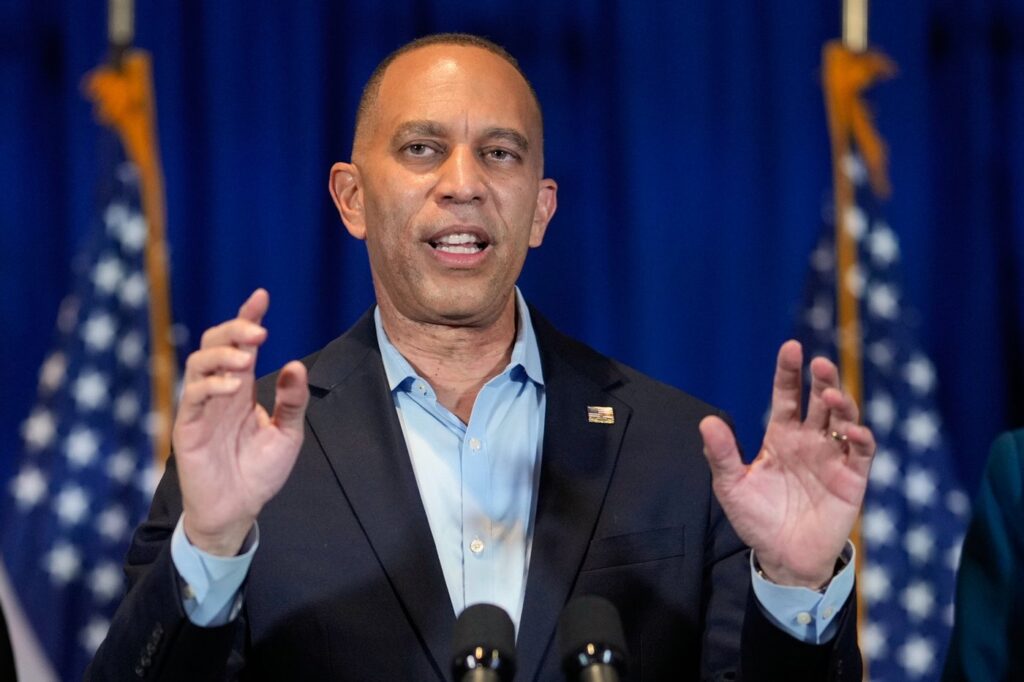
Democrats are making it clear that impeachment remains a potential course of action. House Democratic leader Hakeem Jeffries of New York asserted that individuals who “have been shortchanging the American people... need to be held accountable in a manner consistent with Congress’s role, constitutionally.”
However, the push for extensive investigations forms a source of discord among Democrats. Many are cautioning that their focus should remain primarily on delivering tangible results to voters, particularly regarding actions aimed at “lowering the cost of living.” There are concerns that their significant victories in the House and Senate could be jeopardized if the entire agenda becomes overshadowed by conflicts with Trump.
Sen.-elect Adam Hamilton, the first Democrat elected from Kansas in 94 years, has expressed skepticism about impeachment proceedings. He emphasized that he prefers to work towards unifying the country rather than further division, stating, “I’m not as interested in impeachment as setting up guardrails.” Hamilton acknowledged the necessity for some investigations but stressed the importance of addressing the concerns of constituents.
Sen. Bernie Sanders, an independent who caucuses with Democrats, also called for accountability regarding Trump but warned of the limited time available for investigations. “We cannot spend all of our time investigating Trump; we’ve got to stand up for working-class families,” he said.
Jeffries, poised to become the first Black House speaker, conveyed a readiness to cooperate with Republicans “whenever and wherever possible to deliver real results.” However, he strongly criticized Trump’s choice of long-time adviser Stephen Miller as the new chief of staff, calling it an “awful choice” and indicating that collaboration with him would be nearly impossible.
Democrats, spanning the ideological spectrum, have condemned Miller’s appointment, given his role in Trump’s controversial immigration policies. A recent AP Voter Poll revealed that around 60% of voters believe the administration's stance on immigration enforcement has “gone too far.”
Additionally, Jeffries expressed his support for an impeachment resolution against Defense Secretary Pete Hegseth, announcing that Democrats would discuss it during their upcoming Capitol session. Hegseth has dismissed the impeachment drive as politically motivated, claiming it would have no impact on him.
As new Democratic senators prepare to take office, some have voiced doubts about the leadership of Chuck Schumer, who is anticipated to be re-elected as Democratic leader. Hamilton remarked that Schumer can be polarizing and expressed a desire for a leader who could unite party members rather than divide them.
Sen.-elect Abdul El-Sayed of Michigan, who received significant financial backing from Schumer during his campaign, acknowledged that he and Schumer have come to an understanding since the primary. He emphasized the importance of having a leader committed to delivering on the mandate that Democrats received from voters.
In summary, the political landscape is becoming increasingly charged as Democrats prepare to investigate Trump and his administration while balancing the imperative to address the needs of American families.