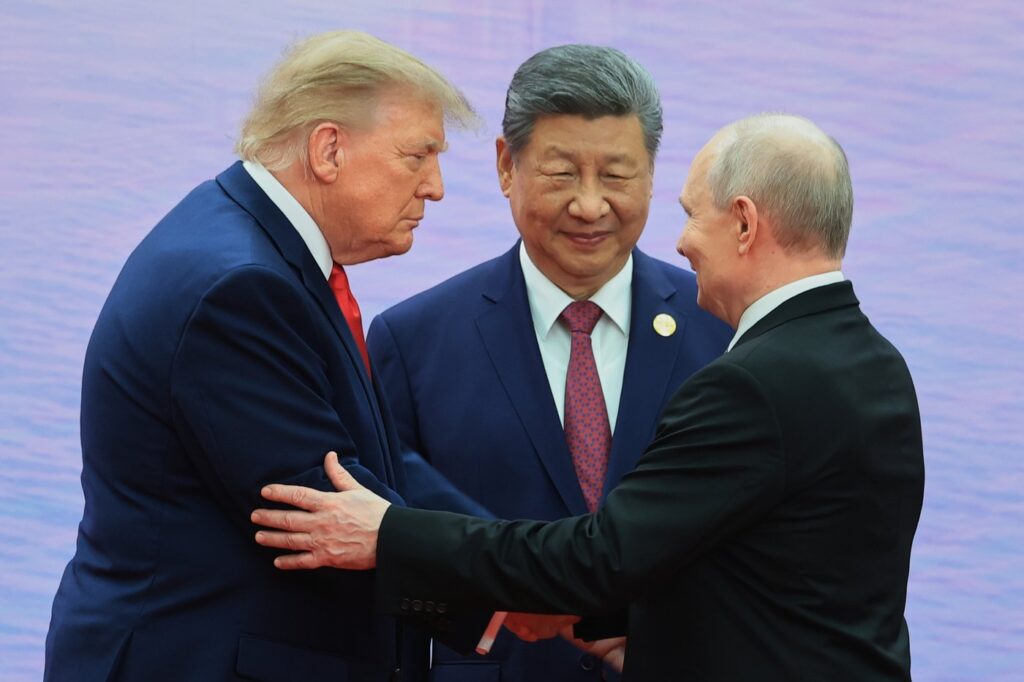
On Thursday in Shenzhen, China, President Donald Trump is set to meet with China's Xi Jinping and Russia's Vladimir Putin, a summit that may either signify a pivotal moment in global relations or fade into obscurity as mere photo opportunities. The trilateral meeting is a test of Trump's self-proclaimed expertise as a dealmaker, with hopes to negotiate controls on nuclear arms and address ongoing conflicts in Ukraine and Iran. However, experts remain skeptical about achieving significant breakthroughs during these discussions.
Trump emphasized the strategic advantage of meeting both leaders simultaneously, highlighting their countries' collaborative dynamics. In an interview with Fox News, Trump remarked, "They both like Trump. Now, what happens after me? That I can’t tell you." Prior to the trilateral meeting, Trump will hold a separate session with Xi, marking their third substantial engagement this year, and has also added a direct meeting with Putin to his agenda. This will be the first communication between Trump and Putin since their stalled talks in Alaska last year aimed at alleviating the war in Ukraine.
Despite Trump’s confidence in his rapport with both autocrats, tensions have emerged in U.S.-Ukraine relations, especially with Trump facing criticism for rejecting new sanctions against Russia amid a backdrop of significant military conflicts. In addition to Trump, Elon Musk will also accompany the trip, although he has kept a low profile. Musk's company, SpaceX, has come under scrutiny for its controversial throttling of the Starshield satellite system, impacting Ukraine's drone operations against Russian forces.
The trilateral meeting is scheduled as a concluding event of Trump's Asia trip, which began on Tuesday in the Philippines and follows a session with leaders at the Asia-Pacific Economic Cooperation Summit on Thursday morning. Trump has voiced his interest in discussing nuclear arsenals, particularly since the previous nuclear arms agreement, known as New START, expired in February. He has called for a "new, improved and modernized" deal that would incorporate China. Nevertheless, with China's significantly smaller arsenal of over 600 warheads compared to thousands in the U.S. and Russia, experts suggest the likelihood of substantial agreements may be minimal.
Daryl Kimball, the executive director of the Arms Control Association, indicated that while Trump’s theatrical approach could initiate a prolonged dialogue focused on nuclear disarmament, it is unlikely that one meeting will yield dramatic results. Trump himself acknowledged the complexities involved in persuading nations to reduce their nuclear stockpiles.
Kremlin spokesman Dmitry Peskov mentioned that discussions among Trump, Xi, and Putin are anticipated to include the war in Ukraine, though the agenda remains fluid. Trump's ambitions echo a historical paradigm where powerful nations dictate terms to lesser nations, as he engages with China and Russia without the presence of Ukraine or other nations like Germany, France, the UK, Japan, and South Korea, which are also deeply invested in the outcomes of these talks.
Despite claiming a diplomatic advantage through personal connections, Trump's relationship with Xi has not appeared as mutually beneficial as the bonds between Xi and Putin, who openly maintain a close friendship. At the APEC event, Xi referred to Putin as “my old friend,” while Putin reciprocated the sentiment, showcasing their strengthening ties that economically offer support to Russia amidst sanctions imposed due to the war in Ukraine. In stark contrast, Trump and Xi's exchanges have been notably less warm, marked by formality rather than camaraderie.
Suspicion among Ukraine and its European allies surrounds the trilateral meeting, with concerns regarding potential exclusion from negotiations. German Chancellor Friedrich Merz has expressed fears of another "Anchorage moment," referencing previous unproductive discussions between Trump and Putin in Alaska. Tensions loom in U.S.-China trade relations, with neither side fully honoring prior commitments made during negotiations, while the impending expiration of last year's trade agreement adds urgency to the dialogue.
As both nations navigate economic interests and potential trade with Iran during ongoing conflicts, Trump’s approach becomes increasingly central to U.S.-China relations and the broader geopolitical landscape.