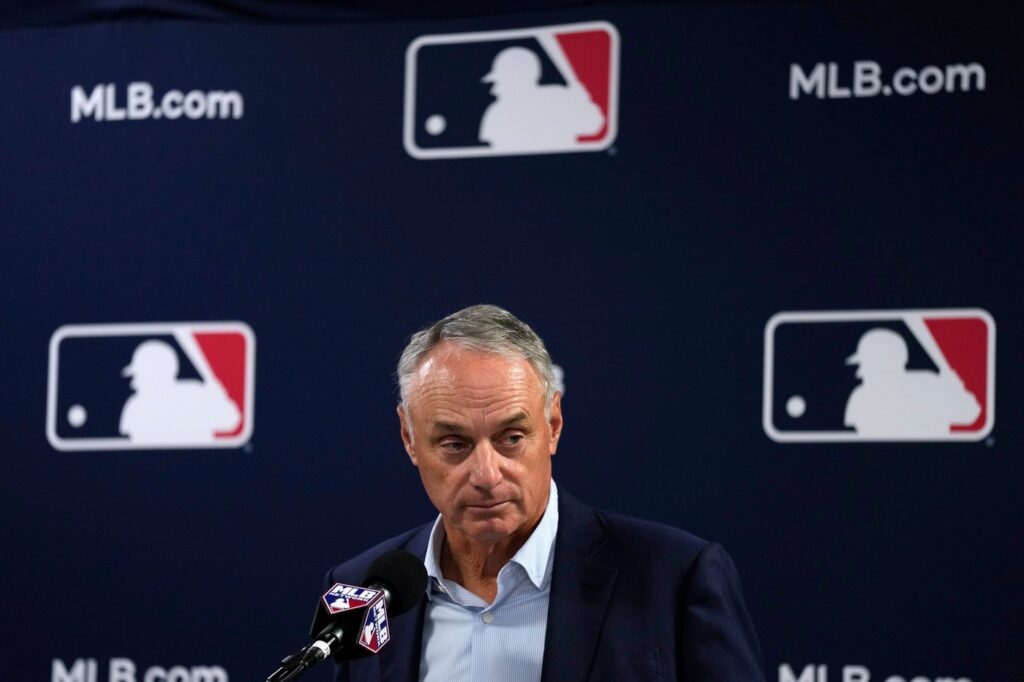
Major League Baseball (MLB) Commissioner Rob Manfred has stated that the team owners are firm in their demand for a salary cap, setting the stage for a potential lockout beginning December 2, which could jeopardize the 2027 season. During a news conference held at an owners meeting, Manfred expressed doubt that owners would ratify any agreement that does not include a salary cap and a floor. This stance leads to an impasse with the players' union, which firmly opposes the implementation of a salary cap.
Manfred emphasized the necessity of a salary cap and a floor, citing fan sentiment as a critical factor. He noted, “We are not prepared to tell 70% of our fans that they’re wrong on this issue. Competitive balance is a serious problem.” The last substantial proposal for a salary cap occurred in 1994 and resulted in a historic 7.5-month strike, which led to the cancellation of the World Series for the first time in 90 years.
The current collective bargaining agreement for MLB is set to expire at 11:59 p.m. EST on December 1, marking the potential for a lockout, which would impede trades and player signings. Manfred stated that a decision regarding the lockout would be made at the last moment, emphasizing the league's willingness to negotiate. “I’m not that big on Thanksgiving as a holiday. We’ll make ourselves available whenever and wherever to bargain in an effort to make an agreement,” he added.
MLB's proposal includes a hard cap of $258.2 million for the 2028 season and a floor of $180.2 million. The plan permits teams to operate at 90% of the floor but mandates that they spend the entire floor amount over a three-year timeframe. Individual contracts are proposed to be capped at 15% of total payroll. Additionally, MLB asserts that they proposed a 50-50 split of revenue, while the players' union argues that players currently receive more than 55% of total revenue.
Union head Bruce Meyer criticized the owners' proposals, labeling them as serious threats to player compensation and the integrity of contracts. He stated, “There should be no illusions about the owners’ true motivation in pushing for this system. They want to make more money in profits and franchise values by artificially suppressing player salaries.” The players have termed the salary cap a “non-starter,” indicating their staunch refusal to accept such terms.
In contrast, Manfred urged the MLB Players Association (MLBPA) to re-evaluate their position and seek a middle ground, asserting the need for the union to engage more actively in negotiations. He remarked that the MLBPA "has not made a significant economic proposal since their opening proposal,” prompting a call for more constructive dialogue. The players proposed a “competitive integrity tax” to penalize teams that drop below the payroll floor, alongside requests for an increase in the luxury tax threshold and improved salary arbitration rights.
MLB executives argued that high-spending teams consistently enjoy better chances of winning, pointing out that only one team without a top-20 payroll has won a championship since 1998. They cited the recent success of small-market teams as unusual and not a sustainable trend, highlighting that successful teams tend to invest heavily in player salaries. In the 2026 season, if enacted, the proposed salary cap would require major reductions for high-spending franchises such as the Los Angeles Dodgers and New York Mets, indicating far-reaching implications for team operations.
Furthermore, MLB's proposal includes a change in local media revenue distribution, suggesting that revenue be split equally among all 30 teams for the first time. This amendment comes amid a decline in local media revenue attributed to the decreasing viability of cable networks. With market dynamics shifting, MLB stressed the importance of enhancing the competitive landscape to ensure better financial health and appeal for franchises across the league.