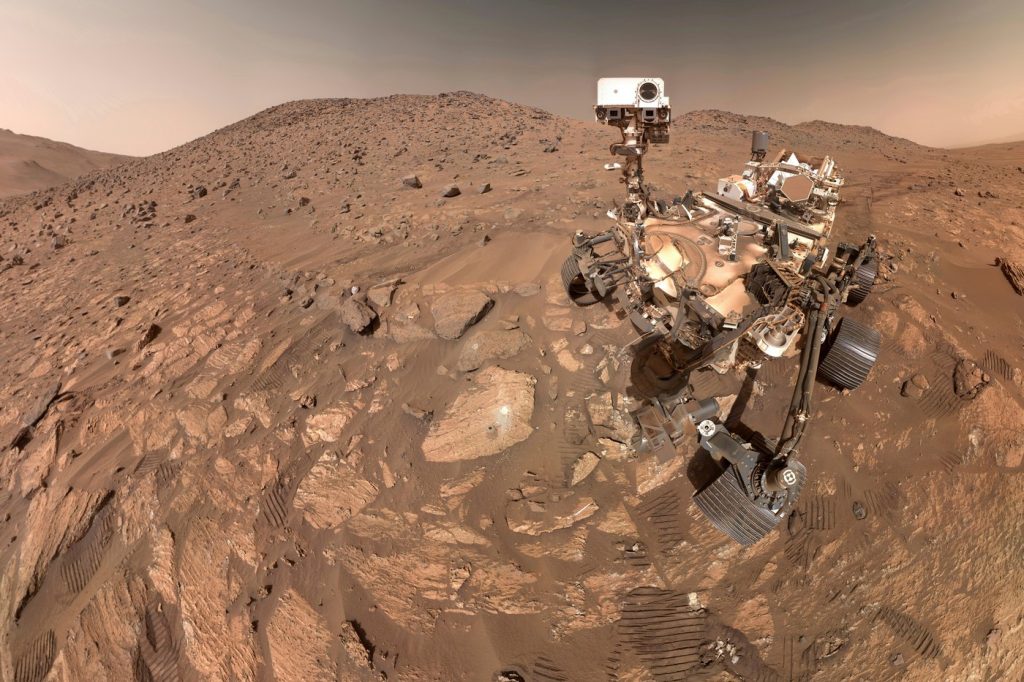
Scientists have detected what they believe to be lightning on Mars by analyzing the sounds captured by NASA's Perseverance rover. A French-led research team reported their findings on Wednesday, unveiling evidence of “mini lightning” as recorded by a microphone on the rover. These electrical discharges were documented over two Martian years, with a total of 55 instances primarily occurring during periods of dust storms and dust devils.
The tiny electrical arcs measured just inches in size and were recorded within a distance of 6 feet (2 meters) from the microphone, which is situated atop the rover’s tall mast. This microphone is part of a system designed to scrutinize Martian rocks using cameras and lasers. The distinct crackling sounds resembling static electricity were clearly audible against the backdrop of noisy wind gusts and the dust particles striking the microphone.
After decades of searching for signs of electrical activity and lightning on Mars, lead author Baptiste Chide from the Institute for Research in Astrophysics and Planetology in Toulouse expressed excitement about the discovery. He stated that these findings could open up a new field of investigation in Martian science, highlighting potential chemical effects resulting from electrical discharges. Chide described this discovery as akin to finding a crucial piece of a puzzle.
Despite the compelling evidence, experts caution that it is based on recordings from a single instrument not originally intended to detect lightning, which has led to some skepticism within the scientific community. According to Daniel Mitchard of Cardiff University, who was not part of the study, the electrical discharges were detected through sound rather than visual confirmation. In his accompanying article published in the journal Nature, Mitchard acknowledged that while the evidence points towards Martian lightning, continued debate among scientists is expected until additional instruments can be deployed to validate these findings.
Lightning has been confirmed on gas giants like Jupiter and Saturn, and Mars has long been a candidate for similar phenomena. To analyze the recordings, Chide and his research team reviewed a total of 28 hours of audio captured by Perseverance, identifying episodes of “mini lightning” based on acoustic and electric signals. They found that the electrical discharges caused by rapidly moving dust devils lasted a few seconds, while those from dust storms were more persistent, lasting as long as 30 minutes.
Chide characterized the activity on Mars as “like a thunderstorm on Earth, but barely visible with the naked eye” and filled with faint electrical zaps. He further explained that the thin, carbon dioxide-rich atmosphere on Mars absorbs much of the sound, rendering some of the electrical discharges barely perceptible.
In terms of atmospheric conditions, Mars is considered more prone to electrical discharges due to the interaction among grains of dust and sand. Although Mitchard stated that it is highly unlikely for the first human visitors to Mars to be struck by a lightning bolt while planting a flag, he noted that these small, frequent static-like discharges might pose challenges for sensitive scientific equipment.
The Perseverance rover has been sending audio recordings back to Earth, providing insights beyond just the detection of lightning. So far, sound transmissions have included the rustling of its wheels navigating the Martian surface and the whirring of its helicopter companion, Ingenuity.
Since arriving on Mars in 2021, Perseverance has been exploring a dry river delta, collecting rock samples in search of potential signs of ancient microscopic life. NASA has plans to return these core samples to Earth for further analysis; however, the timeline for this return has been indefinitely postponed as the agency investigates more cost-effective options.