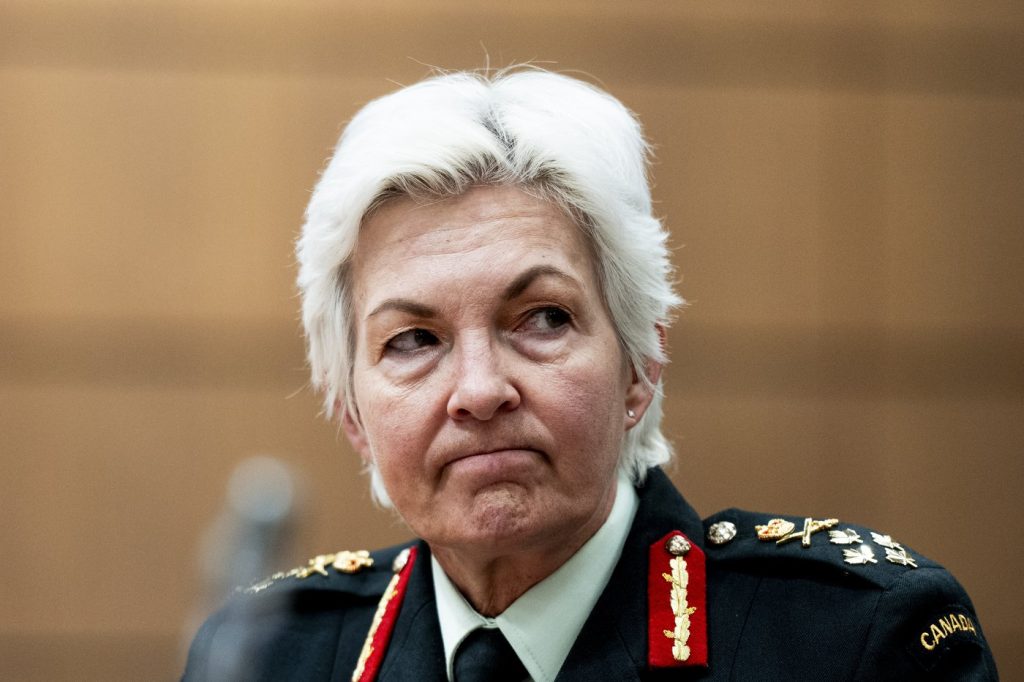
HALIFAX — The Chief of Defence Staff of the Canadian Armed Forces, General Jennie Carignan, announced that the military is receiving support from the federal Immigration Department to enhance its recruitment of highly skilled foreign military professionals amid ongoing personnel shortages. The Canadian Armed Forces is particularly looking to fill specialized roles, including pilots experienced in flying the F-35 fighter jets that Canada is in the process of acquiring from the United States.
During a media briefing in Halifax, Carignan provided an example of a fighter pilot from the Netherlands who is interested in relocating to Canada. She explained that the Immigration Department would now assist in spotlighting individuals with specific skills that the military is seeking. “We are going to be looking for F-35 pilots,” she emphasized, highlighting the collaboration between the military and immigration authorities to attract sought-after professionals.
Carignan further discussed the military’s urgent requirement for maritime technicians, especially as the Royal Canadian Navy prepares to expand its fleet with new river-class destroyers. The military is particularly keen on recruiting technicians from NATO member countries or other nations within the Five Eyes intelligence-sharing alliance, which includes Australia, New Zealand, the United Kingdom, and the United States. She noted, “If you are a maritime technician operating somewhere… your file becomes very attractive as you’re planning to move to Canada.”
The Chief of Defence Staff also mentioned the necessity of recruiting individuals proficient in advanced military technologies. This includes expertise in long-range precision weapons for the army, new drones for the navy and air force, as well as capabilities in cyber-warfare and space operations. These efforts come as the Canadian military looks to enhance its operational effectiveness through modern technologies.
Charlotte Duval-Lantoine, a fellow at the Canadian Global Affairs Institute in Ottawa, offered insights into the military’s recruitment challenges. She indicated that while there is a steady influx of young recruits, the military struggles with retention, particularly after the long training processes required for roles such as doctors and pilots, which may extend over four to six years. Duval-Lantoine acknowledged that while collaboration with the Immigration Department is a positive step, it is unlikely to cover all the military’s recruiting challenges comprehensively.
Furthermore, Duval-Lantoine suggested that the military’s recruitment strategy may also target American personnel who are disillusioned with recent U.S. policies perceived as hostile to female, racialized, and transgender service members. She pointed out parallels with Canada’s attempts to attract American academics dissatisfied with the political climate under former President Donald Trump, noting the potential for similar motivations among military personnel.
Recent developments include Immigration Minister Lena Diab's announcement of three new permanent residency streams within Canada’s express entry program, specifically accommodating military roles among other professions. Additionally, a new stream for foreign military applicants who have been recruited by the Canadian Armed Forces as doctors, nurses, and pilots is also being introduced. Diab stated that these measures aim to bolster the government’s $6.6 billion defense industrial strategy, which was revealed recently.
This initiative reflects the Canadian Armed Forces’ commitment to addressing its personnel shortages through innovative recruitment strategies, while also fostering international collaboration in defense capabilities.