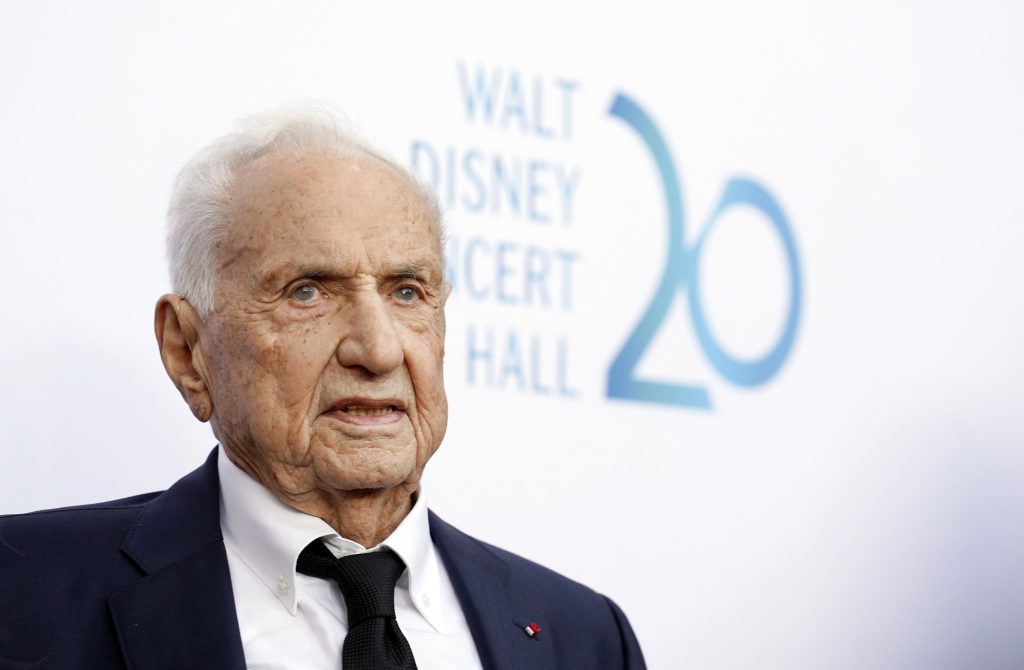
Frank Gehry, the renowned Canadian-born architect synonymous with bold and unconventional design, has passed away at the age of 96. His death was confirmed by Meaghan Lloyd, chief of staff at Gehry Partners, LLP, who shared that he succumbed to a brief illness at his home in Santa Monica, California, on Friday morning.
Gehry was celebrated for transforming cultural landmarks around the globe, with iconic structures including the Art Gallery of Ontario in Toronto, the Guggenheim Museum Bilbao in Spain, the Walt Disney Concert Hall in Los Angeles, and Facebook's headquarters in Menlo Park, California. His innovative approach to architectural design led to works that generate widespread recognition, a rarity for architects. Gehry's influence reached popular culture, as he was even featured as a cartoon character in an episode of "The Simpsons."
Throughout his career, Gehry openly faced criticism regarding his distinct design philosophy. While introducing a concept for a series of condominium buildings in Toronto in 2012, he acknowledged the backlash from locals, who were initially displeased with the models. Among the trio of structures, two residential skyscrapers will stand prominently in the city’s entertainment district. “In Bilbao, Spain they wanted to shoot me when they saw the Guggenheim design, and now they get $500 million a year in revenue to the city,” he remarked regarding the challenges he faced from critics.
Born Frank Owen Goldberg on February 28, 1929, to Polish immigrant parents in Toronto, Gehry's family life significantly shaped his career in architecture. His grandmother, Leah, played a crucial role in nurturing his creativity, encouraging him to build imaginary structures using wood scraps scattered across their kitchen floor. Gehry described these experiences as “the most fun I ever had in my life,” realizing that it was a “license to play.”
Following his family's move to Los Angeles in 1947, Gehry became a U.S. citizen in 1950. His early life included juggling various jobs, such as truck driving, while pursuing his passion for architecture by attending night school for sculpture classes. He eventually earned a degree from the University of Southern California. In the mid-1950s, Gehry changed his surname from Goldberg, following his first wife’s concerns about potential antisemitism impacting their children; a decision he later expressed regret over.
Gehry launched his career in 1962 when he opened his architectural practice in Los Angeles. His early projects, like the Danziger Studio and Residence, adhered to modernist styles characterized by geometric simplicity. By 1967, he had gained significant acclaim in the architectural field with the design of the Merriweather Post Pavilion in Columbia, Maryland, which garnered praise as “an unqualified architectural and acoustical success” from The New York Times.
As his career progressed, Gehry's designs began to gain international acclaim, particularly in the 1990s. Landmark projects, including the Frederick Weisman Museum of Art, the Guggenheim Bilbao, and the El Peix fish structure built for the 1992 Summer Olympics in Barcelona, showcased his innovative, playful approach. In 1989, Gehry received the prestigious Pritzker Architecture Prize, with juror Ada Louise Huxtable highlighting how his works evoke delight and transform the ordinary into the extraordinary through imagination.
Among Gehry's extensive portfolio are several other noteworthy projects, such as the renovation of the Art Gallery of Ontario, the Gehry Tower in Hannover, Germany, and the Louis Vuitton Foundation for Creation in Paris. Motivated by his grandmother’s encouragement of creative exploration, Gehry actively contributed to arts education through his involvement in Turnaround Arts, a program aiming to enhance academic performance in underprivileged schools through artistic engagement.
In addition to his architectural innovations, Gehry received the Presidential Medal of Freedom in 2016 from former U.S. President Barack Obama, who noted Gehry's impact on arts education and philanthropy. In a powerful tribute, Obama remarked that Gehry "upended" traditional concepts of architecture, asserting that buildings, though physical and anchored, can inspire and elevate the human spirit, much like art.