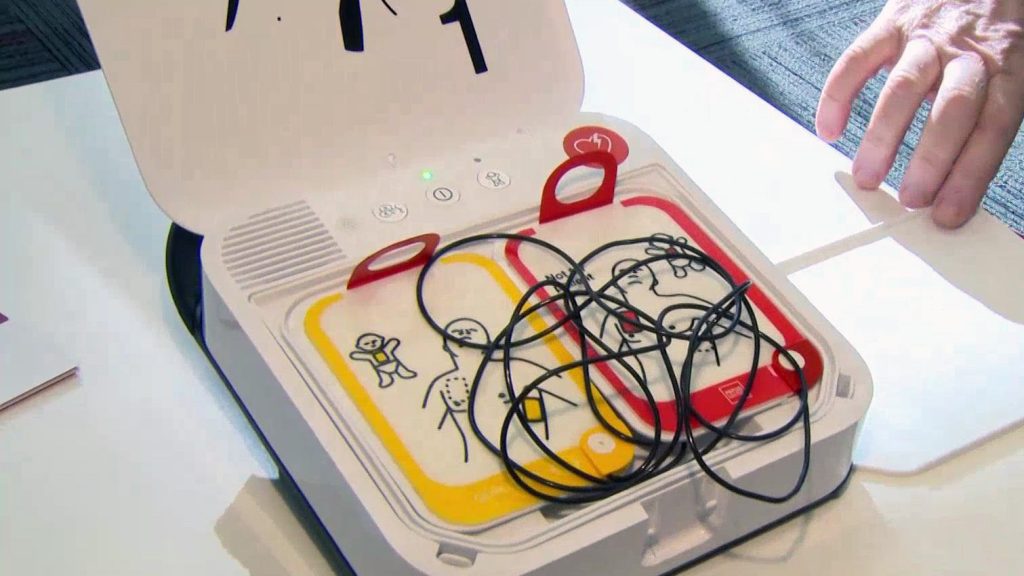
Automated External Defibrillators (AEDs) have become recognized as essential, user-friendly devices that can be operated by anyone and have significantly contributed to saving lives in emergencies. Typically found in public spaces such as schools, shopping malls, and subway stations, AEDs serve a crucial role in the chain of survival for individuals experiencing cardiac arrest.
According to health experts, the combination of using an AED and performing Cardiopulmonary Resuscitation (CPR) within the first few minutes of cardiac arrest can more than double a person’s chances of survival. Roberta Scott, a representative from the AED Foundation Ontario, emphasizes the importance of acting promptly: “So if someone collapses, you’re going to call 911, you’re going to get the AED, start CPR and put that machine on. And that machine will shock someone in a certain type of rhythm, and it can resuscitate them after a sudden cardiac arrest.”
Despite their lifesaving potential, AEDs are notably absent in many of Toronto's high-rise buildings, a concern that experts have flagged due to its serious implications on survival rates. A 2016 study published in the Canadian Medical Association Journal revealed alarming statistics regarding survival rates based on building height. The study found that for residents living below the third floor, the survival rate stands at approximately 4.2%. Conversely, for those on the third floor and above, the survival rate drops to 2.6%, and for individuals situated above the 16th floor, it plummets to a mere 0.9%. The study highlights that for residents above the 25th floor, there are typically no survivors.
Dr. Lesley James, the Director of Health Policy and Systems with the Heart and Stroke Foundation of Ontario, noted, “So much of our population is living in these high-rise buildings, and as you go higher up, the chances of survival decrease, unfortunately.” Contributing factors to this drop in survival rates include extended travel times for emergency response teams, locked lobby doors, and delays caused by waiting for elevators.
Toronto paramedics typically have a response time of about eight minutes, which can be detrimental in a high-rise setting where accessing a patient on a higher floor may significantly delay urgent care. Recognizing this issue, the Toronto Planning and Housing Committee has voted to explore the possibility of mandating AEDs in high-rise buildings. Currently, it is up to landlords or condo boards to decide whether to equip residential buildings with AED kits, which can incur costs of around $2,200 each.
Dr. James emphasizes the critical need for awareness among bystanders and residents of high-rise buildings about the location and accessibility of AEDs: “It’s really important that bystanders, people living in these high-rise buildings, know where the nearest AED is, it’s accessible, it’s not blocked up somewhere or in the lobby of a building, 25 floors down.”
At present, Ontario law mandates that AEDs be available at construction sites. To improve accessibility, city staff in Toronto are set to conduct an assessment, with a report anticipated by summer 2026. Furthermore, the AED Foundation of Ontario is working towards establishing a provincial registry that will inform 911 dispatchers of AED locations, thus enabling quicker access to these lifesaving devices. This registry is projected to be implemented in 2026.