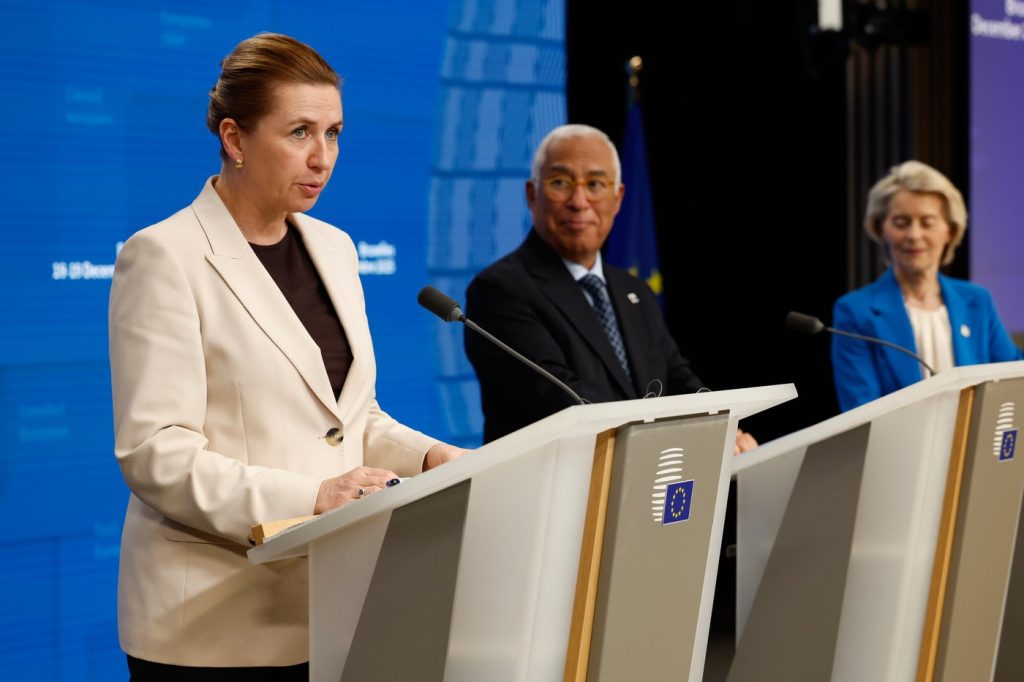
On Friday, European Union leaders reached an agreement to provide a substantial interest-free loan to Ukraine aimed at addressing its military and economic needs over the next two years. However, they could not reconcile differences with Belgium that would have permitted the use of frozen Russian assets to fund this initiative.
After nearly four years of conflict, the International Monetary Fund estimates that Ukraine will require €137 billion ($161 billion) in funding for the years 2026 and 2027. The Ukrainian government is on the brink of bankruptcy and urgently needs these funds by spring.
The initial plan involved utilizing a portion of the €210 billion ($246 billion) in Russian assets currently frozen in Europe, primarily held in Belgium. EU leaders negotiated late into Thursday night to assure Belgium that it would be shielded from any Russian retaliation should it agree to the loan plan. Ultimately, however, the talks stalled, leading leaders to decide instead to raise the required funds through capital markets.
“We have a deal. Decision to provide €90 billion ($106 billion) of support to Ukraine for 2026-27 approved. We committed, we delivered,” EU Council President António Costa stated in a social media post.
Not all EU member states supported the loan package. Hungary, Slovakia, and the Czech Republic opposed the initiative but ultimately refrained from blocking it in exchange for assurances regarding protection from any financial risks associated with the package.
Hungarian Prime Minister Viktor Orbán, who is known as Russian President Vladimir Putin’s closest ally in Europe and portrays himself as a peacemaker, remarked, “I would not like a European Union in war. To give money means war.” Orbán also characterized the rejected proposal to use frozen Russian assets as a “dead end.”
French President Emmanuel Macron hailed the agreement as a significant step forward. He commented that borrowing on capital markets is “the most realistic and practical way” to finance Ukraine’s war efforts.
German Chancellor Friedrich Merz also praised the decision, stating, “The financial package for Ukraine has been finalized,” and emphasized that Ukraine is granted a zero-interest loan. He indicated that the funds are adequate to address both military and budgetary needs for the upcoming two years and expressed that the frozen assets would remain blocked until Russia pays war reparations to Ukraine, which Ukrainian President Volodymyr Zelenskyy estimates would exceed €600 billion ($700 billion).
Merz added, “If Russia does not pay reparations, we will make use of Russian immobilized assets to repay this loan fully in accordance with international law.” Zelenskyy had traveled to Brussels for a summit coinciding with significant protests by farmers regarding a proposed trade agreement with five South American nations, where he urged for a swift decision to maintain Ukraine's stability as the new year approaches.
Polish Prime Minister Donald Tusk warned early Thursday that failing to assist Ukraine would lead to dire consequences: “It will be a case of sending either money today or blood tomorrow.”
The proposal to utilize frozen Russian assets encountered resistance when Belgian Prime Minister Bart De Wever called the scheme legally dubious, cautioning that it could jeopardize the operations of Euroclear, a Brussels-based financial clearinghouse where €193 billion ($226 billion) in frozen assets are held. Belgium experienced concern the previous Friday when Russia’s Central Bank initiated legal action against Euroclear to prevent any loans from being issued to Ukraine using its frozen funds.
De Wever stated after the meeting, “For me, the reparations loan was not a good idea. There are many questions that were left unanswered, and if you start pulling at the loose ends, the whole thing collapses.” He emphasized that they avoided creating a precedent that could threaten legal stability globally and reinforced the principle that Europe must uphold the law, even under pressure. Despite the challenges, Costa noted that the EU retains the right to use immobilized assets to repay the impending loan.