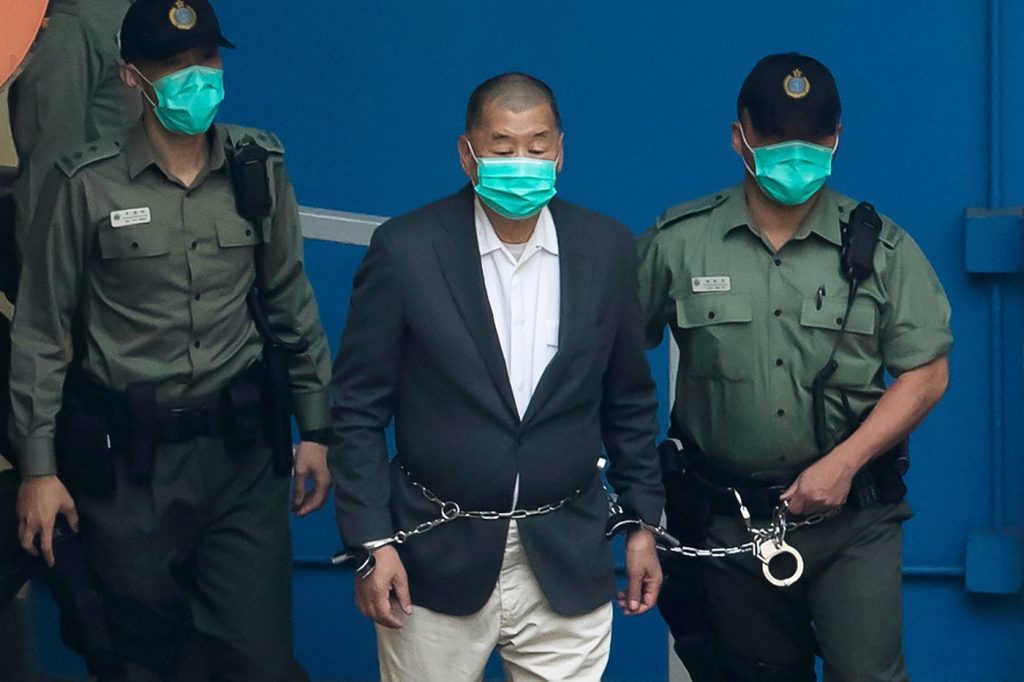
HONG KONG (AP) — Jimmy Lai, the pro-democracy media tycoon and prominent critic of Beijing, was sentenced to 20 years in prison on charges of conspiring with foreign forces to endanger national security and conspiracy to publish seditious articles. At 78 years old, Lai's sentence under the China-imposed national security law reflects one of the most significant legal actions taken against dissenters in Hong Kong. Three government-approved judges ruled in December that he was guilty, opting against a life sentence largely due to his age, although the current term could see him incarcerated for the remainder of his life.
Lai's trial has raised serious concerns about the state of press freedom in Hong Kong, which was once known for its independent media landscape. The government argues that the case has no implications for press freedom, asserting that Lai and his associates used journalism as a guise to engage in activities harmful to Hong Kong and China. The former media mogul was arrested in August 2020 under the contentious national security law, part of a broader crackdown on pro-democracy activists in the region.
During a lengthy 156-day trial, prosecutors accused Lai of colluding with six former employees of his newspaper, Apple Daily, two activists, and others to solicit foreign sanctions and interference against China. Lai maintained his innocence throughout, claiming he had not sought foreign intervention after the national security law came into effect. The judges characterized him as the mastermind behind a conspiracy aimed at destabilizing the Chinese Communist Party, pointing to his repeated calls to the United States for assistance in undermining the Chinese government.
On the day of his sentencing, which took place on a Monday morning, Lai was supported by family members and friends, including Cardinal Joseph Zen, a prominent Roman Catholic figure in Hong Kong. Lai's daughter, Claire, expressed her hope for her father's release, emphasizing their religious faith and determination to continue advocating for his freedom.
The implications of Lai's conviction extend beyond Hong Kong, as it has drawn international criticism and could strain diplomatic relations between China and foreign governments. Critics, including U.S. President Donald Trump and U.K. Prime Minister Keir Starmer, have publicly called for Lai's release, highlighting his British citizenship. Lai's health has reportedly deteriorated during his imprisonment, raising concerns regarding his well-being in solitary confinement.
In addition to Lai's sentence, his co-defendants, who have pleaded guilty, may receive reduced sentences based on their cooperation with the prosecution. These include former staff members of Apple Daily, such as publisher Cheung Kim-hung and editor-in-chief Ryan Law. The legal repercussions of this case signal a troubling shift for journalism in Hong Kong, where engaging in political discourse or seeking international support could be misconstrued as collusion with foreign antagonistic forces.
Lai founded Apple Daily in 1995, just before Hong Kong was handed back to China after over a century as a British territory. The publication gained a reputation for bold and sometimes sensational reporting that resonated with pro-democracy readers, especially during the 2019 anti-government protests. However, since the implementation of the national security law, Hong Kong's press freedom has seen a significant decline, reflected in its plummeting ranking in global press freedom indices.
The city has fallen to 148th out of 180 territories according to a media freedom organization, a significant drop from its rank of 18th in 2002. Lai's case, and the subsequent crackdown on media outlets, mark a critical moment in Hong Kong's ongoing struggle for democratic freedoms and highlight the challenges faced by journalists in the region.