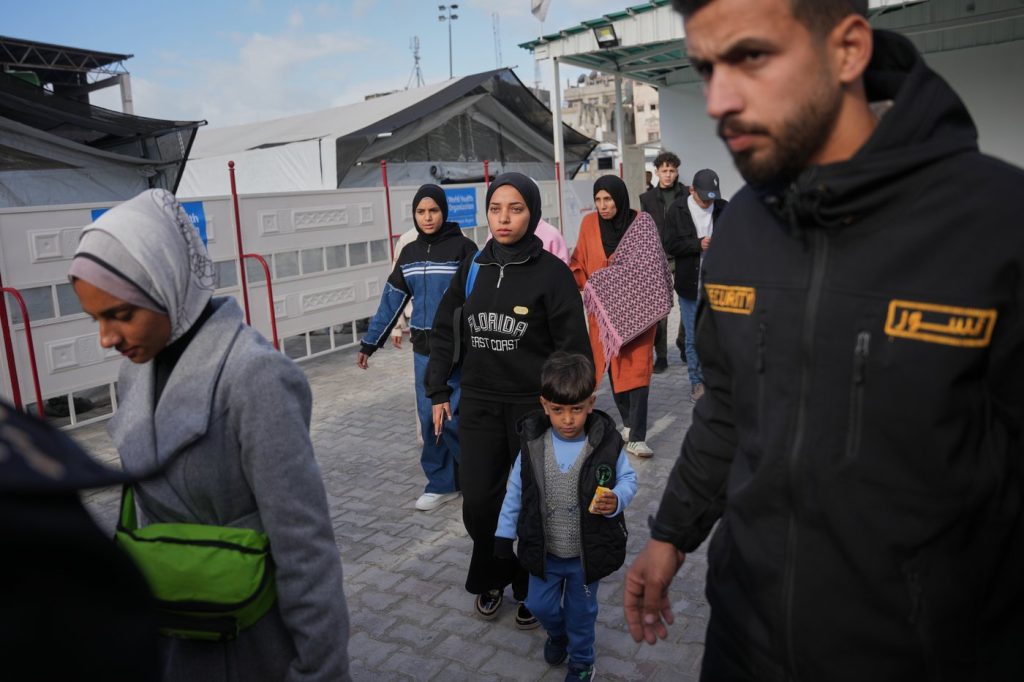
CAIRO (AP) – A limited number of Palestinians traveled between Gaza and Egypt on Sunday as the Rafah crossing reopened after a two-day closure, as reported by Egyptian state media. The Rafah border crossing had opened for the first time since mid-2024 last week, which was one of the primary conditions for the U.S.-backed ceasefire between Israel and Hamas. The crossing was previously closed on Friday and Saturday due to operational confusion.
The Palestinian Red Crescent confirmed that 17 medical evacuees, accompanied by 27 companions, began crossing into Egypt. A similar number of individuals is expected to be allowed to travel back into Gaza, although Israel had not immediately confirmed this.
In parallel, Israeli Prime Minister Benjamin Netanyahu is slated to meet with U.S. President Donald Trump in Washington on Wednesday. While various topics are expected to be discussed, the primary focus will likely be on Iran, according to an announcement from Netanyahu’s office.
Over the initial four days of the crossing's operation, U.N. data indicated that merely 36 Palestinians requiring medical care were permitted to leave for Egypt, alongside 62 companions. The reopening of Rafah followed Israel's retrieval of the last hostage in Gaza, alongside visits from U.S. officials aimed at applying diplomatic pressure.
Palestinian officials report that nearly 20,000 individuals in Gaza are seeking to leave for medical treatment unavailable in the war-affected area. On Sunday, a group of patients gathered at a Red Crescent hospital in Khan Younis before heading to the crossing for medical assistance abroad, as stated by family members who spoke to The Associated Press. One patient, Amjad Abu Jedian, was scheduled to cross for treatment during the first day the crossing reopened but found that only five patients were permitted to travel. His mother, Raja Abu Jedian, expressed her relief when their family received notification about his travel on Saturday.
"We want them to take care of the patients (during their evacuation)," she stated, adding a plea for the Israeli military not to burden the medical evacuees.
On the same day, a group of Palestinians arrived at the Egyptian side of the Rafah crossing to return to Gaza, as reported by Egypt's state-run Al-Qahera News satellite television network. Those returning to Gaza in the early days of the crossing’s operation described experiencing lengthy delays and invasive searches by both Israeli authorities and the Israeli-backed Palestinian armed group known as Abu Shabab. Israel has denied any allegations of mistreatment.
The border crossing, crucial for Gaza, was the only crossing not controlled by Israel prior to the war, although Israel seized control of the Palestinian side in May 2024. Even before the current conflict, traffic through the Rafah crossing was heavily restricted. Currently negotiated restrictions stipulate that only 50 people can return to Gaza daily alongside 50 medical patients permitted to leave, each with two companions. However, far fewer individuals have crossed thus far.
In recent discussions, senior Hamas official Khaled Mashaal expressed that the militant group is open to negotiating the future of its weapons. This dialogue is part of a "balanced approach" that also encompasses the reconstruction of Gaza and ensuring the protection of the enclave from Israel. These matters are integral to the ceasefire’s second phase. Mashaal indicated that Hamas has presented multiple options, including a long-term truce, as part of ongoing negotiations with Egyptian, Qatari, and Turkish mediators.
In further statements, Mashaal emphasized that Hamas is prepared to agree to a set of "guarantees," citing a potential 10-year disarmament period and the establishment of an international peacekeeping force on Gaza's borders to sustain peace and mitigate any violent interactions between militants and Israel. Conversely, Israel has repeatedly asserted its demands for the complete disarmament and dismantling of Hamas, both its military and civil infrastructure.
Additionally, Mashaal accused Israel of financing and equipping militias like the Abu Shabab group, which operates in areas under Israeli military control in Gaza, to foster chaos. When questioned about Hamas' stance on the newly formed Board of Peace, a Trump-led initiative aimed at raising funds for Gaza's reconstruction, he refrained from providing a specific answer, insisting that the group would not tolerate "foreign intervention" in Palestinian affairs.
He declared, "Gaza is for the people of Gaza. Palestinians are for the people of Palestine. We will not accept foreign rule."
___
Find more of AP’s coverage at https://apnews.com/hub/israel-hamas-war