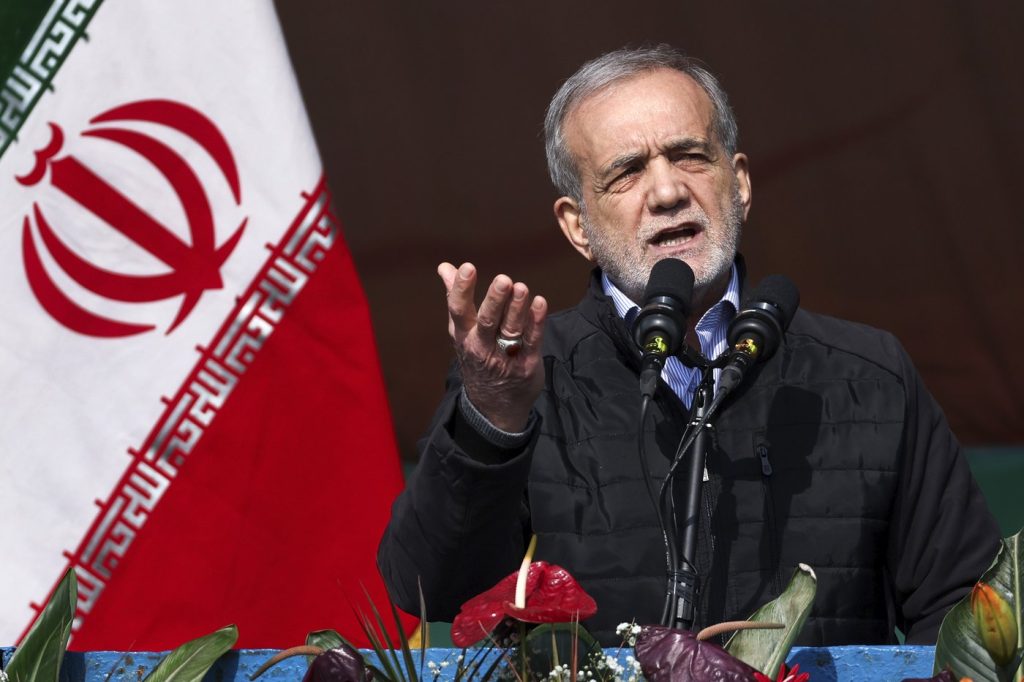
DUBAI, United Arab Emirates (AP) – In a significant political development, Iran's President has publicly announced that the newly established leadership council has officially commenced its operations following the recent death of the country's supreme leader. This announcement marks a pivotal moment in Iran's political landscape, raising questions about the future direction of the nation amid an atmosphere of uncertainty and potential shifts in power dynamics.
The supreme leader's passing has left a power vacuum, prompting the need for a governing body to provide stability and direction. The president indicated that the leadership council, formed in the wake of this critical event, is tasked with overseeing the transition and ensuring that governance continues smoothly. The details regarding the composition of this council and the scope of its powers have yet to be fully disclosed, but it is expected to play a crucial role in guiding Iran through this transitional period.
President's remarks reflect a sense of urgency and responsibility on the part of the government to maintain order and prevent any potential unrest that could arise from the leadership change. The leadership council is anticipated to address both domestic and international challenges, with a focus on maintaining Iran's political integrity and its position on the world stage. Analysts are closely watching the developments as they could have significant implications for Iran's foreign policy and its relationships with other nations, particularly Western powers.
As discussions surrounding the council’s inception gain traction, there are also concerns about how this leadership transition will impact the Iranian populace. Many citizens are apprehensive about potential changes in governance and how these changes may affect their daily lives. The situation calls for transparency and effective communication from the leadership to reassure the public during this time of uncertainty.
Furthermore, the council's formation raises critical questions about succession and the future of power in Iran. Traditionally, the supreme leader holds immense authority, and the transfer of power to a new leadership framework introduces complexities regarding decision-making and policy implementation. Observers are keen to see how the new council will navigate these challenges and what strategies they will employ to maintain national unity and uphold the Islamic Republic's ideological foundations.
In light of these recent events, it remains to be seen how both the domestic and international communities respond to the establishment of the leadership council. The world is watching to gauge if this new governing body can effectively stabilize Iran or whether it may lead to further complications in an already strained geopolitical landscape.
As this situation continues to evolve, experts warn that caution should be exercised when making predictions about Iran's political future. The interplay between various factions within Iran, along with external pressures, will inevitably shape the trajectory of the country's governance. The coming weeks and months are likely to be critical in determining the efficacy of the newly formed leadership council and its ability to steer Iran towards a stable and prosperous future.