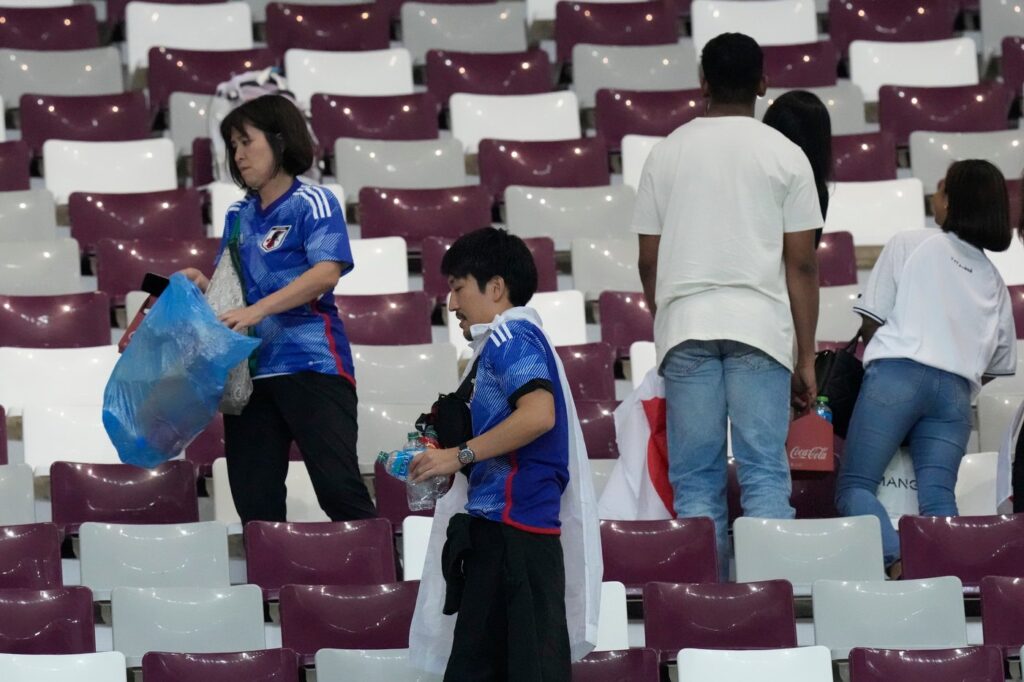
In the world of soccer, Japan is not only known for its competitive spirit but also for its unique tradition of cleanliness, particularly during the FIFA World Cup. This practice began during Japan's inaugural appearance in the tournament in France in 1998, where fans were seen actively cleaning stadiums after matches. This commendable behavior has continued every four years, most recently observed at the 2022 World Cup in Qatar, and is expected to be upheld during Japan's matches in June 2026, which will take place in Arlington, Texas, and Monterrey, Mexico.
The sight of Japanese fans diligently sweeping up and collecting trash after games stands in stark contrast to the experience of many non-Japanese spectators, who might be accustomed to leaving behind litter. During the 2018 World Cup in Russia, the behavior extended to the Japanese players as well; they famously tidied their dressing room following a game, leaving behind a thank-you note written in Russian. Similarly, notes of gratitude were left in multiple languages by fans at the 2022 World Cup.
The roots of this tradition lie deep within Japanese culture. From an early age, children in Japan are taught the importance of cleanliness in various settings, including classrooms and outdoor spaces. Koichi Nakano, a politics and history instructor at Sophia University, mentions that for Japanese sports fans, the habit of cleaning up post-event is a continuation of behaviors learned during their formative years in school.
A significant Japanese phrase encapsulates this ethos: "Tatsu tori ato wo nigosazu," which translates to "A bird leaves nothing behind." This phrase emphasizes the value of returning spaces to their original condition. Many elementary schools in Japan do not employ janitors, which means students take responsibility for keeping their surroundings clean. Additionally, the scarcity of trash bins in public areas encourages citizens to take their waste home, thereby maintaining cleaner public spaces and minimizing the potential for vermin.
Barbara Holthus, deputy director at the German Institute for Japanese Studies in Tokyo, notes that there is a distinct socialization process at play in Japan, contributing to this cultural norm. As a sociologist, she highlights the concept of "meiwaku," which signifies not causing discomfort or inconvenience to others. In densely populated regions like greater Tokyo, where nearly 35 million people reside, the necessity to coexist harmoniously becomes paramount.
In Japan, the communal approach often takes precedence over individual rights, contrasting with more Western perspectives that emphasize personal freedom. Holthus explains that in the West, some may operate under the assumption that public services will manage cleanliness in shared spaces, which is not typically the understanding in Japanese culture. The positive recognition and praise received by Japanese fans for their cleaning habits have further solidified this practice as a point of cultural pride.
This tradition extends beyond the World Cup. Instances of Japanese fans cleaning up after matches have been reported in other competitions, including the Under-20 World Cup in Chile. More recently, this behavior was observed when Japan faced England in an international friendly match at Wembley Stadium.
Toshi Yoshizawa, who coordinated the cleanup efforts in Chile, emphasized that this practice is ingrained as part of their cultural values: "We grew up with the teaching that we should leave a place cleaner than when we arrived." William Kelly, an anthropologist specializing in Japan, points out that the strong connection between soccer fandom and community responsibility likely traces back to the establishment of Japan’s professional football league over 30 years ago, which promoted community engagement and club loyalty in a manner distinct from baseball.
Thus, the tradition of cleaning up after soccer matches has evolved into a hallmark of Japanese cultural identity, reflecting broader societal values of cooperation, responsibility, and respect for communal spaces.