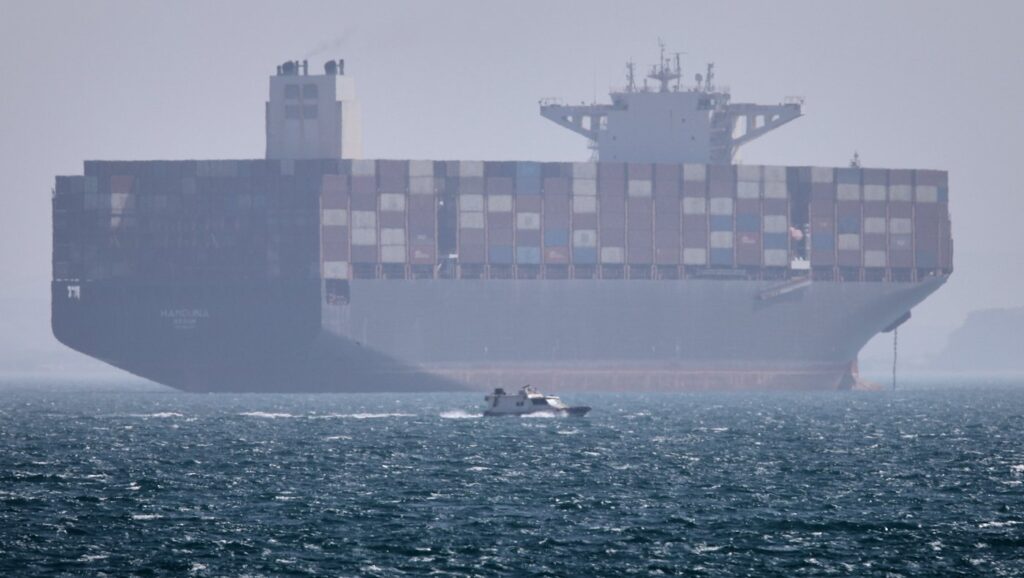
DUBAI, United Arab Emirates (AP) – On Monday, the U.S. military announced it had engaged Iranian forces and sank six small boats that were reportedly targeting civilian vessels in the strategically important Strait of Hormuz. This escalation comes as the United Arab Emirates (UAE), a crucial ally of the U.S., reported being attacked by Iran for the first time since a tenuous ceasefire was established in early April.
The U.S. military confirmed that two American-flagged merchant ships successfully passed through the strait as part of a renewed initiative to maintain safe navigation in the area. The UAE's Defense Ministry stated that its air defenses had intercepted 15 missiles and four drones launched by Iran. Additionally, the authorities in the eastern emirate of Fujairah reported that one drone attack caused a fire at a significant oil facility, injuring three Indian nationals. Meanwhile, the British military noted that two cargo vessels were ablaze off the UAE coast.
Iran did not explicitly acknowledge the attacks but Iran's Foreign Minister, Abbas Araghchi, used social media platform X to warn both the U.S. and the UAE to be cautious of being pulled back into conflict. In a vague assertion, an unnamed Iranian military official indicated that Tehran had “no plan” to target the UAE or its oil fields, attributing the incidents as a consequence of U.S. military actions designed to create an “illegal passage.” The official appeared to refer to President Donald Trump’s recent efforts to reopen the Strait of Hormuz.
The U.S. attempts to break Iran's control over the strait could alleviate global economic anxieties and diminish Iran's leverage in the region. However, these actions risk reigniting the hostilities that began following U.S. and Israeli attacks on Iran that led to its previous closure of the strait.
Shipping companies and insurers are likely to be cautious given Iran’s prior attacks on vessels and its threats to do so again. Iran maintains that the U.S.’s new initiative violates the fragile ceasefire that has persisted for more than three weeks. The effective closure of the strait, which lies between Iran and Oman, has resulted in rising global fuel prices and disturbed the worldwide economy.
The U.S.-led Joint Maritime Information Center advised vessels to navigate through Oman's waters while establishing an “enhanced security area.” U.S. Central Command’s Adm. Brad Cooper reported that American forces successfully opened a safe passage through the strait, free from Iranian threats, while asserting that all threats, including cruise missiles, drones, and small boats targeting civilian ships, were neutralized.
President Trump had previously warned that Iranian actions attempting to obstruct passage through the strait "will, unfortunately, have to be dealt with forcefully." He framed the initiative, termed “Project Freedom,” as a humanitarian mission intended to assist seafarers stranded on numerous vessels due to the ongoing conflict.
In light of the attacks, the UAE's Foreign Ministry condemned what it deemed “renewed treacherous Iranian aggression,” demanding an immediate cessation of hostilities. On the same day, four missile alerts were issued for UAE residents, marking the first such alerts since the ceasefire started nearly a month ago. Commercial flights headed for the UAE, which includes the global travel hubs of Dubai and Abu Dhabi, were halted mid-air in response to the missile threat.
While the extent of the damage in Fujairah is still unclear, the emirate serves as a critical hub for oil storage and has established pipelines to bypass the Strait of Hormuz for some oil shipments. Additionally, Omani authorities reported that a residential building near the strait was targeted, leading to injuries among foreign workers and damaging vehicles and nearby infrastructure. Iran's military has voiced warnings that any foreign military, specifically the U.S., intending to approach or enter the Strait of Hormuz will be met with aggression.
In a related incident, the South Korean government confirmed that a fire aboard a South Korean-operated vessel in the Strait of Hormuz was fully extinguished, with no injuries among the 24 crew members onboard. An explosion and resultant fire occurred on the Panama-flagged ship, impacting its engine and requiring prompt action to mitigate the situation.
The UAE has also accused Iran of drone strikes targeting a tanker linked with its state oil company while navigating the strait, although details surrounding the incident have not been disclosed, and no injuries were reported. The disruption of the Strait of Hormuz has significant ramifications for countries in Europe and Asia that rely on oil and gas supplies, leading to increases in fuel prices.
The U.S. has warned shipping companies that they could face sanctions if they opt to pay Iran for transit through the Strait of Hormuz. Since April 13, the U.S. has implemented a naval blockade on Iranian ports, directing at least 49 commercial vessels to turn back and denying Iran essential oil revenue crucial for its struggling economy. U.S. officials are hopeful that the blockade will compel Iran to negotiate on its contested nuclear program and other long-standing issues.
As the situation continues to evolve, Iran has submitted a proposal for ending the war, which calls for the U.S. to lift sanctions, halt the blockade, withdraw military presence from the region, and cease all hostilities, including efforts by Israel in Lebanon. Although Iranian officials claim their proposal is independent of nuclear-related issues, U.S. officials remain skeptical regarding the potential for a deal.