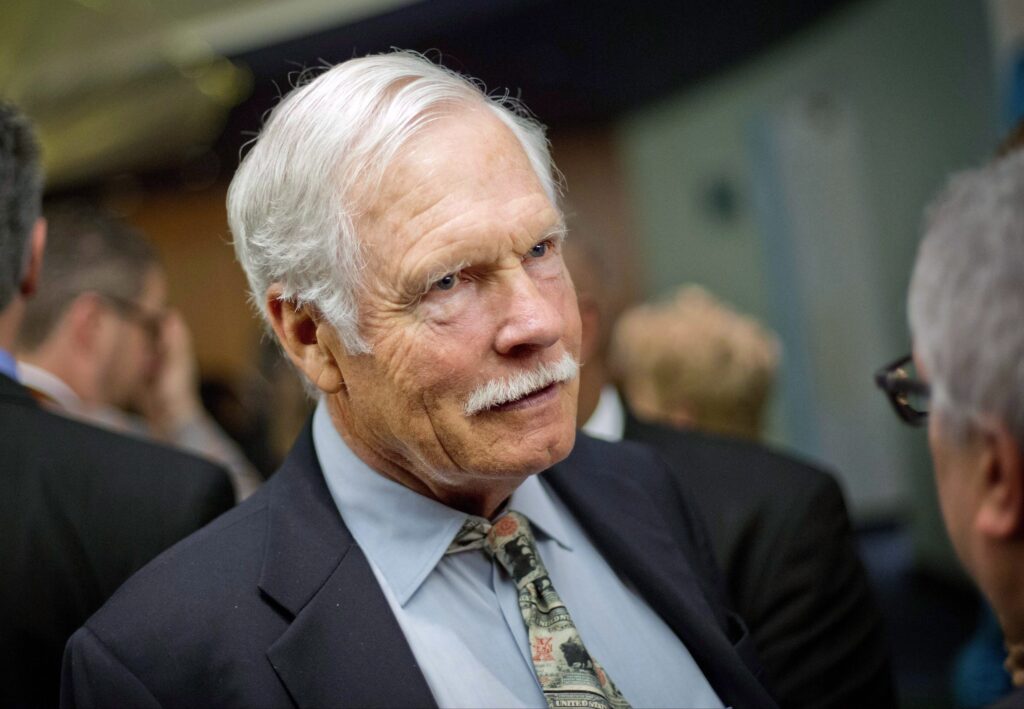
Ted Turner, a bold and outspoken television pioneer who revolutionized the news industry by founding CNN in 1980, has passed away at the age of 87. His death was reported by CNN on Wednesday, based on a news release from Turner Enterprises.
Turner was a multifaceted figure who owned significant portions of land in the American West, participated in yacht racing, and owned professional sports teams in Atlanta. His philanthropic efforts were notable, especially his extraordinary donation of $1 billion to United Nations charities. He had a colorful personal life, having been married three times, with his most famous marriage being to actress Jane Fonda. Over time, he earned nicknames such as "Captain Outrageous" and "The Mouth of the South."
Despite his larger-than-life persona, Turner faced health challenges in his later years due to Lewy Body Dementia. Having stepped away from the television industry, he shifted his focus towards philanthropy and managing his vast properties, which included the largest bison herd in the United States, spanning more than two million acres.
Turner’s ambitious character often overshadowed a keen business sense. By the time he sold Turner Broadcasting System to Time Warner Inc. in 1996 for $7.3 billion, he had transformed his late father’s billboard company into a global media powerhouse. This conglomerate included seven major cable networks, three professional sports teams, and two successful movie studios.
The cornerstone of Turner’s legacy was CNN, the first 24-hour all-news television network, which he launched in 1980. In an era when news was primarily delivered through scheduled broadcasts, the concept of a continuous news service was groundbreaking. Turner’s frustration with conventional television news – typically available only after traditional newscasts – fueled his desire to create CNN. He famously lived above the network's Atlanta office during its early, uncertain days.
Turner was aware that he needed to act fast to compete with established broadcast networks. “I was going to have to hit hard and move incredibly fast, and that’s what we did,” he reflected in a 2016 interview. He believed traditional networks lacked the vision necessary to adapt to the changing media landscape.
One of CNN’s pivotal moments came during the Gulf War in 1991, when many journalists vacated Baghdad out of fear for their safety. In contrast, CNN remained in the war zone, broadcasting startling visuals of the conflict as it unfolded, including anti-aircraft fire and reporters reacting to explosions. They gained immense credibility for their live coverage, significantly impacting public perception of news reporting.
Turner was initially promised a continuing role in CNN following the sale to Time Warner, but he gradually found himself sidelined, which he later regretted. “I made a mistake,” he admitted, reflecting on his decision to relinquish control of the company he built.
The same year, 1996, marked the inception of Fox News Channel, bringing a new dominant player into the cable news domain. The emergence of Fox News and its emphasis on political commentary reshaped the landscape of television journalism. Despite CNN establishing a strong global presence, particularly online, it still struggles with a waning appetite for traditional, straight news broadcasts.