BUDAPEST, Hungary (AP) – Hungary's incoming prime minister, Péter Magyar, officially took office on Saturday, marking the end of Viktor Orbán's autocratic 16-year rule. Magyar's political party, the center-right Tisza party, achieved a historic victory over Orbán's nationalist-populist Fidesz in last month’s elections, securing a greater share of votes and seats in Parliament than any party in Hungary's post-Communist history.
The Tisza party's win allowed it to obtain a two-thirds parliamentary majority, positioning Magyar to reverse several policies that had led many critics to label Orbán a far-right authoritarian. This shift is expected to not only address issues of alleged corruption within the previous administration but also recalibrate Hungary's political stance within the European Union, an organization that Orbán had often challenged by vetoing pivotal decisions.
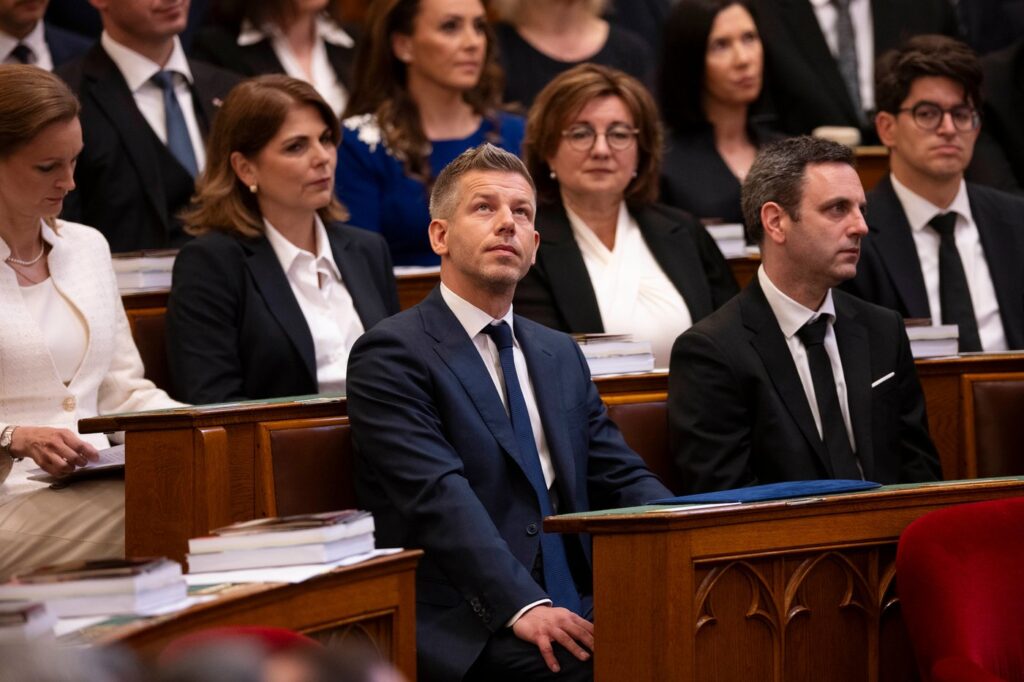
During the inauguration ceremony at the neo-Gothic Parliament building in Budapest, Magyar was accompanied by 140 representatives from his party, who together hold 141 of the 199 seats in the assembly. The Fidesz-KDNP coalition led by Orbán now controls only 52 seats, a significant decrease from the 135 they previously held, while the far-right Mi Hazánk (Our Homeland) party retains six seats. Notably, Orbán was absent from the Assembly for the first time since the establishment of Hungary's post-Communist government in 1990.
A total of 199 newly elected representatives took their oaths of office around 11 a.m. local time, with the new national assembly comprising 54 women lawmakers, predominantly from the Tisza party, representing the largest percentage of female representation in the country’s history.
Péter Magyar, a 45-year-old lawyer and founding member of Tisza, has pledged to combat corruption, claiming it has deprived Hungarians of economic opportunities that they deserve. To commemorate his inauguration and the conclusion of Orbán’s era, Magyar has called for an all-day "regime-change" celebration outside the Parliament, prompting several thousand citizens to gather in support as he prepares to take his oath at approximately 3 p.m. local time.
In terms of foreign policy, Magyar has stated his intention to mend Hungary's relations with the European Union, which had reached a critical low point under Orbán's leadership, especially as Orbán increasingly leaned towards Russia. One of Magyar's immediate goals includes unlocking approximately 17 billion euros (equivalent to roughly $20 billion) in EU funds that were suspended during Orbán's reign due to concerns related to rule-of-law violations and corruption. The reintegration of these funds is crucial for revitalizing Hungary’s stagnant economy.
To symbolize a shift in Hungary’s European relations, Tisza officials have announced plans to once again fly the EU flag on the Parliament's façade after it was taken down in 2014 under Orbán's government.
In a related festive spirit, Budapest’s liberal mayor, Gergely Karácsony, has organized a celebration by the Danube River later on Saturday to honor the fall of Orbán and the establishment of the new government. He expressed his gratitude towards the citizens who bravely spoke out against Orbán's administration over the years, highlighting the struggles faced by teachers, journalists, and civilians under the former regime. Karácsony emphasized the importance of remembering these "everyday heroes" as Hungary turns a new page in its political history.