CARACAS, Venezuela (AP) – U.S. President Donald Trump has shown renewed interest in the idea of transforming Venezuela into the 51st state of the United States, with this notion echoed in two recent statements made this week. The latest comment came via a post on Truth Social, featuring a map of Venezuela superimposed with the U.S. flag.
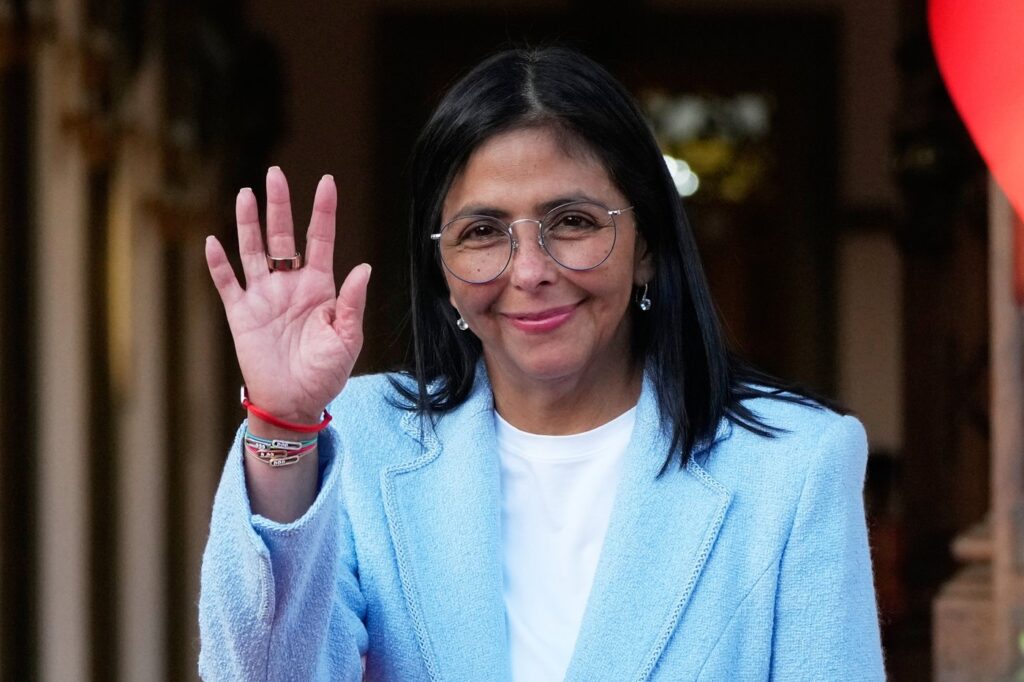
Historically, comments questioning Venezuela's sovereignty have drawn swift backlash from the country's senior officials, including President Nicolás Maduro. Demonstrations in Caracas, complete with chants of "Gringo go home," were organized as recently as January 3, following Maduro's capture by U.S. authorities. However, the Venezuelan government has adopted a notably quieter response this time, with Delcy Rodríguez, the acting President, providing a measured statement to journalists.
Rodríguez's remarks reflect her need to balance external and internal political considerations, especially in the wake of a January military operation by the U.S. in Caracas. The Trump administration is pursuing a phased approach to tackle Venezuela's ongoing crisis, compelling Rodríguez's political faction, Chavismo, to soften its long-standing anti-U.S. rhetoric. Christopher Sabatini, a senior fellow at Chatham House, indicated that this reaction is in line with the government's current strategy of self-preservation over ideological purity, advising that they would be wiser not to provoke the U.S. further.
On Monday, Rodríguez clarified that Venezuela does not intend to become a part of the United States, although her tone differed significantly from previous presidential addresses that typically condemned such U.S. comments. Despite Trump's suggestion of seriously considering the statehood move, Rodríguez stated, "We will continue to defend our integrity, our sovereignty, our independence, our history," emphasizing that Venezuela is a "free country" and not a colony.
Since Maduro was ousted, the U.S. administration has surprised many by working alongside Rodríguez rather than the country's political opposition. She has taken a leading role in collaborating with U.S. efforts while promoting Venezuela's oil-rich resources to international investors, opening the energy sector to private investment and international arbitration. Rodríguez has also made significant personnel changes within the government, replacing some of Maduro's closest allies.
Trump's administration has praised Rodríguez's initiatives, easing sanctions against her and acknowledging her as the "sole" head of state of Venezuela, following the U.S. decision to stop recognizing Maduro's leadership in 2019 due to the contentious nature of the electoral process that year. After Maduro and his wife, Cilia Flores, were apprehended and taken to New York to face drug trafficking charges, they both pleaded not guilty and are currently held in a Brooklyn detention center.
In Caracas, public reception of the government’s response to Trump’s comments varies, with some residents perceiving it as capitulation. However, others like college student Adonai Osoria view Rodríguez's cautious approach as sensible given the political landscape and acknowledge the pressure she faces. The government’s reaction contrasts markedly with past demonstrations, where pro-government factions openly displayed hostility toward the U.S. through the burning of flags and anti-American signs.
Among the government’s staunch supporters are paramilitary groups known as colectivos, who play a significant role in pro-government demonstrations. Local leader Jorge Navas labeled Trump’s remarks as "irresponsible acts of provocation" but commended Rodríguez for her diplomatic demeanor, affirming that while the Chavismo movement is currently cautious, it continues to resist external pressures strategically.