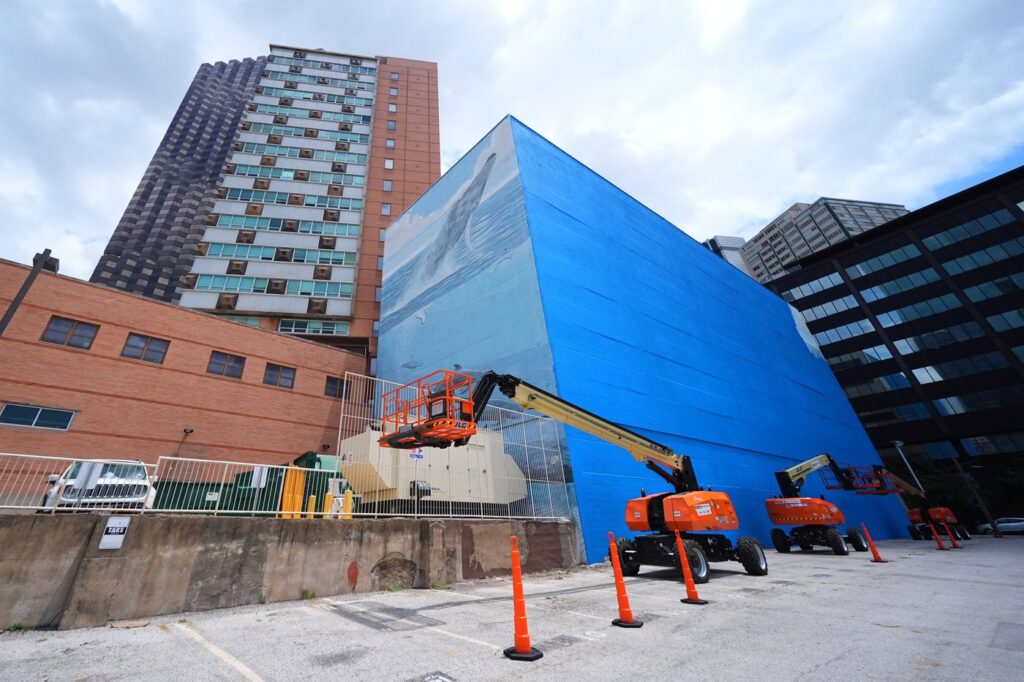
An artist named Wyland has initiated a substantial $25 million lawsuit against FIFA, soccer's international governing body, along with other parties, claiming they unlawfully painted over his large mural of life-sized swimming whales located on a downtown Dallas building. This mural, which spans approximately 17,000 square feet (or 1,580 square meters), had been a prominent feature of the city for nearly three decades before its recent erasure.
Wyland's mural, titled “Whaling Wall 82,” was completed in 1999 as part of his initiative to promote ocean conservation through public art. Recently, the mural was covered by construction workers in preparation for the upcoming World Cup matches to be held in Dallas. This action provoked backlash from local residents who cherished the mural and its significant message.
The local organizing committee for the World Cup stated that they plan to replace Wyland's mural with new artwork that embodies the "energy, unity, and global spirit" of the 2026 World Cup. They have indicated that a portion of Wyland's mural will be preserved, but the artist contends that he was neither consulted nor informed about the intersection of these plans with his work.
In his lawsuit filed on Monday in the U.S. District Court in Dallas, Wyland argues that the decision to paint over his mural infringes upon the Visual Artists Rights Act (VARA) of 1990, a federal law designed to protect artists from the destruction or alteration of public artworks without their permission. He asserts that the actions of the World Cup organizers, as well as the building's owner and management company, amounted to the "hasty and irrevocable destruction" of a civic landmark.
The lawsuit expresses disappointment in FIFA's involvement, suggesting that although they claimed to be fostering art development for the host city, they ended up defacing a respected cultural site. A FIFA spokesperson has stated that the federation is not involved in this matter and redirected inquiries to the local organizing committee. Meanwhile, the North Texas FWC Organizing Committee opted not to comment, even though they are not named defendants in the lawsuit.
Additionally, Slate Asset Management, which oversees the building, claimed that local World Cup organizers asked them in March to allow new art to be installed in place of Wyland's mural. The company emphasized that they are not receiving any compensation for this and were led to believe that Wyland had been informed of the changes.
The World Cup will take place across various cities, with Dallas hosting more matches than any other city involved in the event co-hosted by the United States, Canada, and Mexico. Specifically, nine matches are scheduled to occur at AT&T Stadium in Arlington, previously home to the Dallas Cowboys.
In response to the mural's destruction, an online petition advocating for the preservation of public art in Dallas has garnered over 2,600 signatures. Wyland's legal challenge references the Visual Artists Rights Act, citing it as a critical component of his claim. The act ensures the protection of artworks of "recognized stature," a claim supported by a notable precedent in which a judge awarded $6.7 million to graffiti artists whose work was whitewashed without consent in New York.
This ongoing legal battle highlights the tensions between urban development, artistic expression, and the rights of creators to safeguard their work, raising questions about the balance between progress and preservation in public spaces.