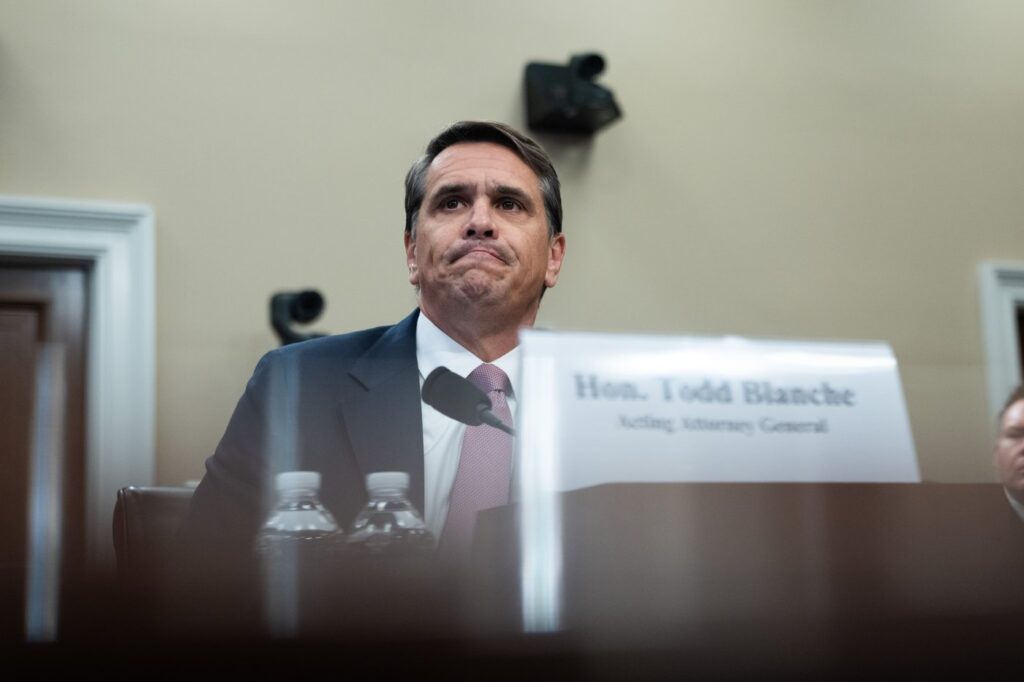
WASHINGTON (AP) – The Trump administration announced on Tuesday that it is abandoning plans for a $1.8 billion compensation fund aimed at helping allies of former President Donald Trump. This decision was revealed by Acting Attorney General Todd Blanche during a House hearing focused on the Justice Department's budget, following intense political backlash that could have hindered key elements of the White House's agenda.
“We are not moving forward with the fund, period,” Blanche stated when questioned by Representative Grace Meng, a New York Democrat. She asked for clarification, to which Blanche replied, “Correct.” This marked a significant turnaround for the administration, which had introduced the fund only two weeks prior in response to claims that its allies were being unfairly targeted by the criminal justice system.
The initiative faced swift criticism from both sides of the political spectrum, particularly due to concerns regarding oversight and the possibility of providing compensation to individuals involved in the violent January 6, 2021, riots at the U.S. Capitol. The fund had lost support from Senate Republicans, who effectively stalled legislation intended to fund Trump's immigration enforcement agencies after Democrats objected to linking the funding to the newly established compensation program.
The controversial fund, termed the “Anti-Weaponization Fund,” was created to address Trump's lawsuit against the Internal Revenue Service (IRS) regarding the leak of his tax returns. The Justice Department had claimed that the fund was a necessary measure against what it characterized as the weaponization of federal law enforcement under the Biden administration, during which Trump faced multiple criminal charges and investigations into his associates.
Despite the administration's assertion that anyone who felt unjustly persecuted could apply for funds, concerns grew when it was revealed that even those convicted for their actions during the Capitol riot might be eligible for compensation. The structure of the fund faced additional scrutiny due to the absence of appointed commissioners who would decide on payout applications, leaving the criteria for eligibility unclear.
During the hearing, Blanche maintained his belief in the fund's rationale, stating, "This Department of Justice, unfortunately, was weaponized against many, many Americans," while emphasizing the administration’s ongoing efforts to address these issues. However, he clarified that the only aspect of the plan being abandoned was the compensation fund itself, while maintaining that agreements with the IRS regarding Trump’s tax investigations remained unchanged.
On the same day, multiple indications suggested the administration's vacillation regarding the fund. A source reported that Trump was reconsidering the initiative, leading to the Justice Department’s compliance with a temporary court order from Virginia that had paused the fund's development.
Senate Majority Leader John Thune expressed hope that the White House would discontinue the program voluntarily. The hearing had originally aimed to discuss the Justice Department's budget, but soon shifted its focus to the contentious fund, drawing scathing remarks from lawmakers like Representative Rosa DeLauro, who characterized the initiative as "a corrupt payout scheme" benefiting Trump and his political allies.
Moreover, the fund faced legal challenges from several parties critical of Trump, including former prosecutors and law enforcement officers who defended the Capitol on January 6. A federal judge had enacted a temporary halt on the fund's formation, with a hearing scheduled to determine whether the pause should extend further.
The Justice Department’s struggles to advance the fund signals considerable challenges in navigating political tensions while addressing issues of perceived justice system inequities. As Blanche concluded his remarks, the dynamics surrounding the fund underscore the complexities inherent in balancing political agendas with public sentiment and legal scrutiny.