ANKARA, Turkey (AP) — On Tuesday, President Donald Trump asserted that the United States should have control over Greenland instead of its NATO ally Denmark. This claim sparked fresh tensions within Europe, coinciding with a NATO summit where billions in arms deals were being announced to pacify the unpredictable U.S. leader. Trump characterized the semi-autonomous island as "an important part" for the United States, repeating the mistaken assertion that it is encircled by Chinese and Russian naval vessels, and declared that he would not allow Greenland to be at risk.
During a meeting with Turkish President Recep Tayyip Erdogan in Ankara, Trump stated, "That should be controlled by the United States, not by Denmark." This rhetoric contrasts sharply with NATO's foundational principle, which affirms that the alliance's 32 members will collectively defend each other’s territory rather than seek to seize it. At the summit, European countries and NATO's Secretary-General Mark Rutte were already addressing Trump's persistent complaint regarding European allies’ insufficient military spending.
In a separate development, Trump announced the lifting of sanctions on Turkey, which were imposed after Ankara procured a Russian missile defense system, leading to Turkey's removal from the F-35 fighter jet program. This move was seen as a gesture towards strengthening relations with Erdogan. The Turkish purchase of the S-400 missile defense systems in 2019 had previously led to significant friction, despite the warm personal rapport between Trump and Erdogan that has existed since Trump’s first term.
Although legal challenges remain before Turkey can be reinstated into the U.S. F-35 program, the revocation of sanctions under the Countering America’s Adversaries Through Sanctions Act would facilitate the reinstatement process. Trump stated, "We’re going to be taking the sanctions off, OK?" He indicated that discussions regarding Turkey's potential purchase of F-35s were underway, noting, "Turkey's been, in many ways, much more loyal than other countries that we think would be loyal." Erdogan expressed optimism regarding the potential sale of F-35s, remarking that Trump consistently stands by his commitments.
The friendly display between Trump and Erdogan included a formal welcome ceremony where military officials appeared on horseback and jets flew overhead, producing red, white, and blue smoke. Concerns exist among U.S. lawmakers and international leaders regarding Turkey's acquisition of F-35s as long as it retains the Russian missile defense system. Even with sanctions lifted, U.S. law may restrict Turkey from purchasing the fighter jets while it owns the S-400s.
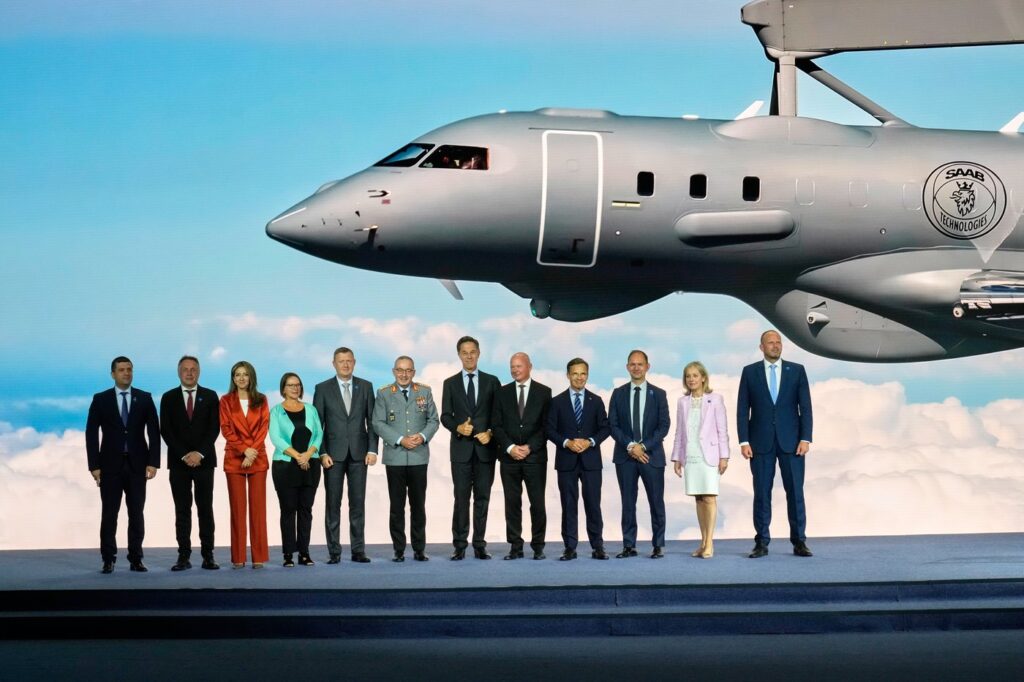
On another front, NATO exhibited military projects worth billions of dollars at the summit, an investment that Rutte described as "money well spent," clearly aimed at satisfying Trump’s demands. Though NATO does not possess weaponry as these belong to individual member nations, they showcased plans to replace aging AWACS early-warning radar surveillance aircraft with up to 10 new GlobalEye surveillance aircraft, a deal announced by Swedish Prime Minister Ulf Kristersson.
Moreover, a collective effort involving 15 nations was announced to procure air-to-air refueling and transport aircraft from Airbus, along with a collaborative initiative to acquire new Triton surveillance drones. Rutte previously hinted at announcing tens of billions in new defense contracts, although specifics were not disclosed during the summit.
Ukrainian President Volodymyr Zelenskyy made a strong case for Ukraine's inclusion in NATO, highlighting his country's seasoned military which could enhance NATO’s defensive capabilities. He pointed out Ukraine's ability to strike deeply into Russian territory and remarked on the significant toll, noting an average of 30,000 Russian troops eliminated every month amidst the ongoing conflict. Zelenskyy is expected to meet with Trump in Ankara shortly, emphasizing Ukraine's reluctant but necessary engagement in the war with Russia.
As fears rise among some European nations about a possible hybrid assault from Russia, which may combine traditional military tactics with cyberattacks, a senior NATO official maintained that the alliance has been effective in deterring any potential threats to member countries, notwithstanding the increasingly provocative actions taken by Russia.