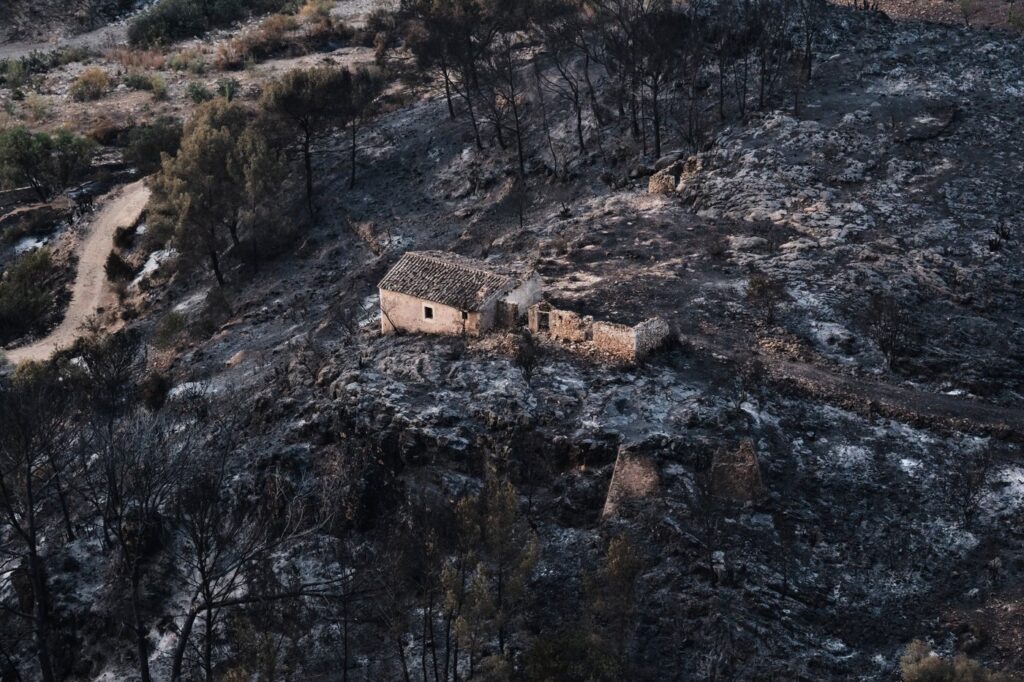
On Saturday, in Bedar, Spain, hundreds of firefighters, supported by helicopters and fixed-wing aircraft, struggled to contain one of the country’s deadliest wildfires, which erupted earlier in the week and has claimed at least 12 lives. The fires have also impacted parts of France, coinciding with Western Europe experiencing its third heat wave within six weeks. The European Union's Copernicus Climate Change Service indicates that Europe is warming at a rate twice as fast as the global average since the 1980s.
In Andalusia, Spain, favorable weather conditions, including light winds and high humidity, have aided firefighting efforts. However, the size of the fire poses significant challenges, with Antonio Sanz, the region’s emergency services head, stating that around 66 square kilometers (25 square miles) of forest and farmland have been scorched—an area comparable to that of Manhattan. Fire crews executed controlled burns overnight to help secure the perimeter of the blaze, which ignited late Thursday in a semi-arid region near the Sierra de Los Filabres mountains in Almería province.
Expectations for continued favorable weather conditions into Sunday may aid in combating the wildfire, according to Spain's EFE news agency. Justice Minister Félix Bolaños announced that nearly all homes along the fire's perimeter remained undamaged. Most of the victims are believed to be foreign nationals who disregarded shelter-in-place orders; seven of them died after leaving their vehicles. Four victims are suspected to be British nationals based on the right-side placement of the steering wheel in their burned car, prompting regional authorities to conduct autopsies and collect DNA samples for identification.
In response to the growing crisis, Spain's Foreign Minister José Manuel Albares has engaged in discussions with his counterparts from the United Kingdom, Belgium, Canada, and the Netherlands regarding the wildfires. Notably, Almería has one of the largest communities of foreign nationals in Andalusia. The authorities have proactively evacuated 1,448 individuals from approximately 11 areas at risk from the fire.
Among those affected, Jeffrey Kember and his wife, Christine, recounted their harrowing escape from their Los Pinos farmhouse as sirens announced the impending danger. Kember described driving through flames while trying to assist a neighbor, sharing a surreal moment when he emerged from the blaze into bright sunshine with his wife at an evacuation center later. Authorities have since arrested two individuals for violating evacuation orders and re-entering high-risk zones, continuing their search for additional victims in the Bedar area.
Spain is no stranger to extreme heat, with the country experiencing temperatures exceeding 40 degrees Celsius (104 degrees Fahrenheit) in recent years. These conditions, marked by wind, high temperatures, and minimal rainfall, contribute to the rapid escalation of wildfires. Minister Bolaños attributed the ferocity of the Almería wildfire to a "climate emergency," noting the fire advanced as swiftly as 100 meters per minute (328 feet per minute). Warnings from Spain's Meteorological Agency indicate that the wildfire risk remains exceptionally high over the weekend.
In addition to Spain’s struggles, several wildfires are still active in France as temperatures soar. Interior Minister Laurent Nunez noted that 32 individuals have been arrested in connection with wildfires since summer's onset. Alarming trends reveal that nine out of ten wildfires are believed to be sparked by human activity, according to French President Emmanuel Macron. Furthermore, data indicates that over 25,000 hectares (62,000 acres) of land have burned in France since the beginning of this year, approximately double the area compared to the same timeframe last year.
Currently enduring its third heat wave, France has reported temperatures reaching 40 degrees Celsius across western and central regions and around 37 degrees Celsius (98 degrees Fahrenheit) in Paris. Consequently, several popular attractions, including the Eiffel Tower, have adjusted their opening hours due to the intense heat. France recorded its hottest June ever last month, experiencing a nearly one-third increase in deaths during the heatwave, heightening concerns about the harmful effects of climate change and extreme weather.
Historically, Spain and Portugal have contended with devastating wildfires. Last year, Spain alone faced a fire season that burned over 393,000 hectares (971,000 acres), resulting in four fatalities. The worst wildfire in Spain’s history occurred in 1979, claiming 21 lives in Lloret de Mar. In neighboring Portugal, 66 individuals perished in a 2017 wildfire, where many succumbed while attempting to flee in their vehicles.