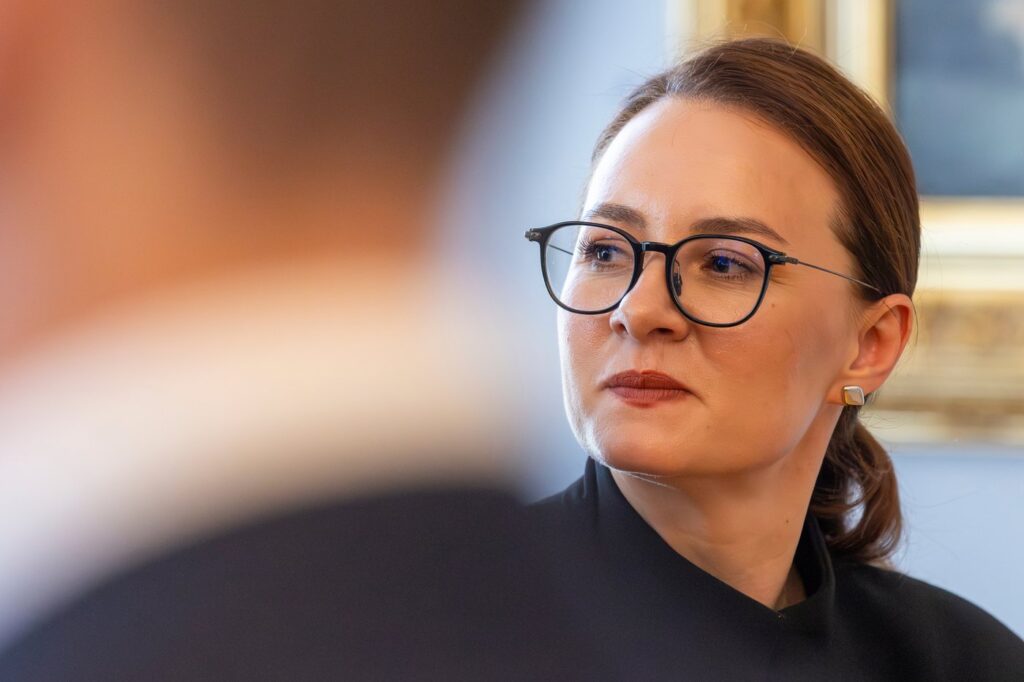
Ukrainian Prime Minister Yulia Svyrydenko announced her resignation on Sunday as President Volodymyr Zelenskyy revealed significant changes to the country's government. Zelenskyy, who remains in power under martial law due to the prohibition of wartime elections, has periodically reshuffled his administration to inject fresh energy into his political strategy.
Svyrydenko, who was appointed prime minister in July 2025 at just 39 years old, had previously served as Ukraine's economy minister. She played a crucial role in securing a mineral agreement with the United States, which was viewed as a pivotal step in aligning U.S. economic interests with Ukraine's security needs. In her resignation statement on social media, she expressed pride in leading the government during what she described as one of the most challenging periods in Ukraine's modern history.
Despite her departure from the premiership, Svyrydenko mentioned that she discussed her "next steps" with Zelenskyy and remains prepared to serve Ukraine in any future capacity focusing on advancing national interests and fostering a just peace. Zelenskyy, in a post announcing her resignation, emphasized that Ukraine is "changing its political strategy" and indicated that he has offered Svyrydenko a new, significant role in managing international relations with a key partner.
The Ukrainian president laid out his vision for the reshuffle, stating that each priority area of foreign policy would be handled by an experienced individual capable of executing agreements made at leadership levels while meeting the expectations of the Ukrainian populace. He also hinted at forthcoming alterations within Ukraine's law enforcement agencies, underscoring the comprehensive nature of the government overhaul.
This latest reshuffle represents the fourth significant reorganization of Zelenskyy’s cabinet since Russia's full-scale invasion began. The president held meetings with key officials, including Energy Minister Denys Shmyhal, Interior Minister Ihor Klymenko, and Defense Minister Mykhailo Fedorov, to discuss the impending changes, though specific details remain unclear.
In a separate development, Ukrainian forces intensified their attacks on Russian oil facilities, with a recent strike in southwest Russia reportedly resulting in one death and three injuries, including a child. The Governor of Samara region, Vyacheslav Fedorishchev, noted that residential buildings and an industrial site were affected by the assault. Russian media suggested that the Syzran Oil Refinery, owned by Rosneft and located about 800 kilometers east of the border, was among the targeted locations, displaying images of black smoke rising above the site.
Additionally, the governor of Rostov region, Yuri Slyusar, reported that a drone attack had damaged an empty tanker in the Azov-Black Sea maritime canal, assuring that there was no risk of an oil spill. Ukraine's strikes on Russian oil refineries and other critical infrastructure have led to a severe fuel crisis in Russia, characterized by gasoline shortages and long lines at filling stations, while the Kremlin has responded by ramping up its missile attacks on Ukrainian cities.
Ukrainian President Zelenskyy described the strikes on Russian energy infrastructure as part of a "long-range sanctions" campaign, emphasizing their role in pushing back against Moscow's ongoing aggression over the past four years. Meanwhile, Russia's Ministry of Defense claimed to have targeted the ports of Odesa and Chornomorsk in Ukraine's Odesa region, though Ukrainian officials have yet to respond to these allegations.