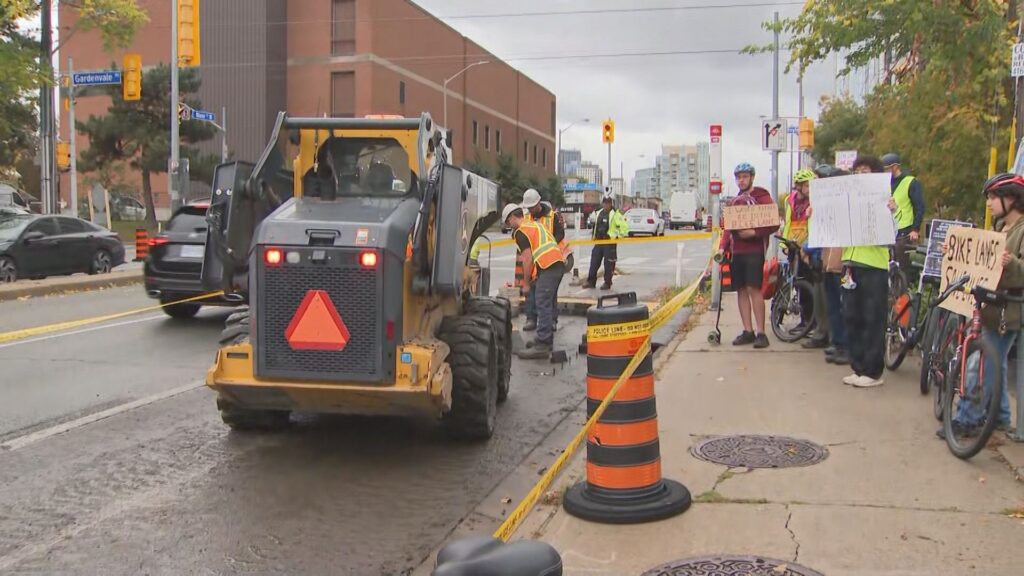
On Halloween, a significant protest took place in Toronto, as dozens of cycling advocates and concerned citizens gathered to voice their opposition to the Ontario government's controversial decision to continue the removal of bike lanes throughout the city. This demonstration followed an announcement by Ontario Transportation Minister Prabmeet Sarkaria, stating that the bike lanes on Bloor Street West in Etobicoke have officially been removed.
Sarkaria defended the removal by citing low usage of the bike lanes, explaining, "We heard from communities, and that’s why we moved forward on this first part of removal on Bloor Street West. The remainder of which will come subsequent in the next construction cycle." The recent removal of a 1.2-kilometer stretch of bike lanes has heightened tensions between construction workers and cycling advocates, leading to protests that have resulted in the arrest of four individuals for what police deemed acts of mischief.
Michael Longfield, the executive director of Cycle Toronto—a charity supported by its members—revealed that the atmosphere among the protesting cyclists was one of optimism despite the ongoing challenges. "The premier might have taken one kilometer from us, but folks are ready to defend the remaining 18," he commented, indicating a strong resolve within the cycling community. Longfield and other advocacy groups have also called upon the Supreme Court of Canada to review Premier Doug Ford's plans, appealing a ruling by the Ontario Court of Appeal that permitted the removal of protected bike lanes.
Protesters showcased their creativity and passion by decorating bikes and wearing signs, with slogans such as "Bike Lanes Save Lives." Many attendees adorned Halloween costumes and participated in the festive atmosphere, where volunteers distributed candy and chocolates. Among the crowd, a skeleton clad in a bright orange shirt could be seen perched on a bicycle, symbolizing the playful yet serious nature of the protest.
Longfield expressed a belief that it is still possible to influence Premier Ford’s stance on the bike lanes, despite the government's assertion that removing these lanes along major streets like Bloor Street, Yonge Street, Avenue Road, and around Queen’s Park would help alleviate traffic congestion. The issue of bike lanes gained considerable traction during Toronto's recent municipal elections, becoming a focal point for many voters. Longfield pointed out that the election results showcased a stronger mandate for pro-cycling voices, particularly with the re-election of Mayor Olivia Chow for a second term, who has been supportive of cycling initiatives.
Oda Al-anizi, a disability rights advocate who lives with a spinal cord injury, shared his perspective on the significance of bike lanes. He utilizes a specialized e-bike attachment on his wheelchair, allowing him greater mobility across the city. Al-anizi expressed that bike lanes have significantly improved his ability to socialize and access work opportunities, stating, "The city has been more open to me and I’ve been able to more easily have a social life or go to work." He emphasized that for individuals with disabilities and mobility challenges, dedicated bike lanes provide a much-needed sense of safety. "Drivers can’t see sometimes; I am pretty low, and (they) can get aggressive. For me, it’s very important to be in a dedicated space for bike lanes; it makes me feel a lot more safe," Al-anizi noted.
The ongoing conflict over bike lane removals continues to mobilize Toronto's cycling community, highlighting the critical need for inclusive and accessible urban infrastructure. The outcome of this dispute will undoubtedly have lasting impacts on the city's transportation policies and the well-being of its diverse residents.