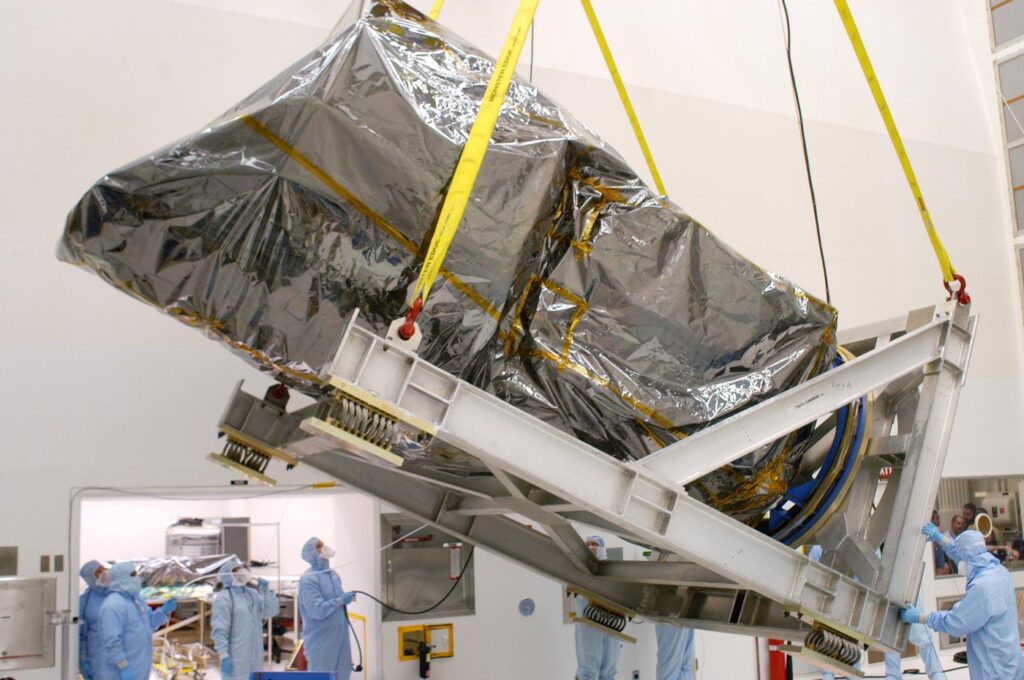
CAPE CANAVERAL, Fla. — An aging NASA telescope known as the Swift Observatory is facing imminent demise as it tumbles toward Earth. After a failed rescue effort left it orbiting at dangerously low altitudes, the telescope is expected to reenter the atmosphere on or around Friday, according to predictions by the U.S. Space Force.
The Swift Observatory, which weighs approximately 1 1/2 tons, was launched on November 20, 2004. It was designed to study some of the most significant explosions in the universe, including gamma-ray bursts and supernovas. Although much of the telescope will likely burn up upon reentry, some denser components made of tungsten, along with mirror parts, could survive the fall, warned Brad Cenko, the mission’s chief scientist.
In the event that any pieces do survive, they are likely to land in the ocean. However, areas in Africa, Australia, India, Southeast Asia, and the Americas are also within the reentry zone. The Space Force is actively monitoring the telescope’s decreasing trajectory.
The impending loss of Swift has left its operational team with mixed emotions—mourning the end of its mission while being grateful for the valuable contributions made over its 22 years in orbit. John Nousek, an astronomer at Pennsylvania State University and the lead of the Swift control team, noted that the team had anticipated this final day since before the satellite was even launched. He reflected on the predictable nature of objects in low-Earth orbit, stating, "what goes up must come down," typically ending in a catastrophic fashion.
Swift's descent has been accelerated by intense solar activity over recent years. In a desperate attempt to extend its lifespan, NASA contracted a company named Katalyst Space last year for a rescue mission. However, the mission was plagued by challenges, as the robot named Link could not get closer than 7 to 9 miles (12 to 15 kilometers) from the telescope before its own descent in September.
Following the cancellation of the rescue operation, the Swift Observatory resumed its observations and continued to make significant discoveries, including more gamma-ray bursts and high-energy events. Nevertheless, by the end of October, it had become too low in orbit to maintain stable observations, leading to a shutdown of its systems.
By its conclusion, Swift had recorded over 2,000 gamma-ray bursts and 1,400 exploding stars, alongside numerous observations of comets, asteroids, and black holes. Its unique capacity to swiftly direct its instruments toward celestial phenomena earned it a respected reputation in the astronomical community.
NASA viewed Swift as a crucial early-warning system for the Hubble and Webb space telescopes. Following its alerts enabled astronomers to conduct deeper explorations of newly discovered events. As the scientific community reflects on Swift's accomplishments, there is a recognition of the need for future missions to build upon the tools and experiences gained from this successful observatory.
Nousek concluded by expressing hope that the lessons learned from Swift's successes could be translated into advancements for future generations of space missions, thereby enhancing our understanding of the universe.