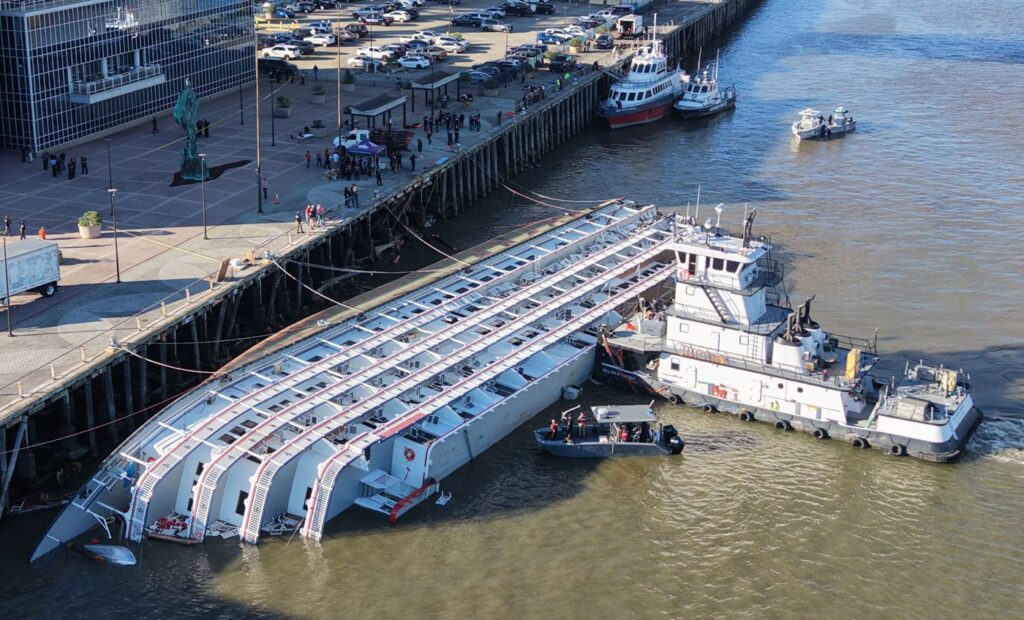
A tankers steering system malfunction caused its rudder to become stuck in a position that ultimately led to the vessel colliding with a cruise ship docked in New Orleans, according to preliminary findings released by U.S. government safety officials on Sunday. This incident occurred on Friday, involving the Atlantic Asphalt tanker, which crashed into the American Heritage cruise ship, resulting in passengers, crew members, and two police officers being thrown into the Mississippi River.
The National Transportation Safety Board (NTSB) officials presented their early assessment during a briefing in New Orleans, stating that the precise cause of the steering failure remains uncertain. NTSB accident investigator Bart Barnum remarked, "It could be many different things. That is something that we’re investigating very closely."
The Atlantic Asphalt tanker is approximately 520 feet (or 160 meters) long and was crewed by 19 personnel. In contrast, the American Heritage cruise ship measures around 300 feet (91 meters) in length and had 140 passengers and 50 crew members on board during the incident.
In the wake of the collision, 32 individuals were transported to nearby hospitals, including the two police officers who were forced into the water when the tanker rolled over. Fortunately, none of the injuries reported were critical; however, as of Sunday, six individuals remained hospitalized, according to a statement from the city of New Orleans.
The steering issue on the tanker caused its rudder to stay fixed in a starboard position, which led the vessel to veer toward the east bank of the river, where it struck the cruise ship just two minutes after the rudder malfunctioned. As the tanker approached the bank, the ship's data recorder captured audio that indicated the vessel's whistle was activated, alongside warnings and requests for assistance transmitted over the marine radio. Barnum highlighted that the recorded data also contained commands to deploy vessel anchors and orders for emergency ship handling procedures.
NTSB Member John DeLeeuw encouraged anyone with photos or videos of the crash to submit them to his agency, as these could significantly aid the investigation. He noted that a preliminary report is anticipated within 30 days. Additionally, DeLeeuw commended the rapid and effective response from federal, state, local, and private rescue teams that assisted in the aftermath of the crash.
The cruise ship capsize occurred within just 22 minutes of the collision, emphasizing the urgency of the response efforts. In the aftermath of the incident, the Board of Commissioners of the Port of New Orleans promptly filed a federal lawsuit, alleging that the tanker caused at least $1 million in damages to its terminal facilities. A judge subsequently issued a warrant on Friday, granting federal authorities oversight of the tanker for the immediate future.
This incident raises serious concerns about maritime safety and the mechanical integrity of vessels operating in busy waterways such as the Mississippi River. The investigation by the NTSB will delve deeper into the causes of the steering failure and evaluate the protocols in place to prevent such accidents from occurring in the future.