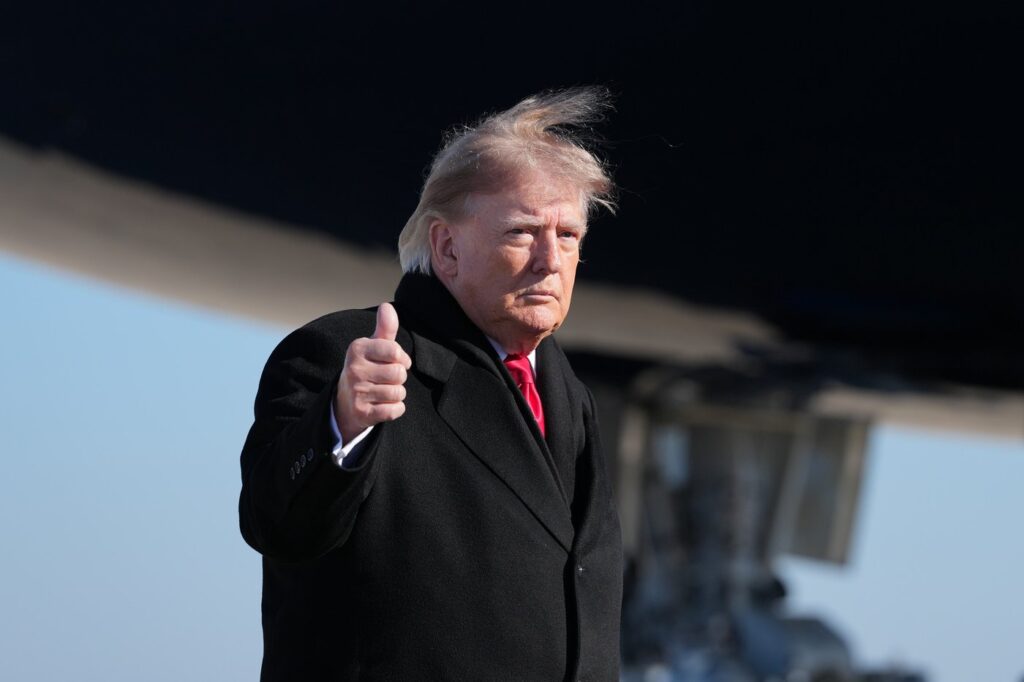
NEW YORK (AP) - A federal appeals court is deliberating on whether to intervene in President Donald Trump’s hush money case, especially as a New York State appellate court has recently heard arguments in Trump's effort to overturn his landmark conviction. A three-judge panel from the 2nd U.S. Circuit Court of Appeals engaged in a lengthy discussion lasting over an hour with both Trump’s attorney and a state prosecutor concerning the president’s latest attempt to transfer the case from state court to federal court, where he aims to dismiss the charges on the basis of presidential immunity. No immediate decision was announced following the arguments.
This marks the second court appearance within 11 days as Trump continues his dual legal strategy aimed at throwing out the May 2024 verdict. He was convicted on 34 felony counts related to falsifying business records to conceal a $130,000 payment to adult film performer Stormy Daniels. In addition to pursuing federal court proceedings, Trump is also appealing through the New York state court system after presenting arguments before the mid-level Appellate Division on November 5. The state court has yet to reach a ruling on the matter.
Regardless of how the situation unfolds in the courts, Trump’s name will be permanently linked to this case, which unfolded as he campaigned for reelection. He has denied any wrongdoing and faced no punitive measures, yet he is fervently working to eliminate the historical image of being the first U.S. president convicted of a crime. His efforts are compounded by the fact that he has less than two years remaining in his presidency.
In court, Trump’s attorney, Robert Giuffra Jr., urged the 2nd Circuit judges to promptly issue an order to take control of the case and halt the ongoing deliberations in the Appellate Division. Giuffra highlighted that without federal intervention, it may take years for state appellate courts to make a ruling, delaying Trump's ability to appeal to the U.S. Supreme Court. Judge John M. Walker Jr. and Chief Judge Raymond J. Lohier Jr. expressed skepticism about the feasibility of Giuffra's request, questioning the procedural mechanisms that would allow for such a transfer of jurisdiction between courts.
Giuffra contended that the case would initially be handled by a federal district court judge, who would then review the state court's verdict before forwarding the case to the 2nd Circuit for considerations regarding dismissal based on presidential immunity. However, Judge Lohier raised concerns about the lack of explicit authorization for such procedural transitions in federal law. The conversation spotlighted the complex interplay of federal and state legal systems that surround this high-profile case.
This appeal comes after a federal judge ruled against Trump’s transfer request three times. Judge Alvin K. Hellerstein previously concluded that "paying hush money to an adult film star or engaging in a cover-up of an embarrassment are not subsumed in presidential immunity." Trump had initially sought to move the case to federal court shortly after his indictment in March 2023. Even following his conviction and the Supreme Court's July 2024 ruling, which affirms that neither current nor former presidents can be prosecuted for actions taken while in office, he continues to push for his case to be examined in a federal setting.
Giuffra emphasized that evidence presented during the trial could be considered under the new rulings related to official acts, suggesting that prosecutors had incorporated now-barred forms of evidence concerning conversations held within the Oval Office. He articulated that the prosecution’s characterization of the hush money as an illegal campaign contribution should be discussed in federal court instead of state court. After Trump’s appeal of Hellerstein’s previous rejections, the 2nd Circuit instructed the judge to reassess the evidence related to Trump’s official duties, although the appellate panel did not indicate how they preferred him to rule on the legal matters at hand.
Conversely, Steven Wu, the chief of the appeals division at the Manhattan District Attorney’s Office, urged the 2nd Circuit to uphold Hellerstein’s initial ruling, stressing that even if Trump were to achieve a favorable outcome, the state appellate court would still have the authority to make a decision.