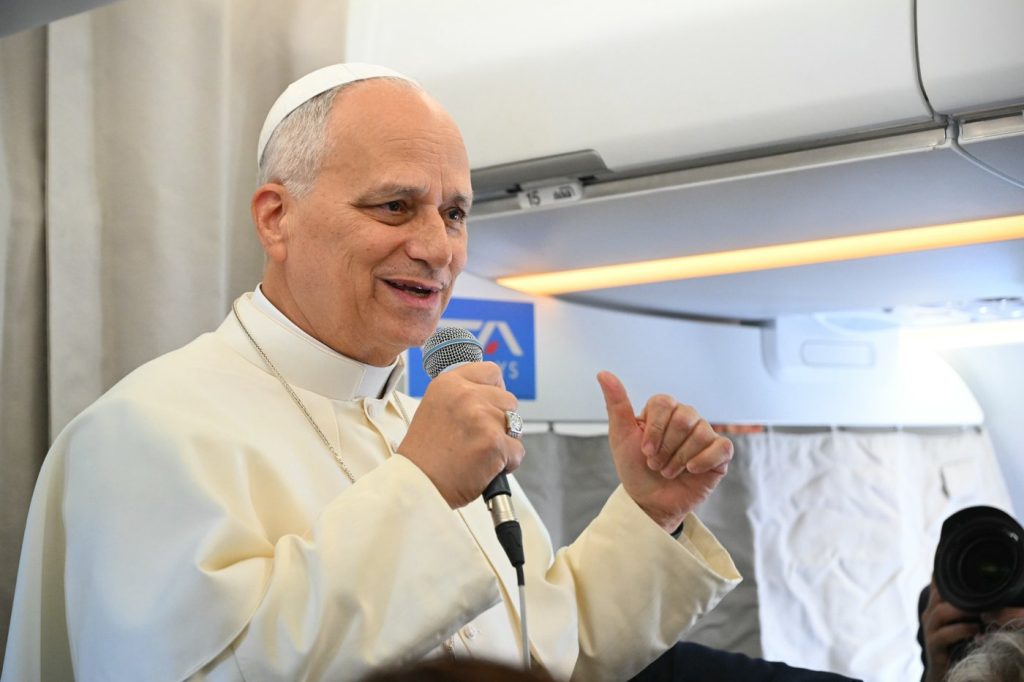
ABOARD THE PAPAL PLANE (AP) – Pope Leo XIV reiterated on Sunday the Holy See's firm stance advocating for a two-state solution to settle the Israeli-Palestinian conflict. During his inaugural airborne news conference, he emphasized that this approach is the “only solution” capable of ensuring justice for both parties involved.
These remarks were made while Leo was traveling from Istanbul to Beirut as part of his first trip as pope. Although he had previously engaged with journalists informally at his residence, this occasion marked his first official press conference as pope, following the practice of his predecessors during foreign trips.
Due to the short duration of the flight, the news conference was limited to two questions from Turkish journalists. However, upon returning to Rome on Tuesday, Leo is expected to have a lengthier encounter with the media.
In response to inquiries regarding his discussions with Turkish President Recep Tayyip Erdogan in Ankara, Leo confirmed that they addressed the conflicts in Gaza and Ukraine. He acknowledged Turkey's crucial role in both issues, noting Erdogan’s government had facilitated preliminary negotiations between Russia and Ukraine aimed at ending the ongoing war.
Leo stated, “Unfortunately we still haven’t seen a solution. But today there are new, concrete proposals for peace.” He expressed hope that Erdogan would continue dialogue with Ukraine, Russia, and the United States to work towards a ceasefire to conclude the nearly four-year war.
Regarding the situation in Gaza, Leo reiterated the Holy See’s longstanding advocacy for a two-state solution for Israel and the Palestinians. The establishment of a Palestinian state in East Jerusalem, the West Bank, and Gaza has been widely recognized internationally as the viable solution to the ongoing conflict.
The Holy See formally recognized a Palestinian state in 2015, and the pursuit of a two-state solution gained enhanced momentum this year amid the Israel-Hamas war in Gaza, with several countries officially recognizing Palestinian statehood during the United Nations General Assembly.
“We know that in this moment, Israel doesn’t accept this solution, but we see it as the only one that can provide resolution to the conflict they are experiencing,” Leo remarked. He also emphasized that the Holy See maintains a friendly relationship with Israel, aiming to act as a mediating voice to bring both sides closer to a just resolution.
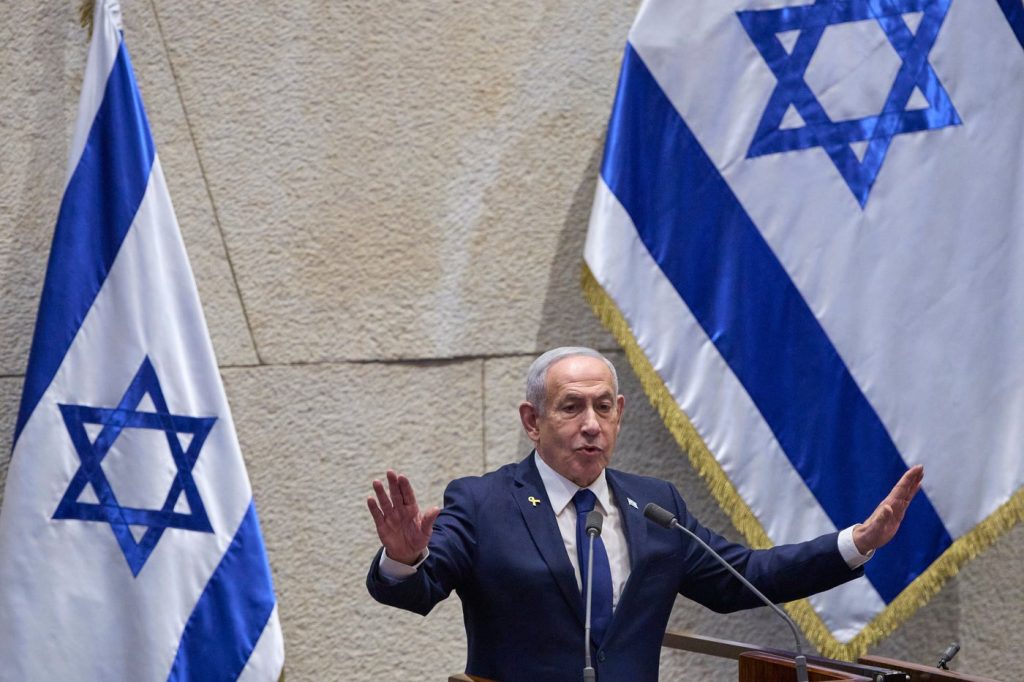
There has been no immediate response from Israeli Prime Minister Benjamin Netanyahu's office. Netanyahu has long maintained that creating a Palestinian state would reward Hamas and potentially lead to a larger Hamas-controlled state bordering Israel.
Earlier this month, Netanyahu reiterated that Israel’s opposition to a Palestinian state has “not changed one bit” and remains unfazed by external or internal pressures, stating, “I do not need affirmations, tweets or lectures from anyone.”
Throughout his time in Turkey, Leo had refrained from explicitly addressing the Gaza conflict. In his summary of the trip, he did not mention his visit to Istanbul’s Blue Mosque, which was a significant engagement with Turkey’s Muslim majority.
Instead, Leo focused on the primary purpose of his visit to the region: to mark the 1,700th anniversary of the significant A.D. 325 gathering of bishops from across the Roman Empire in present-day Iznik, Turkey. This assembly resulted in the agreement on a common creed, or profession of faith.
The Nicaean Creed is still recited by millions of Christians worldwide and represents a rare point of agreement among Catholic, Orthodox, and most Protestant denominations despite various schisms and divisions over the centuries.
During the commemoration of the Council of Nicaea in Iznik, Leo met with various Orthodox patriarchs. He proposed a significant joint event in 2033 in Jerusalem to commemorate the 2,000th anniversary of Christ’s crucifixion and resurrection, indicating that this could serve as a new visible symbol of unity among Christians.
“Obviously an event that all Christians want to celebrate,” he said, adding that there is ample time for preparation, with the various patriarchs welcoming the proposal.