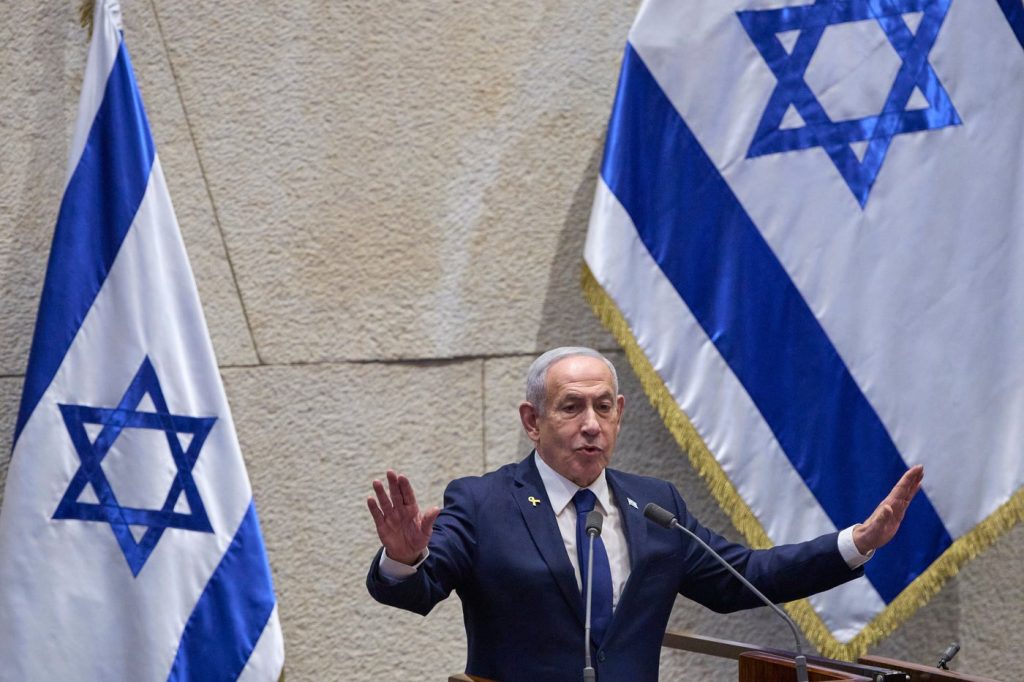
TEL AVIV (AP) – On Sunday, Israeli Prime Minister Benjamin Netanyahu formally requested a pardon from the country's president to resolve a long-standing trial regarding corruption charges. This development has intensified a deep societal divide within Israel as the nation grapples with significant changes in the region.
Netanyahu has been engaged in a fierce battle against the Israeli legal system concerning the allegations against him. He argued that receiving a pardon would promote national unity during a time of crucial transformation. However, his requests were met with immediate backlash from opponents, who contended that a pardon could undermine democratic institutions and suggest that he believes he is above the law.
His pardon application was submitted to the legal department of the President's Office, which labeled the request as "extraordinary" with "significant implications." Netanyahu stands as the first sitting prime minister in Israeli history to face trial, having been charged with fraud, breach of trust, and accepting bribes across three cases, where he is accused of trading favors with wealthy supporters. Notably, he has not yet been convicted.
Rejecting the accusations, Netanyahu portrays himself as a victim, framing the charges as a "witch hunt" driven by the media, police, and judiciary. His pardon request follows recent public comments by U.S. President Donald Trump, who called for Israel to issue a pardon during his address to the Israeli parliament. Trump later reiterated his position in a letter to President Isaac Herzog, labeling the corruption allegations as "political" and "unjustified."
Despite their former political rivalry, Herzog and Netanyahu reportedly maintain a good working relationship. Meanwhile, protests emerged on Sunday, including a notable demonstration outside Herzog's residence, where a pile of bananas was displayed with a sign implying that granting the pardon would liken Israel to a "banana republic."
In a recorded statement, Netanyahu emphasized the need for the trial to conclude to avoid further national discord. He cited the burden of having to appear in court three times a week as a hindrance to his leadership. "The continuation of the trial tears us apart from within," he stated, suggesting that a swift resolution could help reduce tensions and foster reconciliation.
Throughout the previous year, Netanyahu has testified multiple times; however, the trial has faced numerous delays due to national security situations, including the recent Hamas-led attacks on October 7, 2023. His pardon request includes a comprehensive letter from his attorney, which will be reviewed by the Justice Ministry before being forwarded to the legal adviser at the president’s office for further consideration.
Legal experts express skepticism about the potential impact of the pardon request on the ongoing trial, stating that the proceedings cannot be halted in this manner. Emi Palmor, a former director-general of the Justice Ministry, clarified that one cannot simultaneously claim innocence while requesting intervention from the president. The only means to suspend the trial would be to appeal to the attorney general directly.
While it is possible for the president to grant a pardon, such actions are typically taken after all legal proceedings have concluded. The Israel Democracy Institute indicated that pre-conviction pardons are exceedingly rare and could jeopardize the rule of law, threatening the principle of equality under the law.
Notably, Netanyahu's past responses to corruption scandals have contrasted sharply with his current position. In 2008, as the opposition leader, he urged then-Prime Minister Ehud Olmert to resign amid his own corruption issues. Olmert eventually stepped down and served a prison sentence. In stark opposition, Netanyahu now frames his legal woes as a consequence of a conspiracy aimed at ousting him from power.
Since assuming office again in late 2022, Netanyahu sought to reform Israel's justice system, which his opponents criticized as an attempt to weaken the judiciary and compromise the checks and balances necessary for democracy—especially while he was under trial. His reform initiatives have incited widespread protests, with critics arguing that resulting societal divisions emboldened adversaries like Hamas to act aggressively, culminating in the October attacks.
Netanyahu's pardon request has also sparked significant opposition from various advocacy groups and political leaders, with some asserting that without acknowledgment of guilt and sincere remorse, a pardon should not be granted. Opposition leader Yair Lapid emphasized that any pardon should be contingent upon an admission of guilt and a withdrawal from public life. Conversely, a segment of the population supports Netanyahu, arguing that his request is a step toward healing national divides and returning stability.