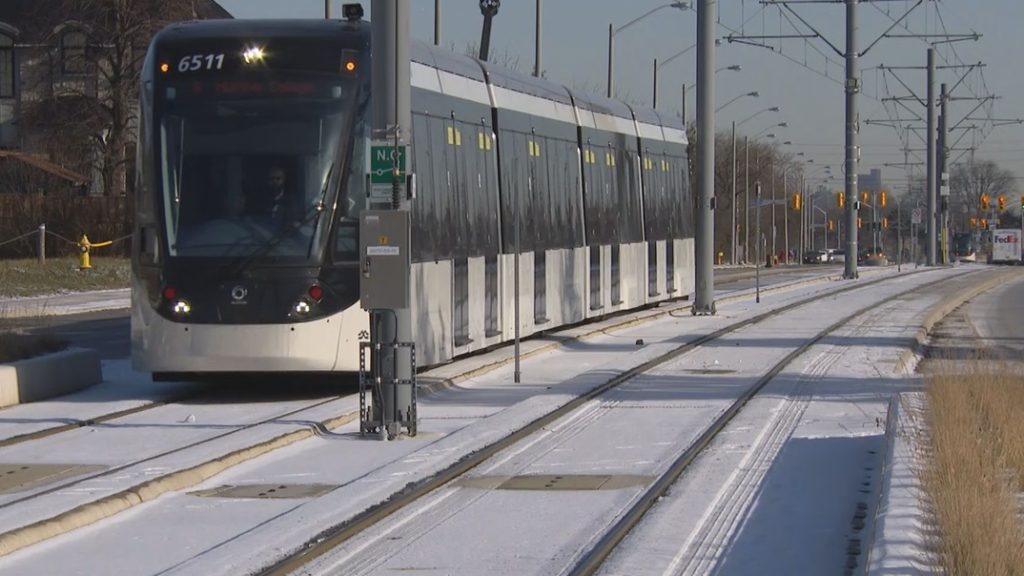
As the Toronto Transit Commission (TTC) riders begin to utilize the newly inaugurated Line 6 Finch West LRT, concerns are mounting regarding the prolonged travel times across the line. Despite many residents praising the new infrastructure during its grand opening on December 7, 2025, issues related to trip duration between the line's endpoints have become a topic of discussion.
Some users on social media reported that travel times from Finch West subway station to Humber College station, which represent the two ends of the 11-kilometer, 18-stop line, reached approximately 55 minutes. The official Metrolinx website for the YRT project indicates that light rail vehicles are expected to travel end to end in about 33-34 minutes at an average speed of 20 to 21 km/h (including stops), while the maximum speed can reach approximately 60 km/h.
CityNews reporters took a closer look at the travel times shortly after the LRT's opening. On a westbound trip, a camera operator driving from Finch West station to Humber College completed the journey in around 23 minutes. In contrast, a reporter taking the LRT reported a trip duration of nearly 47 minutes, hindered by multiple red lights and several street-level stops along the route. For the eastbound journey, the LRT shuttle bus was utilized, taking just over 31 minutes, while the same trip by car took about 29 minutes.
According to a TTC spokesperson, shuttle buses were made available for the initial days of the service to provide redundancy for the new LRT line. The goal was to ensure seamless initial operations while the system gained operational familiarity. CityNews also consulted Matti Siemiatycki, director of the Infrastructure Institute at the University of Toronto, who emphasized the importance of speed and reliability in attracting riders from their cars. He remarked that if LRT service cannot compete with bus travel times, it may lead to a decline in ridership.
Siemiatycki expressed concerns regarding instances where buses outperform LRT trip times, indicating that such discrepancies could impact the ridership numbers negatively. He suggested that transit signal priority, which would allow trains to pass through intersections without delay, could significantly improve the efficiency of the LRT system. Advocacy groups like TTCriders have also been calling for improvements in transit signal prioritization.
While some transit advocates have praised the new LRT system, citing its smooth journey compared to buses that must navigate pothole-ridden roads, concerns remain about operational efficiencies. Chris Drew, a transit advocate, highlighted the potential benefits of the new system for students commuting to Humber College, calling it a significant improvement.
CityNews posed questions to Metrolinx regarding trip times and the implementation of transit signal priority; while no immediate response was available, TTC spokesperson Stuart Green noted that the current opening-day schedule was based on travel times observed during testing phases. Green indicated that operational adjustments could enhance average speeds as the system begins full operations.
During a recent announcement regarding fare capping, Toronto Mayor Olivia Chow and TTC chair Jamaal Myers addressed concerns about the current state of transit signal prioritization. Chow stated that the TTC now has control over how transit signal priorities are managed, asserting that improvements would be forthcoming. Myers recognized that while the system was designed in the 2010s, updates to transit signal prioritization are being considered to ensure efficiency and speed.
Originally, construction on the Finch West LRT project began in 2018, costing an estimated $2.5 billion, which includes both construction and maintenance costs over a 30-year period. As of late September 2025, total expenses had reached approximately $2.45 billion, with the projected baseline cost now standing at $3.75 billion. These financial figures highlight the complexity and scale of the LRT project amid ongoing discussions about operational improvements and rider experience.