In a significant ruling, U.S. District Judge Charles Breyer ordered the Trump administration to stop deploying the California National Guard in Los Angeles and to return control of the troops to the state. This decision came after California officials sought a preliminary injunction to reinstate state control over its National Guard troops, which had been called up without Governor Gavin Newsom's authorization in June 2020.
President Donald Trump initiated the deployment of more than 4,000 California National Guard troops as part of his administration's immigration enforcement efforts. By late October, the number of deployed troops had decreased to several hundred, but California continued to oppose Trump's command over the forces deployed in the state.
White House spokeswoman Abigail Jackson indicated that the administration would appeal Judge Breyer's ruling, describing it as a situation where Trump was exercising lawful authority in response to violent riots that local leaders were unwilling to control. She referred to Governor Newsom derogatorily as "Newscum," a nickname Trump has used frequently.
California Attorney General Rob Bonta welcomed the ruling, viewing it as a victory for democracy and rule of law, while criticizing the administration for allegedly manipulating the troops for political purposes. He asserted that no President has the unilateral power to federalize the National Guard without justification.
Judge Breyer criticized the arguments presented by the Trump administration that he could not review the extensions of the Guard deployment, labeling the claim as "shocking." He also pointed out that the assertion that the presence of Guard troops was necessary for protecting federal personnel and property bordered on "misrepresentation." Breyer emphasized that the U.S. government was structured as a system of checks and balances, rejecting the idea that the executive branch should have unchecked power over military forces.
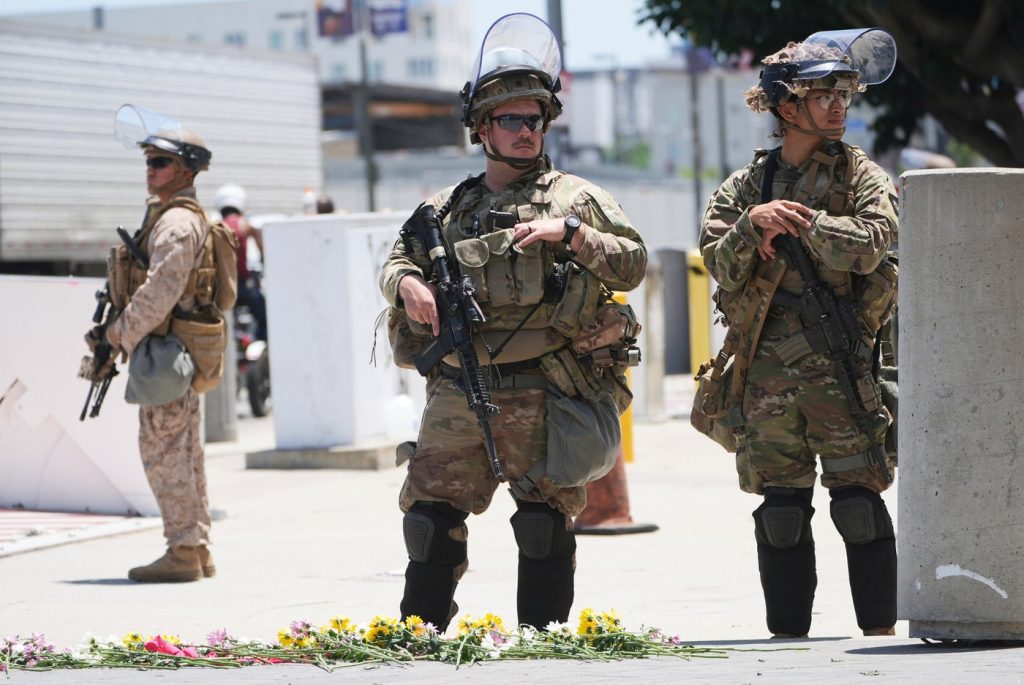
Currently, roughly 100 California National Guard troops remain in Los Angeles, tasked with guarding federal buildings or stationed at a nearby base, rather than engaging in immigration enforcement activities. California contended that circumstances in Los Angeles had evolved since the initial deployment, referencing protests that erupted in opposition to Trump's intensified immigration policies, which had included clashes between federal immigration officers and protesters.
The Trump administration extended the deployment until February 2021, while simultaneously attempting to use National Guard members in other cities such as Portland, Oregon, and Chicago, highlighting a pattern of federal intervention in Democratic-led urban areas against the wishes of local officials. Judge Breyer accused the administration of effectively creating a national police force comprising state troops, dismissing the notion that risks from demonstrations in Los Angeles required the National Guard's presence as "nonsensical." He noted that local law enforcement agencies, including the Los Angeles Police Department (LAPD) and the California Highway Patrol (CHP), had successfully managed protests since June.
The June 2020 call-up represented the first instance in decades where a state's National Guard was activated without a request from its governor, marking a notable escalation in the Trump administration's efforts regarding immigration enforcement. The deployed troops were positioned near a federal detention center in downtown Los Angeles and initially involved in crowd control during demonstrations against immigration enforcement activities.
California subsequently filed a lawsuit, claiming that Trump's administration was using the Guard as a personal police force, violating federal laws restricting military involvement in domestic affairs. The administration countered by arguing that the courts should not question the president's decisions concerning the necessity of federal troops in situations of public unrest.
In his ruling, Judge Breyer refuted the administration's argument about a potential danger of uprising, indicating that such claims had become increasingly implausible. Additionally, he had previously issued a temporary restraining order requiring the administration to relinquish control of the National Guard, though this had been temporarily suspended by an appeals court. Other judges have similarly blocked the deployment of National Guard troops in cities like Portland and Chicago amid ongoing tensions surrounding federal intervention.