The U.S. government acknowledged on Wednesday that the actions of an air traffic controller and an Army helicopter pilot contributed to a tragic collision that occurred in January, involving an airliner and a Black Hawk helicopter near Washington, D.C., resulting in the deaths of 67 individuals. This incident marked the deadliest plane crash on American soil in over twenty years.
The government's official response came in the context of the first lawsuit filed by a victim’s family, stating that the government bears liability due to the air traffic controller's violation of visual separation procedures. Additionally, the lawsuit pointed out that the helicopter pilots failed to maintain vigilance to see and avoid the aircraft. However, the filing also suggested that the pilots of the airliner and the airlines could have played a role in the incident, with American Airlines and its regional partner, PSA Airlines, named as defendants. Both airlines have since filed motions to dismiss the case.
Despite this, the government maintained that no air traffic controllers or officials within the Federal Aviation Administration (FAA) or the Army were negligent. The collision involved an American Airlines regional jet that was landing at Ronald Reagan National Airport, carrying 60 passengers and four crew members. Meanwhile, three soldiers were on the helicopter. Rescue teams recovered at least 28 bodies from the icy Potomac River following the mid-air collision.
Robert Clifford, an attorney representing the family of victim Casey Crafton, stated that the government has recognized the Army’s role in the “needless loss of life” as well as the FAA's failure to adhere to air traffic control procedures. Clifford emphasized that the families affected by the crash remain deeply saddened by their loss.
The lawyers for the U.S. government acknowledged in their filing that the United States had a duty of care towards the plaintiffs, which it breached, ultimately leading to the collision. An American Airlines spokesperson declined to comment on the filing; however, the airline asserted in its motion to dismiss that the appropriate legal recourse should be directed towards the U.S. government rather than American Airlines. Since the accident, the airline has focused on supporting the victims' families.
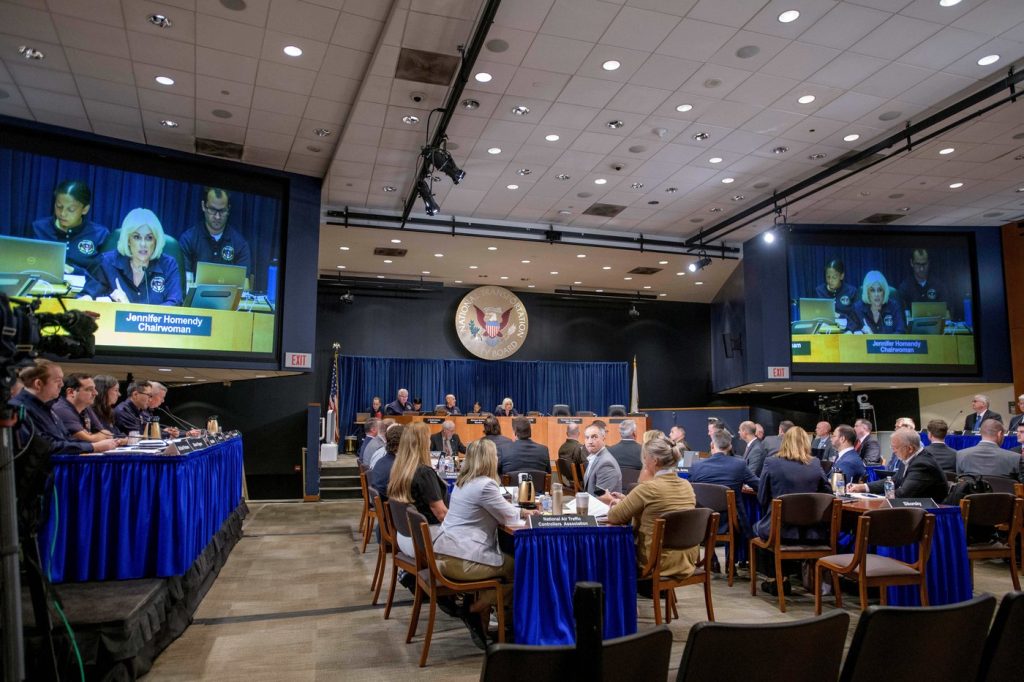
The lawsuit claimed that the airlines did not take adequate measures to mitigate the risks associated with flying in proximity to helicopters in the Washington, D.C. area and lacked sufficient training for their pilots to handle such situations safely. Investigative reports are underway as the National Transportation Safety Board (NTSB) is expected to release its complete findings on the crash early next year. Preliminary investigations have already indicated multiple factors contributing to the incident, including the helicopter flying 78 feet above the 200-foot altitude limit, which allowed minimal separation between aircraft.
The NTSB has also highlighted the FAA's failure to recognize the hazards surrounding the busy airport, despite having recorded 85 near misses involving aircraft around the same time frame. The government conceded in its filing that it had been made aware of certain near-miss incidents involving Army-operated Black Hawk helicopters and civilian aircraft in the vicinity of helicopter routes near Washington.
Before the collision, air traffic controllers had twice inquired whether the helicopter pilots had visual contact with the incoming jet. The pilots confirmed they did and requested visual separation approval. However, FAA officials commented that the Reagan controllers had become overly reliant on visual separation practices, a procedure that has been discontinued since the crash.
Witness testimonies during the NTSB hearings raised questions about the helicopter crew’s ability to visually detect the plane while utilizing night vision goggles and whether they were observing the proper direction. Investigators also theorized that the helicopter pilots may not have fully understood their altitude due to discrepancies in the barometric altimeter readings, which indicated a height 80 to 100 feet lower than what the flight data recorder documented.
The victims of this tragic incident included a group of young elite figure skaters and their coaches who were returning from a competition in Wichita, Kansas, along with four steamfitters from the D.C. area.
Retired pilot Richard J. Levy, an aviation litigation expert, remarked that the government's admission of liability within a year of the crash is rare, especially considering the potential financial implications involved. He stated, “They would not have done that if there was a doubt in their mind about anything the controller did or that the Army did.”