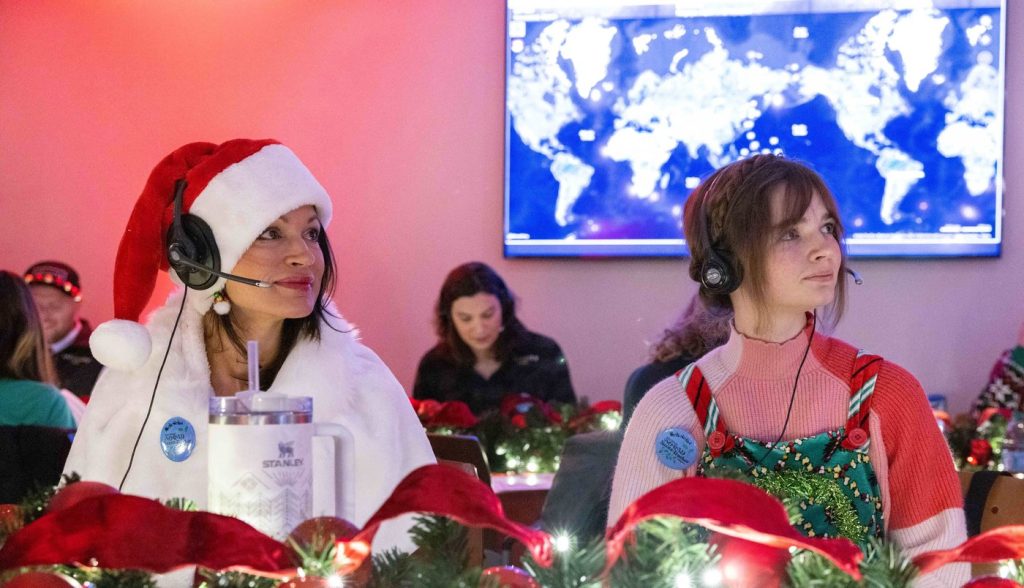
PETERSON SPACE FORCE BASE, Colo. (AP) – Each year, children eagerly call the NORAD Tracks Santa hotline, expressing their anticipation and curiosity about Santa Claus' journey on Christmas Eve. While some kids drop the phone in disappointment upon learning that Santa won’t visit unless they are asleep, others inquire how the jolly figure can locate them on his magical night of gift-giving. For 70 years, tracking Santa has been a cherished tradition at the North American Aerospace Defense Command (NORAD), a joint United States and Canadian initiative that monitors North American airspace for threats, dating back to the Cold War era.
On Christmas Eve, more than 1,000 volunteers will answer calls at 1-877-HI-NORAD from 4 a.m. to midnight Mountain Standard Time. This holiday season introduces a new feature: families can now call through the program's website, enabling easier access for those outside North America. The website allows users to follow Santa’s journey in nine different languages, including English and Japanese, making this tradition even more inclusive for a global audience.
Last year, approximately 380,000 calls were received at Peterson Space Force Base in Colorado Springs, which serves as NORAD's home base. While Santa himself poses no threat, the same technology that NORAD uses year-round—such as radar, satellites, and jets—also enables them to track Santa starting from the international date line over the Pacific Ocean. Col. Kelly Frushour, a NORAD spokesperson, explained that Rudolph's red nose emits a heat signature akin to that of a missile, which NORAD's satellites can detect.
One memorable call last year involved a little girl who was distressed when informed that Santa was headed to the International Space Station, where two astronauts were stranded. Fortunately, by the end of the call, Santa was said to have moved on to another location, relieving the child's worries that Santa would be trapped in space and reassuring her that he would still visit her home that evening.
Another heartwarming story shared by Michelle Martin, a NORAD staff member and Marine veteran, recounted an annual call from a special needs man named Henry. He once asked if a jet pilot could deliver a note to Santa, letting him know that he was already in bed and ready for his arrival. Martin explained to Henry that Santa travels "faster than starlight," making it impossible for the pilot to catch up with him. "He just waves and he goes," she recounted, emphasizing the enchanting nature of Santa's journey.
A Tradition Started by Mistake
The iconic tradition of tracking Santa actually began by accident in 1955. At the time, NORAD's predecessor, the Continental Air Defense Command (CONAD), was on alert for any signs of a potential nuclear attack from the Soviet Union. The story goes that a child mistakenly called the military operations center looking to speak with Santa. Rather than disappointing the child, Air Force Col. Harry Shoup, who was in command that day, instructed his staff to start tracking Santa and answering calls from children.
The first call was reportedly the result of a misprint or misdial of a phone number included in a Sears advertisement in the Colorado Springs newspaper, which encouraged children to call Santa. Over the years, the legend grew that the first call connected to a dedicated hotline intended for emergencies. A 2015 article in The Atlantic questioned the accuracy of this narrative, suggesting the call was likely made to a public hotline instead, but it remains a beloved part of NORAD's storied history.
In a 1999 interview, Shoup fondly recalled how he initially played along with the calls, telling the first caller, "Ho, ho, ho, I am Santa." His staff, initially surprised, joined in on the fun. Although the precise day of the first call remains unclear, by December 23 of that inaugural year, it was reported that CONAD was officially tracking Santa. The organization later evolved into NORAD and shifted its operations to a fortified base inside Cheyenne Mountain, where officers could seek shelter in the event of a nuclear emergency.