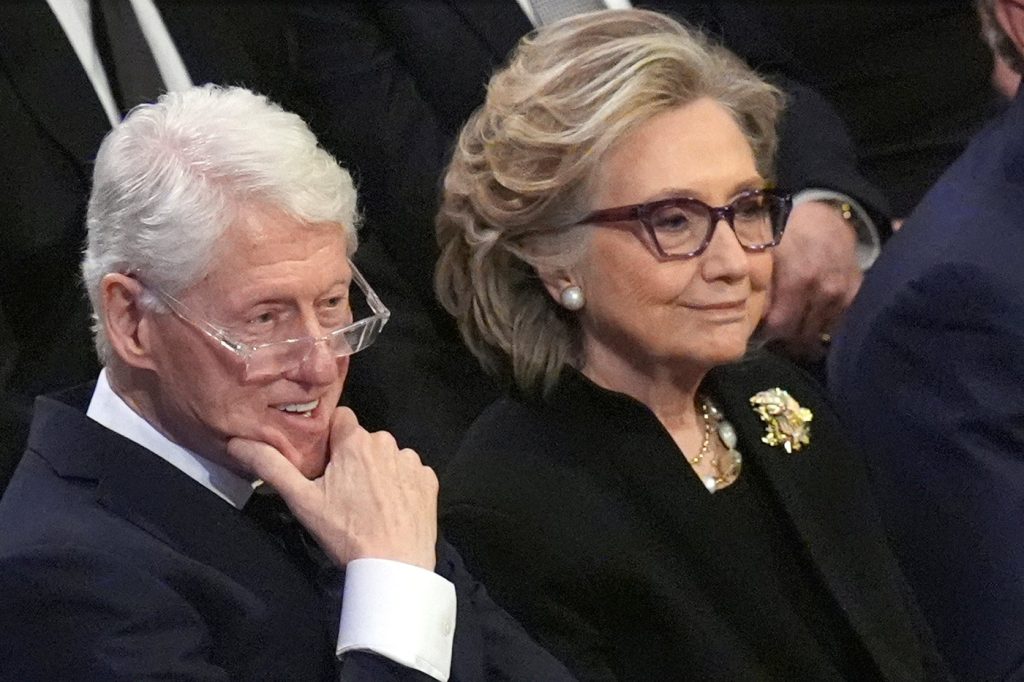
Former President Bill Clinton and former Secretary of State Hillary Clinton have agreed to testify in a House investigation regarding convicted sex offender Jeffrey Epstein. However, Rep. James Comer, the chair of the House Oversight Committee, stated that a formal agreement is still pending.
On Monday evening, Rep. Comer indicated his intention to pursue contempt of Congress charges against both Clintons for not complying with a congressional subpoena. The Clintons' attorneys sent an email to the Oversight panel stating that they would cooperate and appear for depositions on dates agreed upon by both parties. However, Comer did not drop the contempt charges, which could lead to significant fines and possible incarceration if passed by the House and prosecuted by the Department of Justice.
This negotiation occurred as Republican leaders were preparing to advance the contempt resolution through the House Rules Committee, marking a historically significant moment as it would be the first case of Congress potentially holding a former president in contempt. As discussions progressed, the Rules Committee opted to delay the advancement of the contempt resolutions.
Earlier on Monday, Comer rejected a proposal from the Clintons’ attorneys that suggested Bill Clinton undergo a transcribed interview while Hillary Clinton would provide a sworn declaration. Comer insisted that both Clintons must participate in sworn depositions to fulfill legal subpoenas issued by the committee.
A letter from the committee noted that attorneys for the Clintons proposed a four-hour transcribed interview for Bill Clinton regarding matters related to Epstein investigations, while Hillary Clinton would submit a sworn declaration. Comer firmly stated that the Clintons should not dictate the terms of lawful subpoenas.
The Clintons had been resisting subpoenas since August, when the Oversight panel formally requested their testimony as part of an investigation into Epstein and his associates. With Comer threatening contempt proceedings, the Clintons began negotiating a potential compromise. Last month, a bipartisan group within the Oversight Committee advanced contempt charges against Bill Clinton, with nine out of twenty-one Democrats supporting the motion, emphasizing the demand for transparency in the Epstein investigation. Additionally, three Democrats supported similar charges against Hillary Clinton.
Republicans Focus on Bill Clinton’s Involvement
Bill Clinton's connections with Epstein have re-emerged as a significant focus for Republicans amid ongoing scrutiny of Epstein, who died by suicide in 2019 in a New York jail while awaiting trial on sex trafficking charges. Although Clinton has a documented history with Epstein dating back to the late 1990s and early 2000s, he has not been accused of any wrongdoing in connection to Epstein’s illicit activities.
In response to Comer’s actions, the Clintons have voiced strong criticism, accusing him of politicizing the investigation while neglecting accountability regarding the Trump administration for delays in producing Justice Department case files related to Epstein. “They negotiated in good faith. You did not,” said Angel Ureña, a spokesperson for the Clintons, addressing Comer’s threats on Monday.
Despite the ongoing discussions and the potential vote, the situation represents a unique moment in congressional history, as no former president has ever been compelled to testify before Congress, though some have voluntarily appeared. House Democratic leader Hakeem Jeffries announced that the Democratic caucus would deliberate on the contempt resolutions later in the week but refrained from committing to vote against them. Jeffries characterized the contempt motions as politically motivated and accused Comer of focusing on retribution rather than a genuine investigation into the delayed release of materials by the Justice Department regarding Epstein.
Jeffries remarked that “they don’t want a serious interview, they want a charade,” alluding to the contentious nature of the ongoing investigation and the implications it may have for both the Clintons and the Oversight Committee.