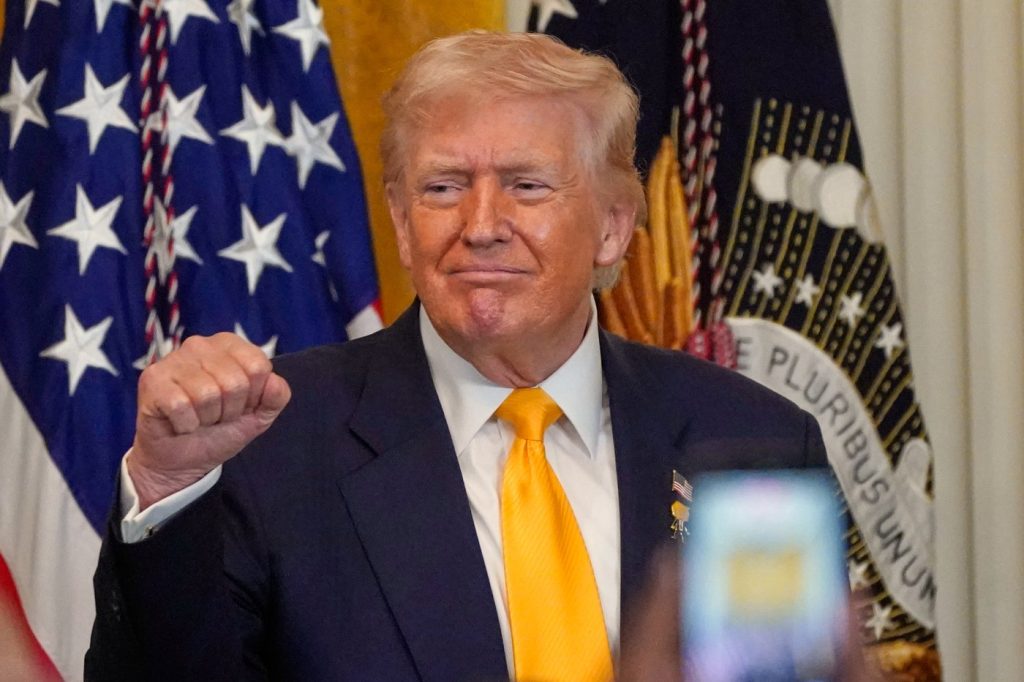
Donald Trump has continued his unpredictable approach to tariffs with a recent announcement pledging to increase his new worldwide tariff to 15 percent. This declaration comes in the wake of a Supreme Court ruling that undermined the U.S. president's preferred mechanism for imposing tariffs.
In a social media post, Trump indicated, "During the next short number of months, the Trump Administration will determine and issue the new and legally permissible Tariffs, which will continue our extraordinarily successful process of Making America Great Again." This statement reflects both his commitment to his economic agenda and the ongoing tension surrounding trade policies.
On Friday, Trump signed an executive order to implement a 10 percent worldwide tariff, effective starting Tuesday, drawing authority from Section 122 of the 1974 Trade Act. The order specifies that this tariff rate can only increase to 15 percent and is set to expire after 150 days unless Congress takes action to extend it.
The fluctuating nature of these tariff threats is not anticipated to significantly impact the Canadian economy. However, it does contribute to the uncertainty surrounding the forthcoming mandatory review of the Canada-U.S.-Mexico Agreement (CUSMA), which is scheduled to take place this year. A fact sheet released by the White House clarified that the new tariffs will not apply to products compliant under the CUSMA framework. Furthermore, these duties will not stack on existing sector-specific tariffs related to steel, aluminum, and automobiles, which were not influenced by the Supreme Court's recent ruling.
The Supreme Court's decision on Friday concluded that Trump did not have the legal authority to invoke the International Emergency Economic Powers Act (IEEPA) for his "Liberation Day" tariffs and associated duties on Canada, Mexico, and China. Shortly after the ruling, Trump expressed his discontent, labeling it a "poorly written, and extraordinarily anti-American decision." This decision curtailed Trump's capacity to impose excessively high tariffs unilaterally, although it is unlikely to deter his broader strategy aimed at reshaping global trade through tariffs.
Meanwhile, U.S. Trade Representative Jamieson Greer mentioned in an interview with "Fox News" that despite the implementation of the new worldwide tariff, the Trump administration plans to initiate investigations into certain countries under Section 301 of the Trade Act of 1974. This provision enables the president to take trade actions against countries deemed to have unreasonable and discriminatory policies. However, any actions resulting from these investigations will require a significant time investment, including a public comment period, potentially prolonging the process before any new actions are taken.