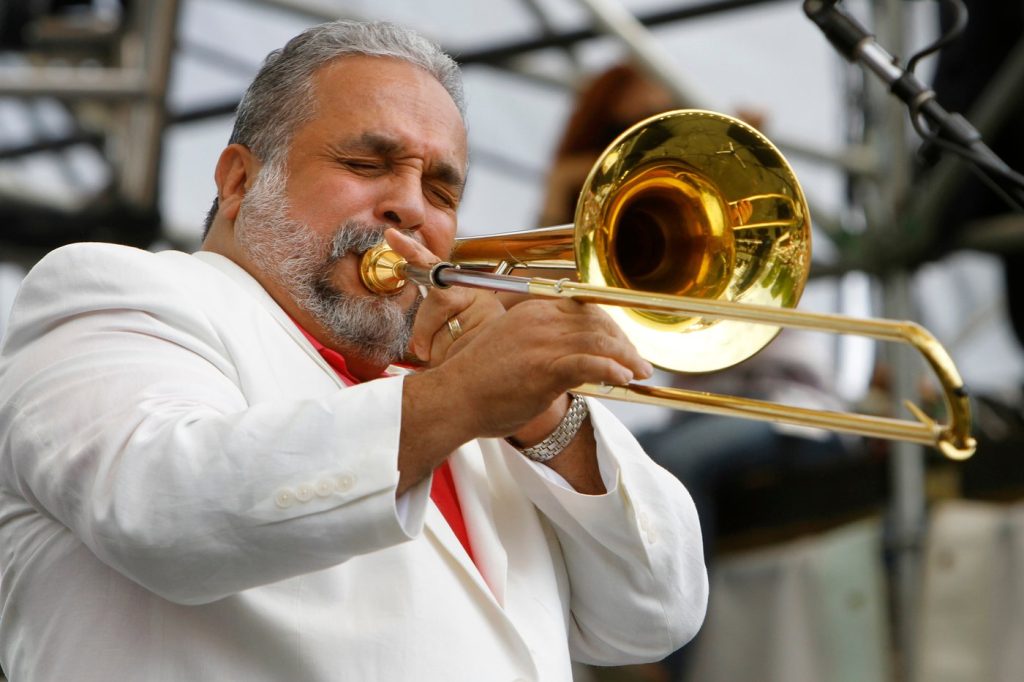
Willie Colón, the renowned architect of urban salsa music and a notable social activist, passed away on Saturday at the age of 75. His family and manager confirmed his death via social media.
Throughout his illustrious career, Colón made substantial contributions to the music industry, releasing over 40 albums that collectively sold more than 30 million copies globally. He was known for his collaborations with a diverse array of artists, including the Fania All Stars, David Byrne, and Celia Cruz. His partnership with Rubén Blades on the acclaimed album "Siembra" remains one of the best-selling salsa albums in history, showcasing not only their musical talents but also their commitment to addressing social issues through the genre.
Colón's influence extended beyond music; his manager, Pietro Carlos, remarked that Colón transformed salsa by politicizing it and representing urban narratives, bridging cultures through his distinctive trombone sounds. The musician was nominated for ten Grammy Awards and received a Latin Grammy, solidifying his position within the industry. He composed several popular songs, including "El gran varón," "Sin poderte hablar," "Casanova," "Amor verdad," and "Oh, qué será."
Born in the Bronx, New York, Colón was raised by his grandmother and aunt, who instilled in him a deep appreciation for traditional Puerto Rican music and rhythms from the Latin American repertoire. From an early age, he explored various musical instruments, ultimately gravitating towards the trombone after being inspired by musician Barry Rogers' unique sound in a song by Mon Rivera. At the age of 17, Colón joined the influential Fania Records, a label instrumental in developing the salsa genre that emerged from New York's vibrant Latin music scene.
Willie Colón was celebrated for his innovative fusion of diverse musical styles, seamlessly blending jazz, rock, funk, soul, and R&B with traditional Latin genres such as Cuban son, cha-cha-cha, mambo, and guaracha. His work not only paid homage to this rich musical heritage but also added elements of nostalgia from Puerto Rican sounds, including jíbara, bomba, and plena music. In recognition of his remarkable career and contributions, Colón received a special Grammy from the Latin Recording Academy in 2004.
In addition to his music career, Colón was a dedicated community leader and civil rights advocate in the United States. He was actively involved with numerous organizations, including the Hispanic Arts Association, the Latino Commission on AIDS, and the Congressional Hispanic Caucus Institute. His efforts in public service were acknowledged when he received the Chubb Fellowship from Yale University in 1991, an honor that has also been awarded to notable figures such as John F. Kennedy and Ronald Reagan.
Colón's political ambitions included a role as a special assistant to David Dinkins, New York’s first Black mayor, and later advising Mayor Michael Bloomberg. He faced challenges in his attempts to run for public office, including a failed bid against then-U.S. Rep. Eliot Engel in the 1994 Democratic primary, and a third-place finish in the Democratic primary for New York’s public advocate in 2001. Although he supported Hillary Clinton's presidential campaign in 2008, he later voiced his decision to vote for Donald Trump in 2016.
The musician’s career was not without controversy; he had public disputes with other artists and politicians. A notable rift developed between him and Blades after Colón sued for breach of contract over a 2003 concert. He also drew criticism for derogatory comments about Venezuelan President Hugo Chávez on social media.
In addition to his music career, Colón appeared in films such as "Vigilante," "The Last Fight," and "It Could Happen to You," as well as TV shows like "Miami Vice" and "Demasiado Corazón." More recently, he made an appearance in Bad Bunny’s music video for "NuevaYol." Colón is survived by his wife and four sons.