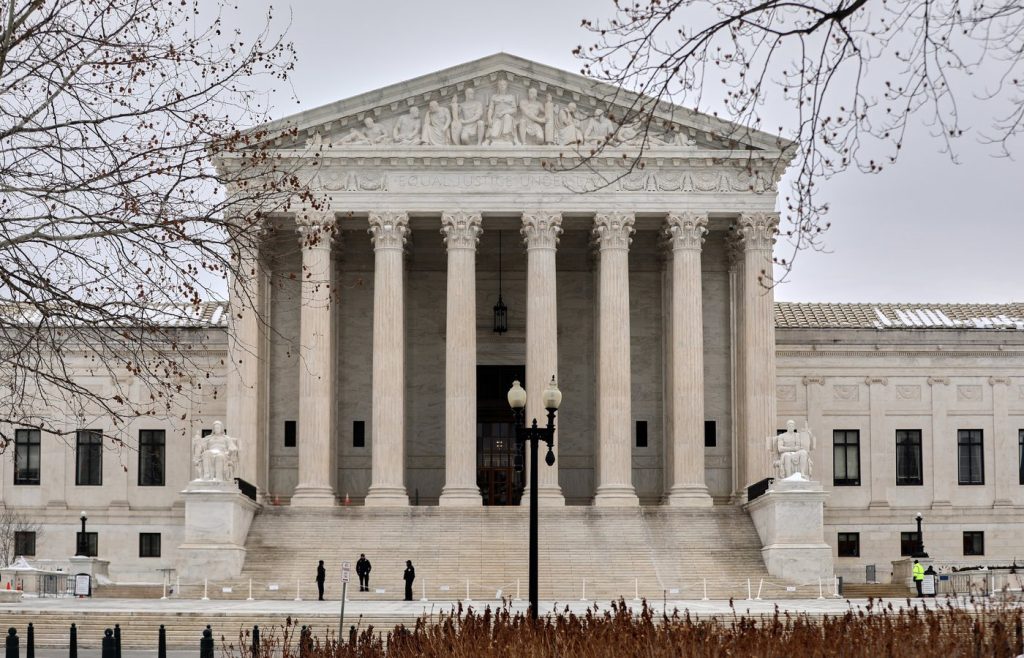
The Supreme Court showed signs of potentially relaxing a federal law prohibiting marijuana users from owning firearms during oral arguments on a recent Monday. The case at hand involved a Texas man, Ali Danial Hemani, who claimed he should not have been charged with a crime merely for possessing a gun while using marijuana a few times a week.
The Trump administration was pushing for the court to revive the case against Hemani, arguing that the current law, which bans all illegal drug users from owning guns, is essential for public safety. However, justices from both ends of the political spectrum, including both conservative and liberal members, expressed skepticism toward the government's case.
Justice Amy Coney Barrett questioned the government's rationale, asking, “What is the government’s evidence that using marijuana a couple of times a week makes someone dangerous?” This line of questioning hinted at the justices' willingness to reconsider coupling gun ownership with marijuana use.
Principal Deputy Solicitor General Sarah Harris advocated for the law as a necessary measure to prevent firearms from reaching potentially hazardous individuals. This argument is notably premised on the assertion that marijuana users pose a risk, although it contrasts sharply with the view that many responsible cannabis users may not exhibit dangerous behaviors.
In the backdrop of this discussion, Justice Neil Gorsuch pointed out the growing trend of cannabis legalization across various states, despite its continued illegal status at the federal level. He raised the question, “What do we do with the fact that marijuana is sort of illegal and sort of isn’t, and that the federal government itself is conflicted on this?” His concerns reflect the complex intersection of state and federal legal frameworks regarding cannabis.
Moreover, Gorsuch’s position echoes a significant ruling from 2022 in New York State Rifle and Pistol Association v. Bruen, where the court determined that gun laws must be firmly rooted in the traditions of the nation’s history. Justice Ketanji Brown Jackson chimed in to assert that the lifetime ban on firearm possession for cannabis users lacks historical precedent, noting, “I think your argument sort of falls apart under the Bruen test.” This statement emphasizes the challenge the government faces in justifying the current law.
The government defended its stance by drawing parallels to historical laws that excluded “habitual drunkards” from gun ownership. Justice Gorsuch countered this by pointing out the historical prevalence of alcohol, questioning whether historical figures such as John Adams or James Madison would themselves have been labeled “habitual drunkards” under similar statutes, showcasing the insufficiency of the government's argument.
Interestingly, Hemani's case brought together unlikely alliances with support from both the American Civil Liberties Union and the National Rifle Association, alongside cannabis legalization advocates like NORML. In contrast, gun-safety organizations such as Everytown, which usually stand in opposition to the Trump administration on Second Amendment matters, rallied against the case.
Some justices raised concerns that a favorable ruling for Hemani could inadvertently expand gun possession rights to users of more dangerous drugs like methamphetamine or heroin, complicating the legal landscape significantly. Chief Justice John Roberts expressed concern, suggesting such a decision would necessitate “a fairly cavalier approach to the necessary consideration of expertise and the judgments we leave to Congress and the executive branch.”
This case represents the second gun-related issue the Supreme Court is deliberating this term, following a prior indication that justices may be inclined to strike down a Hawaii law restricting guns in commercial establishments.
The Supreme Court is expected to issue a decision on this pivotal case by the end of June, which could have far-reaching implications for gun control laws and the legal status of marijuana users in the context of firearm ownership.