CHICAGO (AP) - Oil prices have surpassed $100 per barrel for the first time in over three and a half years, reaching a notable $107.97 for Brent crude and approximately $106.22 for West Texas Intermediate (WTI) on Sunday. This represents a significant increase of 16.5% and 16.9% from the previous Friday's closing prices of $92.69 and $90.90, respectively. The surge comes amidst escalating tensions due to the ongoing war involving Iran, which has severely impacted oil production and logistics in the Middle East.
Last week's market fluctuations saw U.S. crude prices jump by 36% and Brent crude prices rise by 28%, primarily driven by the conflict that has escalated since U.S. and Israeli attacks on Iran began on March 1. These developments have raised concerns about disruptions to oil shipments, particularly through the Strait of Hormuz, a key passage that facilitates the transit of roughly 15 million barrels of oil daily, accounting for about 20% of the global oil supply.
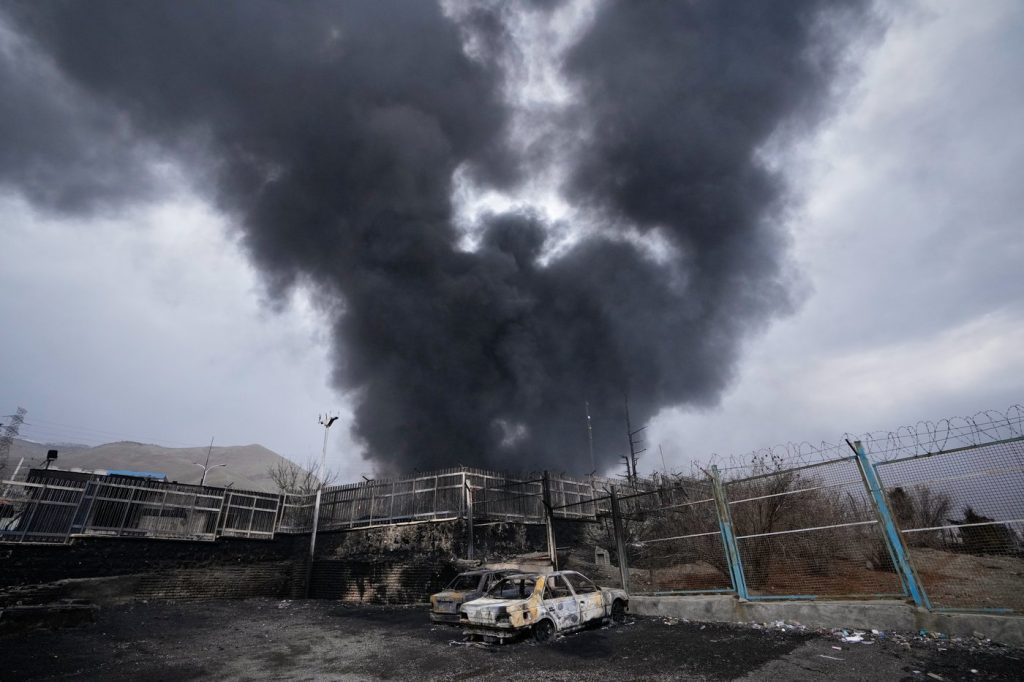
The ongoing threat of Iranian missile and drone attacks has significantly deterred oil tanker operations in the strait, located along Iran's northern border and essential for transporting oil from several Gulf nations, including Saudi Arabia, Kuwait, Iraq, Qatar, Bahrain, and the United Arab Emirates. Concurrently, nations like Iraq, Kuwait, and the UAE have reduced their oil production as their storage capacities fill up due to limited export capabilities.
Additionally, attacks on oil facilities have further exacerbated supply worries. The last time U.S. crude prices reached above $100 per barrel was on June 30, 2022, when prices hit $105.76. For Brent crude, the last instance was on July 29, 2022, when prices reached $104 per barrel. The recent spike has rattled financial markets, with fears that persistent high energy costs could stoke inflation and discourage consumer spending in the U.S., a critical driver of the nation's economy.
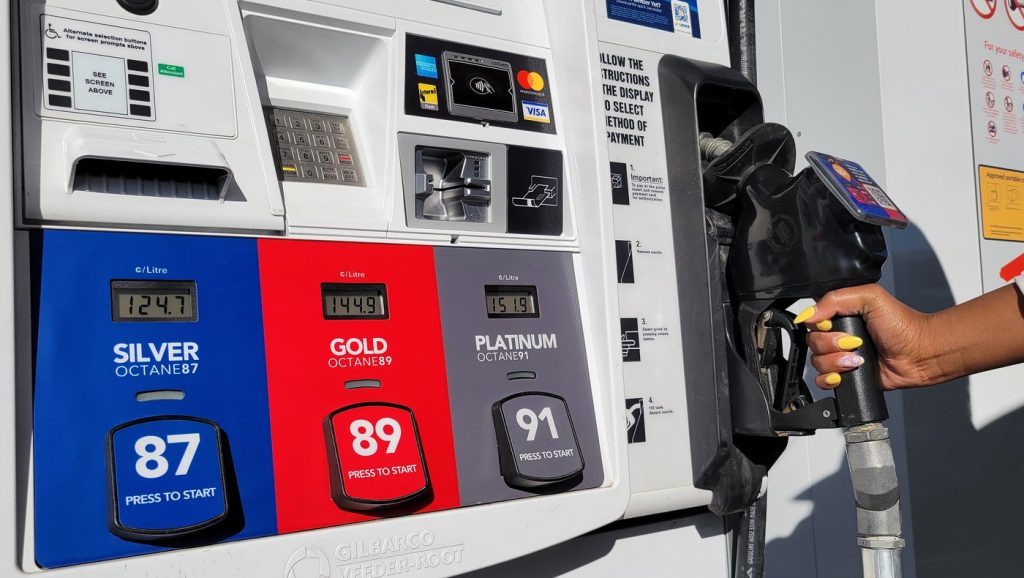
Gasoline prices in the U.S. have also surged, with regular gasoline reaching $3.45 per gallon on Sunday, marking a 47-cent increase from the previous week. Diesel prices topped around $4.60 per gallon, reflecting a dramatic weekly rise of approximately 83 cents. U.S. Energy Secretary Chris Wright expressed optimism, stating that gas prices could dip below $3 per gallon "before too long," although he emphasized the uncertainty surrounding the timeline.
Market indicators suggest that if oil prices remain above the $100 mark, it could pose challenges to the global economy. Iran, which exports about 1.6 million barrels of oil daily, primarily to China, may find its export capabilities hindered, potentially prompting China to seek alternative suppliers and further escalating energy prices.
Natural gas prices have also seen increases during the conflict, climbing to around $3.33 per 1,000 cubic feet, a 4.6% rise from the previous Friday's close of $3.19, following an 11% increase last week. As a response to these developments, U.S. stock index futures fell late Sunday, indicating a bearish opening for major Wall Street indexes on Monday. The futures for the S&P 500, Dow, and Nasdaq composite each indicated declines of 1.6%, 1.8%, and 1.5% respectively.
Overall, the unfolding situation highlights the fragility of global energy markets amid geopolitical conflicts, changing supply chains, and their potential impact on the overall economy. The conflict’s ramifications will continue to unfold as stakeholders monitor oil and gas production, pricing, and corresponding market reactions.