WASHINGTON (AP) – President Donald Trump expressed frustration on Tuesday regarding NATO and other allies' refusal to assist the United States in securing the Strait of Hormuz. He lamented his inability to garner support for what he refers to as his war in Iran, which he believes is aimed at promoting global stability, despite the lack of appreciation from the international community.
Trump has been urging NATO allies to contribute to safeguarding this vital waterway, a crucial point for oil exports, and voiced his anger that the U.S. efforts have not been reciprocated. He stated, “despite the fact that we helped” NATO significantly, allies seem unwilling to aid in preventing Iran from acquiring a nuclear weapon.
As the conflict enters its third week, it is evident that the international community views it as a challenge that Trump must handle independently. He asserted, “You would have thought they would have said, ‘We’d love to send a couple of minesweepers. That’s not a big deal,’” highlighting his disappointment in allies who have not provided assistance.
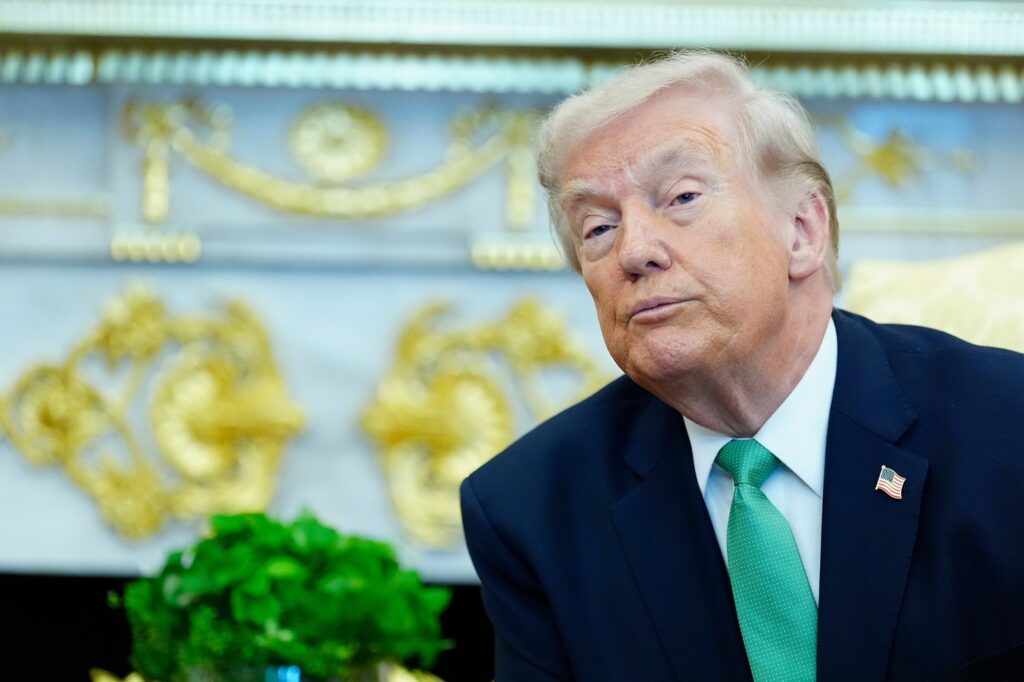
During a St. Patrick's Day visit with Ireland’s Prime Minister Micheál Martin, Trump claimed, “We don’t need any help, actually,” displaying his resolve to manage the situation alone. He highlighted the substantial financial support the U.S. has extended to NATO, especially in its ongoing support for Ukraine against Russian aggression, and criticized allies for not helping the U.S. and Israel counter the Iranian threat.
On the same day, the U.S. military confirmed the deployment of multiple 5,000-pound bombs on Iranian missile installations along the coastline near the Strait, aimed at neutralizing military assets that threaten international shipping routes, as stated by U.S. Central Command.
Trump’s relationship with NATO, a cornerstone of post-World War II security, is characterized by skepticism. He continues to criticize member countries for inadequate defense spending and has even questioned U.S. commitment to NATO's mutual defense treaty. Despite NATO’s defensive purpose, it has previously engaged in offensive operations, such as its involvement in Afghanistan and Libya.
Trump directed substantial criticism towards NATO, noting that countries like Japan, Australia, South Korea, and even China have declined his requests for assistance in ensuring the security of the Strait. This waterway is critical for global oil transport, with about 20% of the world's crude oil typically passing through daily, impacting regions heavily reliant on imported fuel.
The European Union’s chief diplomat, Kaja Kallas, dismissed Trump’s demands, reiterating that "this is not Europe’s war" and that the EU does not wish to join the U.S.-Israel military campaign against Iran. Kallas stated, “We were not consulted,” expressing reluctance to engage in a conflict initiated by others.
Trump described this situation as a "great test" for NATO and criticized the alliance for what he termed a “very foolish mistake” in rejecting his calls for support. When questioned about the future of the U.S. relationship with NATO, Trump suggested that it might be worthwhile to consider changes to this partnership, maintaining that he does not need congressional approval to make such decisions.
While there are ongoing debates over the impact and implications of Trump's stance on NATO, he appears resolute in insisting that allies should provide more substantial support. French President Emmanuel Macron indicated readiness to help secure the Strait but insisted it would be under a separate mission, distancing France from the current conflict.
Trump reacted coldly to Macron's position, predicting his exit from office soon. Additionally, Trump expressed disappointment with British Prime Minister Keir Starmer, who had initially restricted American military operations from British bases before ultimately permitting limited use for operations against Iranian assets.
Despite Trump’s assertion that U.S. military efforts do not require allied assistance, the State Department is actively pursuing support from various nations to isolate Iran further by designating groups like the Islamic Revolutionary Guard Corps and Hezbollah as terrorist organizations, a move designed to invoke sanctions against those entities.
A recent diplomatic cable emphasized the urgency for nations to act against Iran, calling for immediate action to enlist support in this new phase of friction surrounding the Strait of Hormuz.