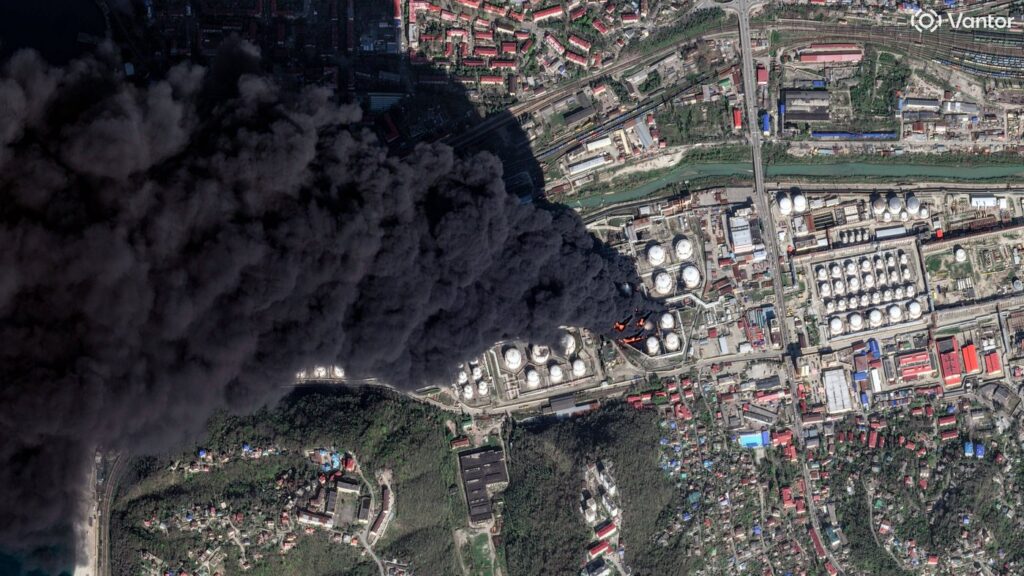
Ukrainian drones have increasingly targeted oil facilities deep within Russia, striking sites such as the oil refinery and export terminal in Tuapse, a Black Sea town approximately 450 kilometers (280 miles) from the front lines. These drone attacks have occurred multiple times within a short span, resulting in significant fires and local evacuations. Video footage from local authorities has shown the devastating aftermath, including boiling oil products spilling onto streets and damaging vehicles.
In further strikes, Ukraine has reported successful attacks on oil infrastructure in Russia's Perm region, located over 1,500 kilometers (900 miles) from its borders. Russian media have acknowledged these incidents, although details have been limited. Another notable target includes Ust-Luga, one of Russia's largest oil terminals on the Baltic Sea, which has faced repeated drone strikes. These events prompted regional authorities to label areas, such as St. Petersburg, as "front-line regions" due to heightened aerial threats.
Ukrainian President Volodymyr Zelenskyy has emphasized the destructive nature of these strikes on Russia's oil sector, estimating a loss of at least $7 billion since the beginning of the year. Ukrainian intelligence suggests a decline in oil exports from key terminals such as Ust-Luga and Primorsk. Experts have noted that the drone attacks have hindered Russia’s oil refining capabilities while sanctions complicate the acquisition of necessary parts for repairs.
Despite the drone strikes, the full economic effects on Russia’s oil industry remain ambiguous, as rising global oil prices from geopolitical tensions, particularly linked to the Iran war, have bolstered Russian oil revenues. In March alone, Russian crude and oil product exports surged to 7.1 million barrels per day—a rise attributed to the global energy crisis linked to Iran’s geopolitical maneuvers. Revenue from oil exports almost doubled, leading analysts to speculate on the strike's effectiveness in disrupting this trend.
According to Chris Weafer, CEO of Macro-Advisory Ltd., while the depicted damages from explosion visualizations may seem severe, they have not significantly impaired Russia's oil infrastructure. The primary focus of these drone strikes appears to be less on the tanks and more on key pump stations and compressors, which remain relatively well-protected. This indicates a calculated approach in Ukraine’s military strategy aimed at stretching Russia’s air defense capabilities.
The capability of Ukrainian forces to strike deep within Russian territory highlights the growth of their military technology and strategies since the onset of the war in February 2022. This evolution in military capability allows Ukrainian drones to target locations that were previously considered secure, complicating Russia's defensive responses. Observers have noted a shift in how average Russians are perceiving the war, as the consequences of these strikes affect towns far removed from the battlefield.
Following the attacks on Tuapse, Russian authorities have begun to inform residents about potential environmental hazards. Reports of high benzene levels, a known carcinogen, have surfaced, and residents are being urged to limit outdoor exposure. The strikes have led to disturbing reports of "black rain," with oily droplets falling on the coastal area, leading to pollution affecting local wildlife, including beached dolphins and stained pets. Such environmental consequences present a stark contrast to the picturesque Black Sea region traditionally enjoyed by tourists.
Environmental concerns have been voiced by figures such as Vladimir Slivyak, co-chairman of the environmental group Ecodefense, who indicated potential long-term damage to both human health and the coastal ecosystem due to the ongoing oil pollution. Despite the grim realities emerging from these strikes, there has not yet been significant public dissent within Russia, suggesting a complex relationship between the state narrative and citizen awareness of the ongoing struggles caused by the conflict.