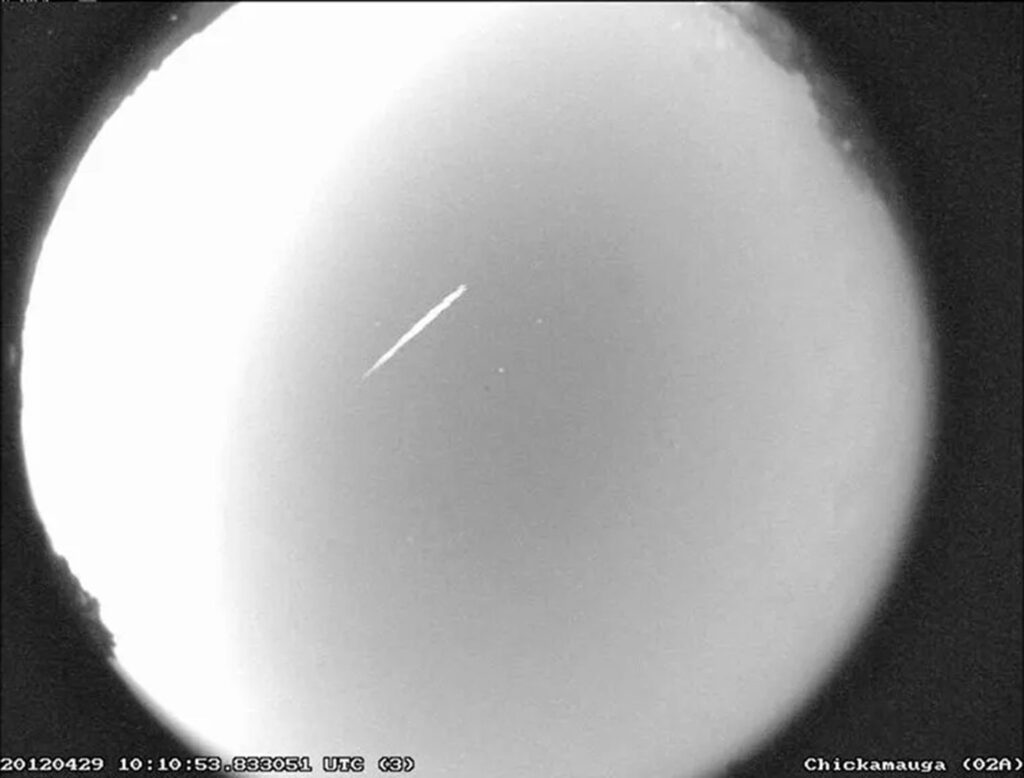
NEW YORK (AP) – The upcoming Eta Aquarid meteor shower is set to illuminate the night sky with celestial debris from Halley’s comet. However, this year’s display is expected to be somewhat diminished due to a bright moon, which will make viewing conditions less favorable.
The shower is anticipated to peak on the night of Tuesday into Wednesday morning. Typically, observers in the Southern Hemisphere experience a dazzling display of up to 50 meteors per hour during this peak. Unfortunately, the interference from the moon could potentially halve that number. In contrast, skywatchers located in the Northern Hemisphere can expect to see fewer than 10 meteors per hour.
Teri Gee, the manager of the Barlow Planetarium in Wisconsin, commented on the situation, stating, “For us in the Northern Hemisphere, it’s not going to be as impressive. The farther south you are, the better you’ll see it.” This highlights another year where meteor enthusiasts in the north may not experience the full splendor of the event.
Meteor showers occur when Earth moves through trails of debris left by comets or asteroids. As these fragments collide with the Earth's atmosphere at extremely high speeds, they create bright streaks of light, often referred to as shooting stars. While stray meteors can be spotted on any clear night, meteor showers provide a more thrilling experience, happening at specific predictable times each year.
Most meteor showers are derived from remnants of comets, and the Eta Aquarid shower is particularly notable as it features debris from the famous Halley’s comet. This comet makes its passage near Earth approximately every 76 years, with its next approach scheduled for 2061.
To enhance your chances of witnessing this meteor shower, it’s recommended to head outdoors just before dawn. Escape from the obtrusive lights of the city and tall buildings for an unobstructed view of the sky. In this specific scenario, finding a location that blocks the bright waning gibbous moon—83% full—will also be advantageous.
For the best experience, bring along blankets and lawn chairs. It is advisable to avoid looking at your phone to allow your eyes to adjust to the darkness. Meteors should be observed towards the east near the constellation Aquarius and the bright star Eta Aquarii.
Astrophysicist Nico Adams, affiliated with SSP International—a nonprofit organization dedicated to promoting STEM education—provided an insightful tip for watchers. He noted, “You’re looking for bright streaks that appear in the corner of your eye for a fraction of a second,” emphasizing the ephemeral nature of meteors.
According to Gee, immersing oneself in the experience of watching meteors can be profoundly rewarding. She asserted, “It almost feels like you’re discovering it yourself,” encapsulating the wonder and excitement that comes with witnessing such a cosmic display.
___
The Associated Press Health and Science Department receives support from the Howard Hughes Medical Institute’s Department of Science Education and the Robert Wood Johnson Foundation. The AP is solely responsible for all content.
Adithi Ramakrishnan, The Associated Press