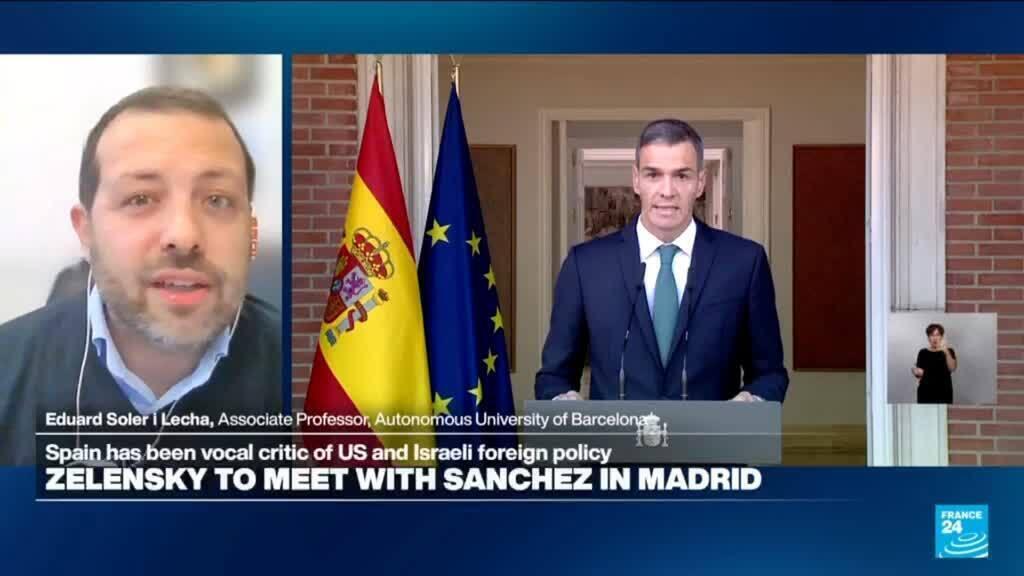
As Ukraine's President Volodymyr Zelensky engages in discussions with European leaders, including Spanish Prime Minister Pedro Sanchez, the international community observes Spain's strategic positioning in foreign policy. Eduard Soler i Lecha, an Associate Professor of International Relations at the Universitat Autònoma de Barcelona and a Senior Research Associate at IBEI, provides insight into the intricacies of Spain's diplomatic approach under Sanchez's leadership.
Mr. Soler i Lecha emphasizes that Spain’s current foreign policy is not merely reactive but is profoundly strategic in its framework. The ongoing geopolitical challenges exemplified by the crises in Ukraine, Gaza, and Iran highlight a deliberate effort by the Spanish government to articulate a clear stance on international law. This articulation serves a dual purpose: it acts as both a guiding principle and a practical instrument for navigating complex international landscapes.
When Spain unequivocally condemns acts of violence occurring in Ukraine, Gaza, or Iran, it does so with calculated intent rather than impulsively choosing sides. This approach underscores a broader worldview embraced by Spain, one that posits the nation’s security and global influence as fundamentally intertwined with the preservation of multilateral norms. Essentially, Spain’s foreign policy reflects an understanding that respecting international law is critical not only for moral standing but also for creating a stable environment for its own security interests.
Soler i Lecha articulates that the Spanish government’s commitment to multilateralism is a cornerstone of its diplomatic strategies. This engagement involves a nuanced understanding of global dynamics; Spain acknowledges that its influence can be significantly bolstered by collaborating with other nations to promote shared values and collective security. Therefore, Spain's denunciation of violence in specific conflicts is rooted in a commitment to fostering a world order where international law prevails, thereby ensuring that all nations operate on a level playing field.
Additionally, the discussions between Zelensky and Sanchez symbolize broader implications for European unity and the response to geopolitical tensions. Spain’s actions, particularly in concert with other European powers, reflect an emerging consensus on the importance of upholding human rights and international justice. The Spanish government’s readiness to position itself as a vocal advocate for these principles demonstrates its desire to play a proactive role on the world stage.
In conclusion, the exchange between Ukrainian leadership and European states, particularly Spain, signals an evolving narrative around foreign policy that prioritizes international law and multilateralism. Under Pedro Sanchez, Spain is positioning itself as a significant player in international affairs, asserting its role as a defender of norms that not only secure its national interests but also contribute to global stability.
```