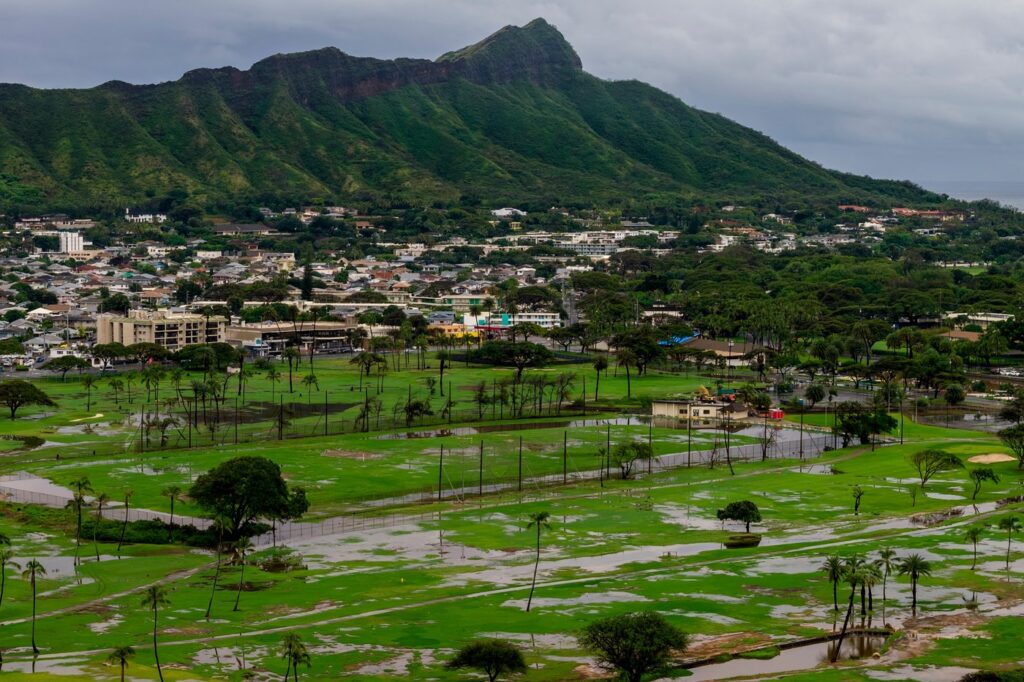
On Sunday afternoon, over 2,000 residents in Hawaii remained without power following the state's worst flooding in more than two decades, caused by heavy rainfall across the islands. The flooding was exacerbated by saturated soil from a preceding winter storm, resulting in raging waters that lifted homes and vehicles. The estimated damage from the storm is projected to reach $1 billion.
Evacuations were ordered for approximately 5,500 individuals north of Honolulu due to the severe conditions, although these orders were later lifted. In total, emergency services conducted rescues for more than 200 people trapped in rising waters. As of Sunday afternoon, there have been no reported fatalities, according to Molly Pierce, a spokesperson for Oahu’s Department of Emergency Management.
By Sunday, Hawaiian Electric had restored power to around 1,200 residents in Waialua on Oahu's North Shore. The utility had previously turned off power as a precaution on Friday due to the flood risks. Crews are actively assessing the damage and making necessary repairs, with expectations of restoring power to an additional 2,000 customers later that day. In contrast, Maui County reported around 100 residents still without power, while Hawaii Island had resolved all major outages.
According to meteorologist Matthew Foster, the worst of the storm appears to be over, with a shift in weather from widespread showers to scattered rain impacting areas from Oahu to Hawaii Island. Forecasts predict less than 5 inches (13 cm) of rain for Hawaii Island and between 1 to 2 inches (3-5 cm) for other regions. Winds are expected to increase from the northeast, particularly in areas with more vegetation, which can absorb more rain.
Foster indicated that while additional localized flooding may still occur, the widespread impact is expected to diminish. A boil water notice is currently in effect for North Shore regions stretching from Mokuleia to Turtle Bay, and residents are encouraged to report damages to local authorities.
Governor Josh Green estimated the storm's overall costs, including damage to critical infrastructure such as airports, schools, roads, homes, and even a hospital in Kula, could exceed $1 billion. There were initial concerns regarding the stability of the 120-year-old Wahiawa dam, but those fears have subsided as water levels have receded. The dam continues to be monitored closely.
The recent deluge has been attributed to winter storm systems known as "Kona lows," which bring moisture-laden air into the region. Experts assert that human-induced global warming has increased the intensity and frequency of heavy rainfall events in Hawaii, contributing to these severe weather occurrences.