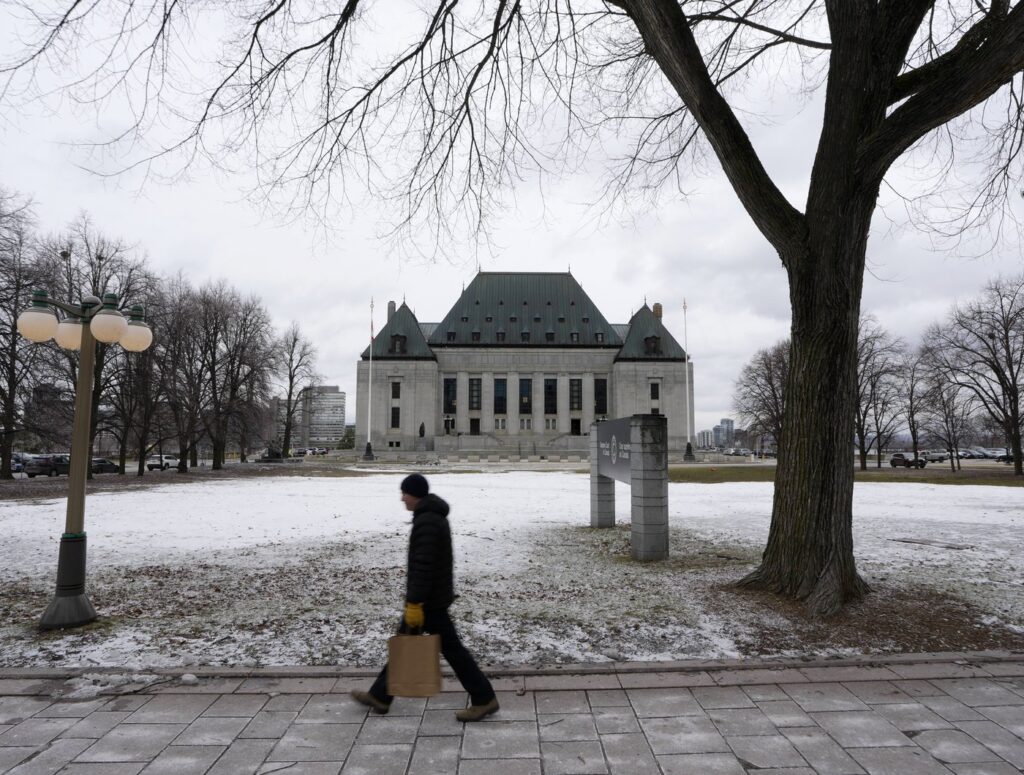
MONTREAL – A significant legal challenge to Quebec's secularism law, known as Bill 21, is set to be heard by the Supreme Court of Canada starting Monday. Legal experts assert that the ruling will have a profound impact on Canadian constitutional law, regardless of the outcome.
Years in the making, this high-stakes challenge to Bill 21 is expected to focus on Section 33 of the Canadian Charter of Rights and Freedoms, known as the "notwithstanding clause." This provision allows legislation to be shielded from most court challenges relating to violations of fundamental rights.
The Coalition Avenir Québec government, led by François Legault, had preemptively invoked this clause when Bill 21 was passed in June 2019. The law, officially titled the Act respecting the laicity of the state, outlines the principles of secularism in Quebec. One of its most controversial components is the ban on civil servants in positions of power—including police officers, teachers, and judges—wearing religious symbols at work.
Legal scholar Louis-Philippe Lampron from Université Laval's School of Law remarked that the core of the Supreme Court challenge lies not only in the act itself but also in how the government applies human rights and freedoms. “This upcoming Supreme Court decision will be a true earthquake in constitutional law, no matter which way it rules,” he stated.
Patrick Taillon, another law professor at Université Laval, emphasized the likelihood of the notwithstanding clause being the focal point of the arguments. He noted that while there are multiple arguments to consider, the central issue remains whether the Supreme Court will revisit the interpretation of Section 33 established in the 1988 Ford decision. This ruling allowed the legislature to suspend rights without needing to justify its actions. Quebec courts have echoed this interpretation, albeit while also critiquing Quebec's application of it.
In his April 21, 2021 ruling, Superior Court Judge Marc-André Blanchard suggested that the legislature's use of derogation clauses could be seen as excessive because of its breadth, though he ultimately dismissed the challenge to Bill 21. The subsequent Court of Appeal decision concurred with Blanchard while lifting exemptions for English school boards.
The February 20, 2024, ruling by a three-judge panel reinforced this interpretation but also indicated that the legislature's ability to exempt a law from certain Charter provisions may produce discomfort. The Quebec high court expressed concerns that this approach could lead to a weakening of rights, enabling governments to bypass protections and potentially create risks for minority groups.
Under the notwithstanding clause, the only limitation is a five-year renewal requirement, which aligns with election cycles. The Quebec appellate court noted that the electorate has the power to remove a government via the ballot box, but Lampron cautioned against relying solely on electoral processes to protect minority rights.
The Quebec government has already renewed Bill 21 for another five years as of May 2024, with the next provincial election scheduled for October. Taillon pointed out that while the Supreme Court cannot amend the Constitution, it possesses the authority to impose limitations on its interpretation.
The Supreme Court has several pathways it could take. It might uphold the Ford decision, effectively granting a legal victory to Quebec. Alternatively, it could determine that Section 33 does not allow preemptive invocation of the notwithstanding clause, potentially sending the case back to Quebec Superior Court for exploration of the law's merits concerning the ban on religious symbols.
If the court decides against the Quebec government, the province might still invoke the notwithstanding clause once legal proceedings conclude. Another option could involve the Supreme Court following a precedent set by the Saskatchewan Court of Appeal, which suggested that courts have the right to assess the constitutionality of laws, even if such evaluations have no immediate effect.
The Supreme Court has requested arguments from all parties based on Section 1, concerning whether the limits imposed would be justifiable. However, Quebec has opted to rely on the Ford decision, which does not necessitate justification.