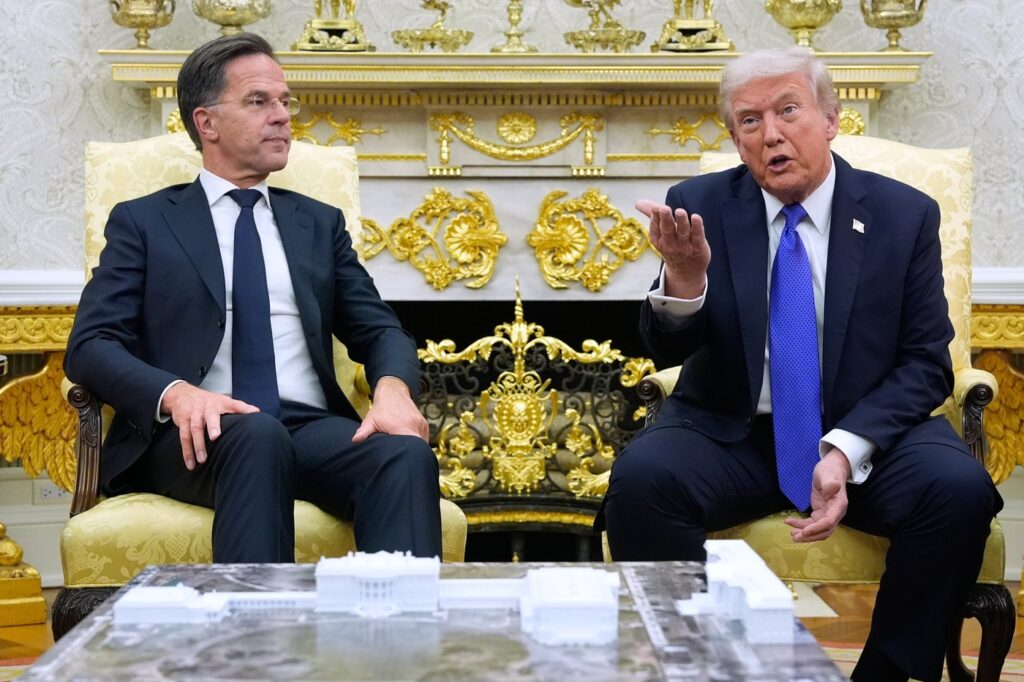
On Wednesday in Washington, President Donald Trump reiterated his dissatisfaction with NATO following a closed-door meeting with the alliance's Secretary-General Mark Rutte. The discussions were expected to address Trump's ongoing grievances with the military alliance over its perceived inaction regarding the Iran conflict. Trump expressed frustration after NATO member nations reportedly did not respond adequately to his calls for assistance as Iran closed the Strait of Hormuz, a crucial shipping lane, resulting in rising gasoline prices.
Trump's discontent was evident in an all-caps social media post, declaring, "NATO WASN’T THERE WHEN WE NEEDED THEM, AND THEY WON’T BE THERE IF WE NEED THEM AGAIN." The White House did not provide further updates post-meeting. Historically, Trump has maintained a cordial relationship with Rutte, which added complexity to the discussions amid heightened tensions between the U.S. and Iran. Recently, the two nations agreed to a two-week ceasefire that would reopen the Strait of Hormuz.
White House press secretary Karoline Leavitt acknowledged prior to the meeting that Trump had indeed floated the idea of the U.S. potentially exiting NATO. This topic coincides with a law passed in 2023 that requires congressional approval for any U.S. president contemplating withdrawal from NATO. Trump has frequently criticized NATO during his presidency, suggesting at one point that he could independently withdraw the U.S. from the alliance, established in 1949 to counter the Soviet Union's threat to European security.
The cornerstone of NATO is a mutual defense pact, where an attack on one member is considered an attack on all. This agreement was invoked only once, following the September 11 attacks in 2001, when NATO allies supported the U.S. effort in Afghanistan. Despite this, Trump has voiced his concerns during the current conflict with Iran, arguing NATO's lack of support indicated that it would not come to the United States' aid in future crises.
Wednesday's meeting also addressed Trump's frustrations regarding NATO's approach toward Greenland, a territory linked with NATO member Denmark. Earlier in the year, Trump had sought U.S. control over Greenland, but later retracted his stance after discussions with Rutte.
In his social media post, Trump referenced Greenland, calling it "that BIG, POORLY RUN, PIECE OF ICE!!!" This statement reflects a broader pattern of Trump's aggressive rhetoric regarding NATO and its member countries. It's uncertain if Trump's administration would attempt to challenge the legislation prohibiting withdrawal from NATO, especially since this law was supported by his current Secretary of State, Marco Rubio, while he was still a senator.
On the day of Trump's meeting, Rubio also met separately with Rutte to deliberate on the Iran conflict and the U.S. approaches to negotiations regarding the ongoing war in Ukraine. Furthermore, Republican Senate Minority Leader Mitch McConnell expressed strong support for NATO in a statement, emphasizing the alliance's critical role in the aftermath of the September 11 attacks and urging Trump to maintain a consistent stance in favor of NATO collaboration.
The backdrop of these discussions includes Trump's previous threats to reduce U.S. military support for Ukraine amidst its war against Russia, contributing to existing tensions within NATO. Moreover, Trump's heightened criticism of NATO escalated following the Iran war's onset in February, where he declared that securing the Strait of Hormuz was mainly the responsibility of countries reliant on oil passage through the strait. Trump's controversial suggestion to seize the strait further illustrated his confrontational approach.
Amid ongoing conflicts, NATO allies, particularly Spain and France, have restricted U.S. military operations in relation to the Iran war, prompting additional frustrations from Trump. British Prime Minister Keir Starmer has been noted as a specific source of irritation for Trump, particularly in the context of navigating foreign policy in the Gulf region and addressing the strait's security post-conflict.
Former NATO Secretary-General Jens Stoltenberg had previously expressed concerns about Trump's potential departure from the alliance during his initial term in office, indicating ongoing unease surrounding Trump's stance on NATO collaboration. The situation reflects the complex dynamics in transatlantic relations as Trump continues to assert his grievances over NATO's efficacy and support.