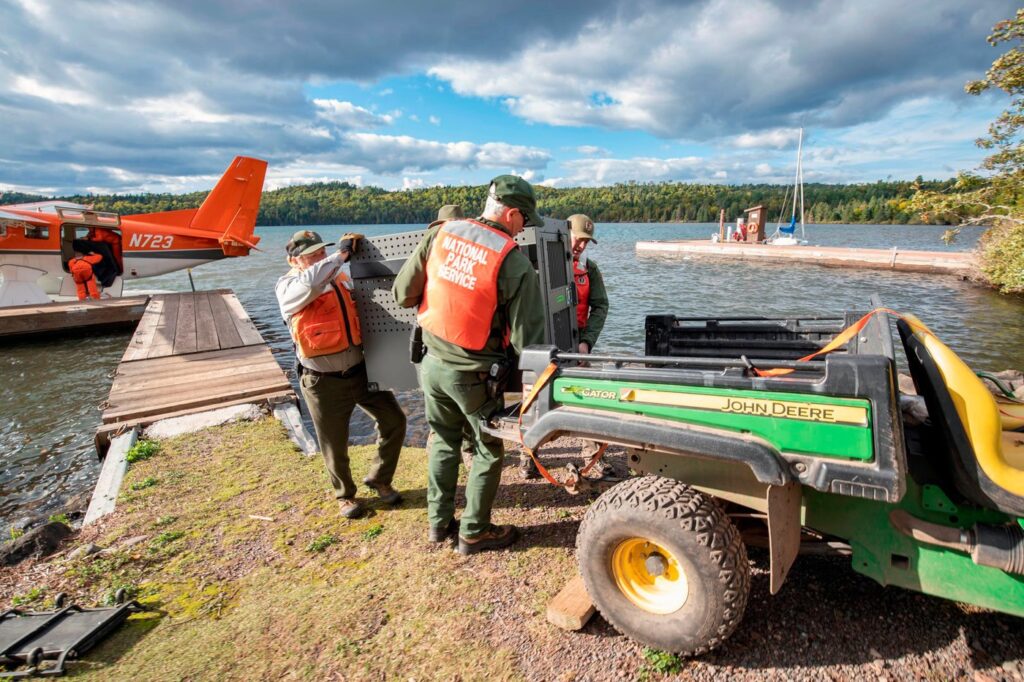
The wolves on Isle Royale, a remote island in Lake Superior, are showing robust health but significantly affecting the moose population they rely on for sustenance, as detailed in a recent report. Isle Royale, encompassing 134,000 acres (54,200 hectares), is located between Grand Marais, Minnesota, and Thunder Bay, Canada, and serves as a unique natural laboratory. Here, scientists can observe the dynamics of wolves and moose with minimal human interference.
Since 1958, researchers have been conducting population surveys of wolves and moose on the island. These surveys typically occur annually during winter, when the roadless island is inaccessible to visitors. However, the researchers have faced multiple challenges in recent years. The COVID-19 pandemic led to the cancellation of the survey in 2021, marking the first time this event was missed. In 2024, researchers were forced to evacuate the island due to unseasonably warm weather that compromised the safety of the ice around the island, making it unsuitable for ski-plane landings. The ski-planes, vital for tracking wildlife, rely on the icy surface of Lake Superior for landing; however, the island lacks a runway. Efforts were further complicated in 2023 when a last-minute medical emergency prevented the pilot from proceeding with the survey.
Despite these obstacles, a research team from Michigan Tech University successfully conducted a survey from January 22 to March 3, 2026. They estimated the wolf population on the island to be around 37, a significant rebound from just two wolves a decade ago. Data collected before the 2024 evacuation indicated a count of 30 wolves. The current estimates represent the highest numbers recorded since the late 1970s. Researchers have noted that previous inbreeding likely contributed to low pup survival rates, but the population is now on a path to recovery.
Conversely, the moose population on the island is experiencing a dramatic decline. The recent survey revealed only 524 moose, a staggering drop of 75% from a peak of 2,000 in 2019. Researchers estimate that predators, primarily wolves, accounted for the deaths of almost a quarter of the moose in the past year. Alarmingly, for the first time in nearly 70 years, no moose calves were observed during the winter survey.
Sarah Hoy, a researcher specializing in predator-prey interactions at Michigan Tech and a co-leader of the survey, reported that the team faced extreme winter conditions, with wind chills plummeting to minus 50 degrees Fahrenheit (minus 45.5 degrees Celsius). Maintaining warmth within their cabins proved challenging, despite the use of wood stoves. Nonetheless, clear skies during the survey allowed for excellent visibility, with scientists spotting wolves on nearly every survey flight. A memorable moment for the researchers was witnessing a pack of wolves snuggling together on the ice on Valentine’s Day.
Hoy expressed her excitement about observing wolves in their natural habitat, emphasizing the privilege of witnessing various social interactions, such as courtship behaviors and playful interactions between pups. Researchers are now planning to conduct summer studies aimed at understanding how the growing wolf populations can maintain ecological balance within the island’s ecosystem.